

TL;DR: Claude Code vs. Codex
| Dimension | Claude Code | Codex |
|---|---|---|
| Models | Opus 4.8 (default since May 28, 2026), Opus 4.7, Sonnet 4.6, Haiku 4.5 | GPT-5.5 (local), GPT-5.3-Codex (cloud) |
| Entry price | $20 Pro (limited); $100 Max for real volume | $20 Plus includes meaningful Codex access |
| Surface coverage | CLI-first; VS Code, JetBrains, web, desktop, mobile push | CLI, IDE, Cloud, ChatGPT app, mobile, Chrome ext |
| Sandbox model | 26 programmable hook events + Auto mode classifier | Kernel-level: Seatbelt, Landlock, Windows sandbox |
| Harness depth | Skills, Hooks, Plugins, Subagents, Dynamic Workflows | MCP, AGENTS.md, Linear/GitHub/Slack, Goal mode |
| Repo instructions | CLAUDE.md (proprietary, hierarchical, @path imports) | AGENTS.md (community-defined open standard) |
Short version: reach for Claude Code when you want the deepest programmable harness and a fast terminal loop. Reach for Codex when you want one product across more surfaces, kernel-level sandboxing, and a lower entry price. Plenty of people run both and route work by task type.
In late January 2026, a thread from Andrej Karpathy about going from 80 percent manual coding to 80 percent agent coding in a single month did 40,000 likes in a week. The replies split exactly the way you would expect: half pointing to Claude Code, half pointing to Codex. (The CLAUDE.md distillation of that thread now ranks in our list of GitHub repos for AI developers.) That is the live debate, late spring 2026. The frontier of agentic coding has narrowed to two terminal-first tools, and the question is which one to use for what.
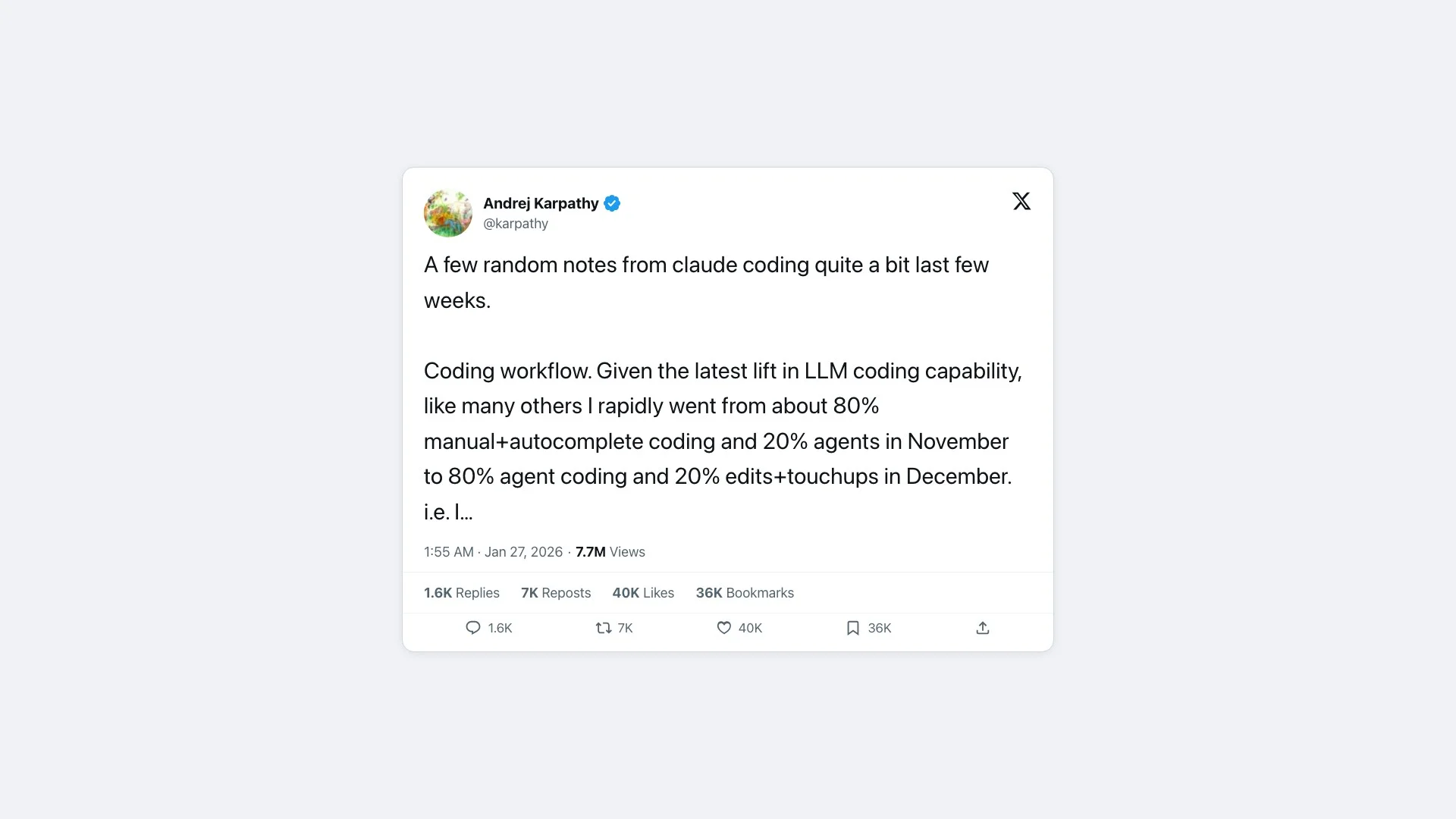
I have spent weeks running both on real work. This is a sourced, hands-on comparison. Neither wins outright. They are built for different days.
What is Claude Code?
Claude Code is Anthropic's agentic coding tool. It reads your codebase, edits across files, runs tests, and commits from the terminal. It also runs in VS Code, JetBrains, the desktop app, the web at claude.ai/code (launched October 20, 2025), and mobile with push notifications. It is tuned for Anthropic's models: Opus 4.8 (default since May 28, 2026), Opus 4.7, Sonnet 4.6, and Haiku 4.5.
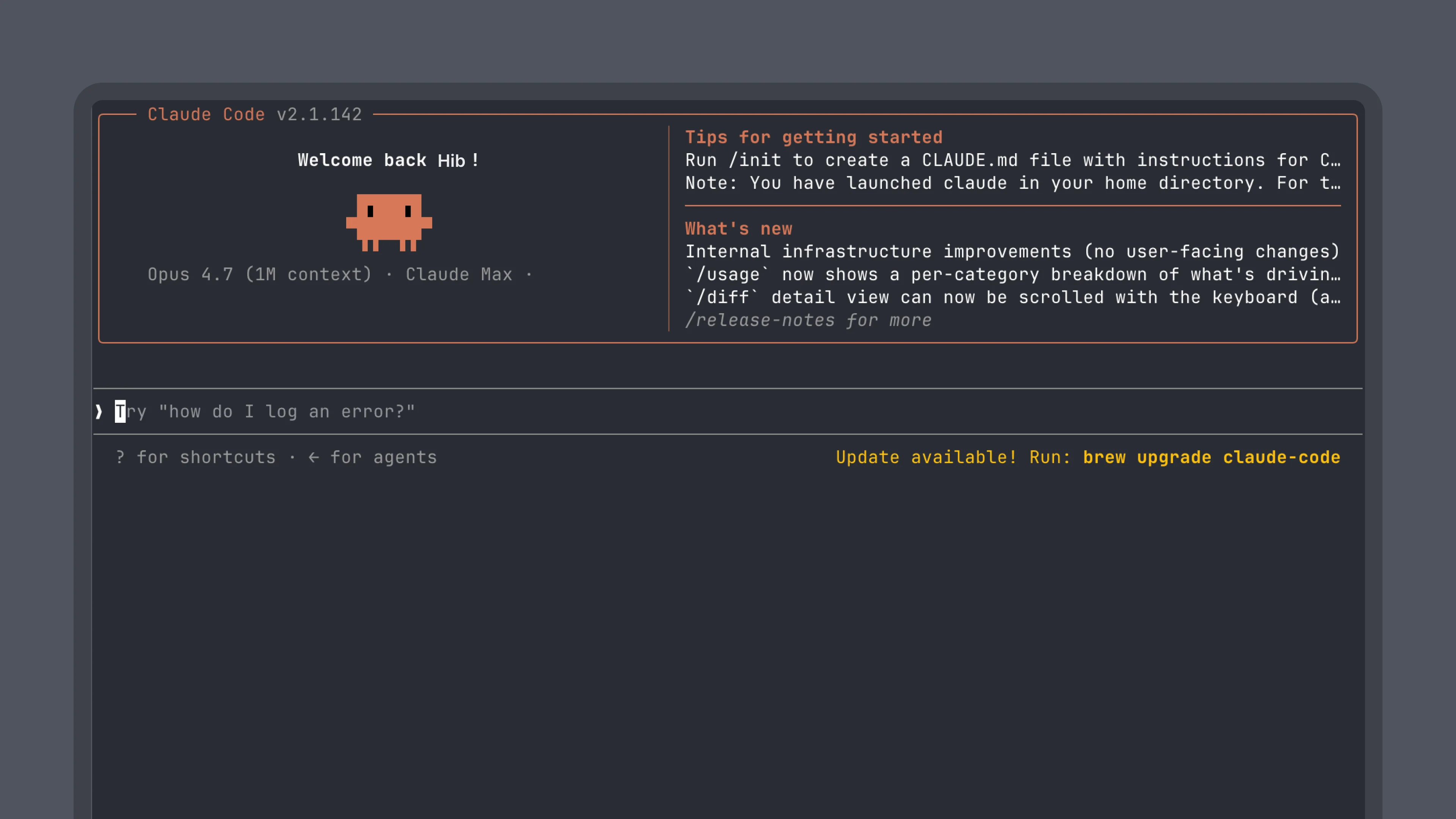 Claude Code's terminal welcome screen, running Opus 4.8 on a Claude Max plan.
If you are new to CLI agents, Firecrawl's piece on why CLIs are better than IDEs for AI coding covers the architectural reason that wrapping a model in a terminal harness gives you more leverage than embedding it in an IDE chat sidebar.
What is Codex?
Codex is OpenAI's coding agent, distributed under Apache-2.0 as a Rust binary. Since September 2025, OpenAI has unified Codex into "a single product experience connected by your ChatGPT account," letting you move work between local and cloud without losing context.
You can reach it through six surfaces: the CLI, the IDE extension (VS Code, Cursor, Windsurf, JetBrains), Codex Cloud for hosted sandboxed runs, the ChatGPT app sidebar, the mobile app (GA May 15, 2026 per the Codex changelog), and a Chrome extension launched in May. Default model in June 2026 is GPT-5.5 for local sessions and GPT-5.3-Codex for cloud and code review, per the Codex pricing page.
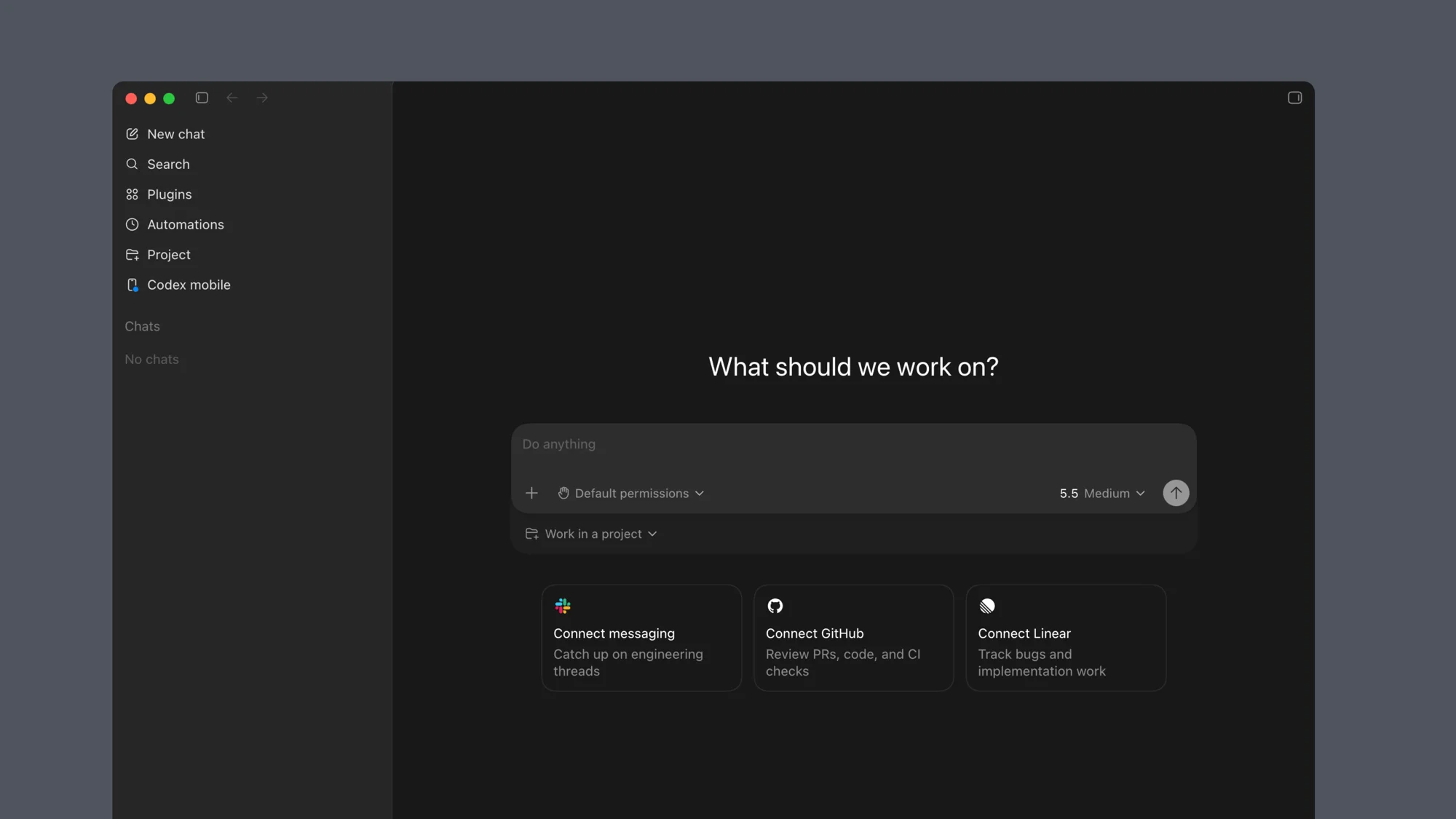 Codex's desktop app landing screen, running 5.5 Medium on a ChatGPT Plus plan.
Codex is now used by "more than 5 million people every week," per OpenAI's June 1, 2026 AWS GA announcement. The scale matters because it shapes how OpenAI prioritizes Codex updates: surface coverage, mobile, code review, and PR automation have all shipped faster than terminal polish.
Claude Code vs Codex: What are the differences?
Models and pricing: the $20 vs $100 asymmetry
Pricing is where the choice often gets made before the technical comparison even starts.
Codex is available on every ChatGPT plan including Free and Go (as of June 2026), though meaningful daily usage starts at Plus ($20 a month). Plus gives you 15–80 GPT-5.5 messages per 5-hour window, 30–150 GPT-5.3-Codex messages, and 10–60 cloud tasks. Pro 5x at $100 a month gives you roughly five times that. Pro 20x at $200 gives you twenty times.
Claude Code Pro at $20 is limited, and Anthropic's own support documentation describes it as suited for light usage. The credible-volume tier is Max 5x at $100 a month, or Max 20x at $200, with usage shared between claude.ai chat and Claude Code.
The asymmetry is real. At the same $20, Codex gives meaningful daily coding-agent runtime; Claude Code gives a tighter quota you will burn through fast. Long-form developer comparisons, including this 100-hour head-to-head on r/ClaudeCode, consistently report that a $20 ChatGPT Plus subscription absorbs daily coding-agent work that on Claude would require Max 5x at $100.
The counter case is real too. Codex's $20 tier ships with tight 5-hour rolling windows that bite harder than the dollar amount suggests, and the limits have been revised mid-stream more than once. The most-discussed r/codex thread this spring is about exactly that: users reporting four-times tighter weekly quotas without notice.
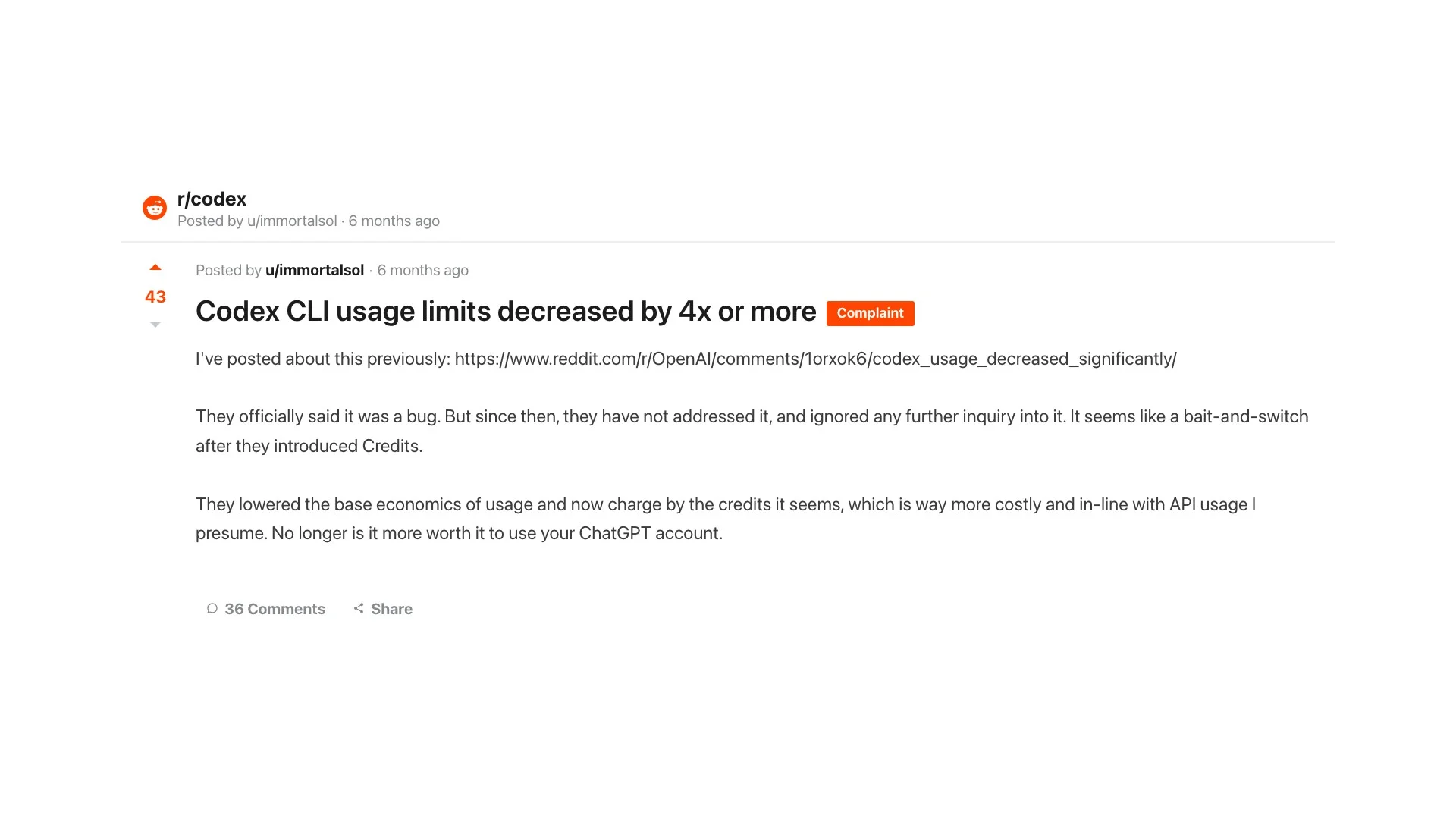 r/codex: "Codex CLI usage limits decreased by 4x or more"
The honest trade-off: Codex is cheaper to try. Both can become expensive at scale. If you are running an agent eight hours a day, the price advantage compresses fast.
Tokens per task: where the real cost lives
Plan pricing is the visible number. The one that decides whether you stay inside your monthly limits is tokens per task, and Claude Code consistently spends more of them than Codex. The cleanest controlled test I have seen is a head-to-head from Composio that ran the same two prompts (a PR-triage system and a real-time code review UI) against Claude Code on Opus 4.7 and Codex on GPT-5.5, with the same MCP setup and the same machine. Claude Code used roughly 192,000 tokens at about $2.50; Codex used 136,000 at about $2.04. That is a 1.4× token gap and a 23 percent cost gap, not the 5–10× ratio that gets repeated in passing.
The headline number is smaller than the folklore but the direction is consistent. Claude Code reads more files, plans before writing, and verifies tools before calling them. In the controlled run, those extra tokens bought a more decomposed architecture (twelve components versus seven), an unprompted smoke test, and a working result on a task that Codex left empty because its MCP path was misconfigured. The premium is real; whether it is worth ~25 percent more cost is a function of how much your team cares about code structure and review survivability.
The asymmetry sharpens in one specific direction: tool-heavy MCP work. If your agent talks to Composio, Linear, GitHub, and a database in one session, Claude Code's "check tools first, then plan, then code" loop runs the bill up faster than Codex's "scope tight, write the file, ship" loop. For a self-contained refactor with no tool calls, the gap nearly closes. If you are on Claude Code and want to systematically reduce consumption, Firecrawl's guide on Claude Code token efficiency covers 12 techniques — from trimming CLAUDE.md to routing subagents to Haiku — that benchmarks show cutting costs by 77–91%. See also the focused guide on cutting tokens during web research in Claude Code, which covers techniques specific to mid-session web lookups.
Surface coverage: terminal-first vs everywhere
Codex is one product across six surfaces. CLI, IDE extension, Codex Cloud, the ChatGPT app sidebar, mobile, and a Chrome extension. The four core surfaces share your ChatGPT account, your session history, and your AGENTS.md config. You can start a refactor on your phone during a commute, pick it up at your desk in VS Code, and review the PR in the Chrome extension. The model behind it does not change. The state does not get lost.
Claude Code started as a CLI and is still CLI-first. The October 2025 web launch opened the door to async use. Routines (cron and GitHub triggers, shipped April 2026), Ultraplan and Ultrareview, and mobile push notifications closed some of the gap. But the terminal is still the center of the product. The cloud is a layer on top, not the other way around.
The design assumption behind Codex's app is explicit: the bottleneck is no longer what agents can do, it is how humans direct and supervise many of them at once. Claude Code's design assumption is different. The bottleneck is feedback latency, and the fastest feedback loop lives in the terminal.
The honest trade-off: if you live in a terminal, Claude Code is the better daily driver. If you want to start work on your phone and finish at your desk, Codex's surface story is more mature.
Sandboxing: kernel layer vs application layer
Both agents care about not letting the model do something dumb. They do it in different places.
Codex enforces sandboxing at the kernel layer. On macOS, Codex runs commands under sandbox-exec with a Seatbelt profile. On Linux and WSL2, it uses bubblewrap (bwrap) with Landlock under the hood. On native Windows, it uses the Windows sandbox inside PowerShell. The Codex sandboxing docs describe three modes: read-only, workspace-write (the default), and danger-full-access. Network is off by default, locally and in the cloud. The OS itself enforces the boundary before the model gets to it.
Claude Code enforces policy at the application layer. The hooks system lets you intercept 26 lifecycle events (PreToolUse, PostToolUse, Stop, SessionStart, MessageDisplay, UserPromptSubmit, and so on) with shell scripts you write. Auto mode, shipped in March 2026 and rolled out to Pro plan in May, uses a classifier to review tool calls. It is a safer alternative to --dangerously-skip-permissions without being kernel-deterministic.
The deepest difference is where governance happens. Codex enforces in the kernel; Claude Code enforces in the harness. Kernel sandboxing is more deterministic. Hook programmability is more expressive. If you are running an agent on a sensitive codebase and want a hard guarantee that it cannot touch network or files outside its workspace without your approval, Codex's model is what you want. If you want to build a custom policy that runs your linter before every commit and rejects commits that fail your test suite without human approval, Claude Code's hooks give you that knob.
Harness depth: Skills, Hooks, Plugins, Subagents, Dynamic Workflows
This is where Claude Code pulls noticeably ahead, and where the ecosystem effect compounds.
Claude Code ships the deepest extensibility stack of any agentic coding tool in the market. The major primitives:
- Subagents: specialized agents defined in
.claude/agents/with their own context window, allowed tools, and model. - Skills: SKILL.md files with progressive disclosure that Anthropic open-sourced as a standard in December 2025.
- Hooks: the 26 lifecycle events covered above, scripted by you.
- Plugins: a marketplace plus
.zipand URL loading since May 2026, bundling skills, hooks, subagents, and MCP servers into installable units. - Dynamic Workflows: Claude orchestrates tens-to-hundreds of subagents in one session. The trigger keyword was renamed from
workflowtoultracodein v2.1.160.
Codex ships MCP (STDIO and Streamable HTTP, with OAuth), AGENTS.md, Linear and GitHub and Slack integrations, Goal mode, and Appshots. No Skills equivalent. No Hooks equivalent. No Dynamic Workflows equivalent. When Anthropic released Skills in October 2025, the immediate read from developers building on the format was that the progressive-disclosure model was a bigger deal than MCP itself.
Here is the feature-by-feature view:
| Extensibility primitive | Claude Code | Codex |
|---|---|---|
| MCP servers | Yes (STDIO + HTTP) | Yes (STDIO + HTTP) |
| Repo-level instructions | CLAUDE.md (hierarchical, @path imports) | AGENTS.md (community standard) |
| Subagents | Yes (.claude/agents/, per-agent tool allowlist) | No native equivalent |
| Hooks | Yes (26 lifecycle events, shell scripts) | No (kernel sandbox instead) |
| Skills (SKILL.md) | Yes (progressive disclosure, marketplace) | No equivalent |
| Plugins | Yes (marketplace + .zip + URL loading) | No equivalent |
| Multi-agent orchestration | Yes (Dynamic Workflows / /ultracode) | Cloud agent tasks (Codex multi-agent orchestration guide) |
| Plan mode | Yes (read-only) | Partial |
| Worktrees | Yes (claude --worktree) | Yes (built-in) |
| Compaction | Auto-compaction at harness layer | First model trained for compaction (GPT-5.1-Codex-Max) |
| Cloud agent | Routines, Ultraplan, Ultrareview | Codex Cloud, @codex review |
If you want to understand why the wrapper around the model matters as much as the model itself, Firecrawl's explainer on agent harnesses is the right read. The short version: every line of harness code encodes an assumption about what the model cannot do on its own. Claude Code lets you write those assumptions yourself. Codex makes them for you.
For specific Claude Code extensions, see Firecrawl's Best Claude Code Skills to Try in 2026, Top 10 Claude Code Plugins to Try in 2026, and Agent Skills Explained: How SKILL.md Files Work. For the Codex equivalent, see best Codex skills.
The honest trade-off: a deeper harness gives you more power and more setup. Codex's simpler surface is faster to start.
AGENTS.md vs CLAUDE.md: the open-standard moment
Codex uses AGENTS.md, a community-defined repo-level instruction convention. The original Codex launch post appendix ships the literal codex-1 system message: "For every file you touch in the final patch, you must obey instructions in any AGENTS.md file whose scope includes that file." Cursor, Windsurf, OpenCode, and most other coding agents respect AGENTS.md. One file, many agents.
Claude Code uses CLAUDE.md, proprietary to Anthropic's ecosystem. It is more powerful inside Claude Code than AGENTS.md is in Codex: hierarchical resolution where the most-specific file wins, @path imports that let you compose instruction files, and an auto-memory system that writes back to project files when you tell Claude to remember something. But it does not work in any other agent.
If you run multiple agents (which the next section argues you probably should), AGENTS.md is the friendlier default. If you live inside Claude Code, CLAUDE.md is more powerful.
Which is faster: Claude Code or Codex?
This is the framing community comparisons keep arriving at, across Reddit, Hacker News, and long-form blog posts: Claude Code feels faster in the loop, Codex goes deeper on complex work. The same model in either harness gives a noticeably different feel. Codex spends more time reasoning before it edits; Claude Code commits to an action quickly and iterates. Neither pattern wins universally; they trade for each other.
There is a frontend-vs-backend split underneath the speed-versus-depth one. Claude Code wins consistently on UI work: multiple developer comparisons attribute this to its richer MCP and skill ecosystem around frontend tooling. Codex wins consistently on long-running backend autonomous tasks, since its cloud agent runs unattended for hours and its compaction model holds long-context coherence better. The harness story explains the pattern: Claude Code optimizes for fast feedback; Codex optimizes for sustained autonomy.
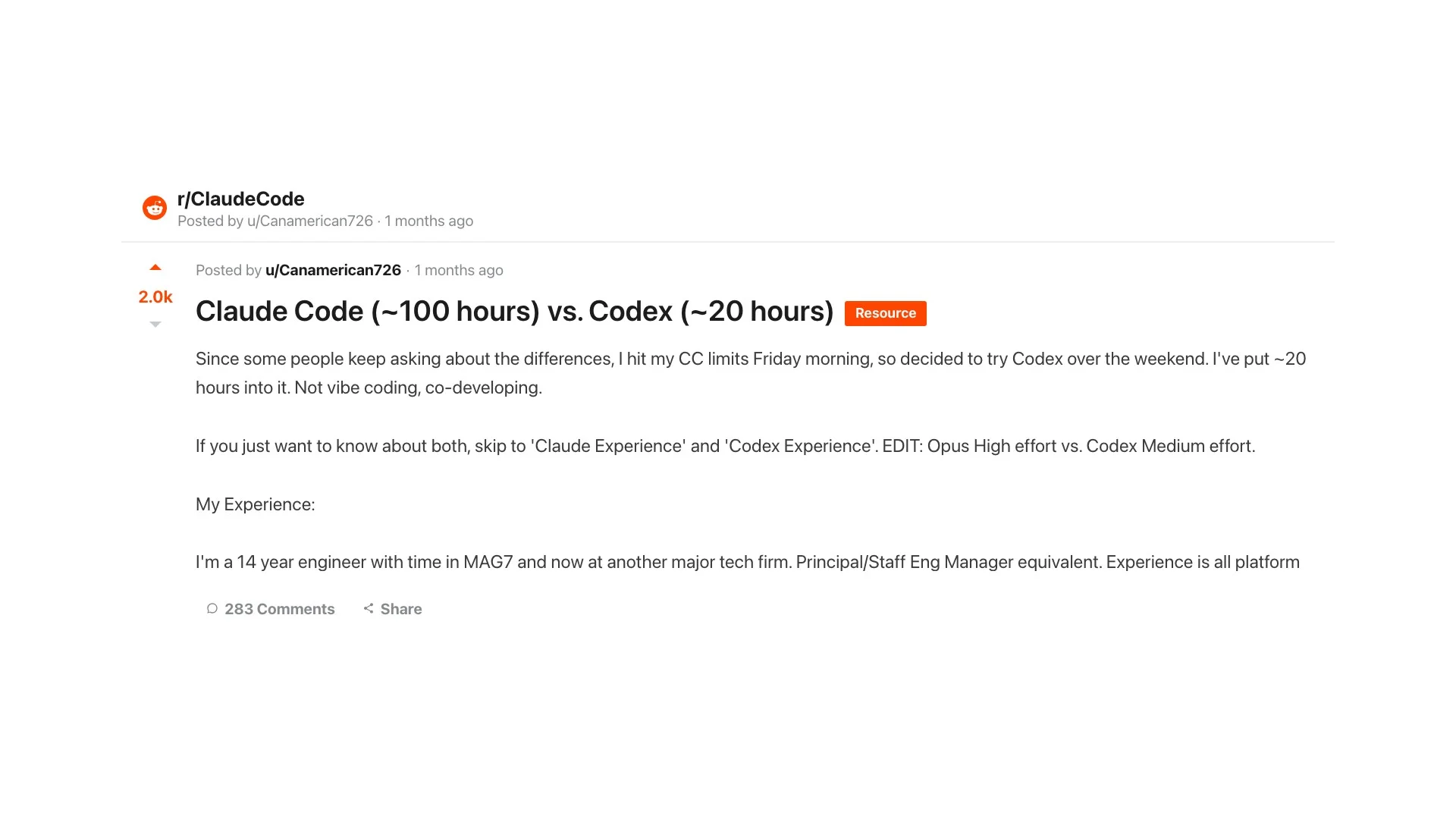 r/ClaudeCode: "Claude Code (~100 hours) vs. Codex (~20 hours)"
The migration goes both ways, often in the same engineer's week. Nathan Lambert at Ai2 captured the recurring pattern when GPT-5.4 dropped: he had been "ragequitting back to Claude Code" every time he tried Codex, until 5.4 was the first version that held him for multiple hours straight.
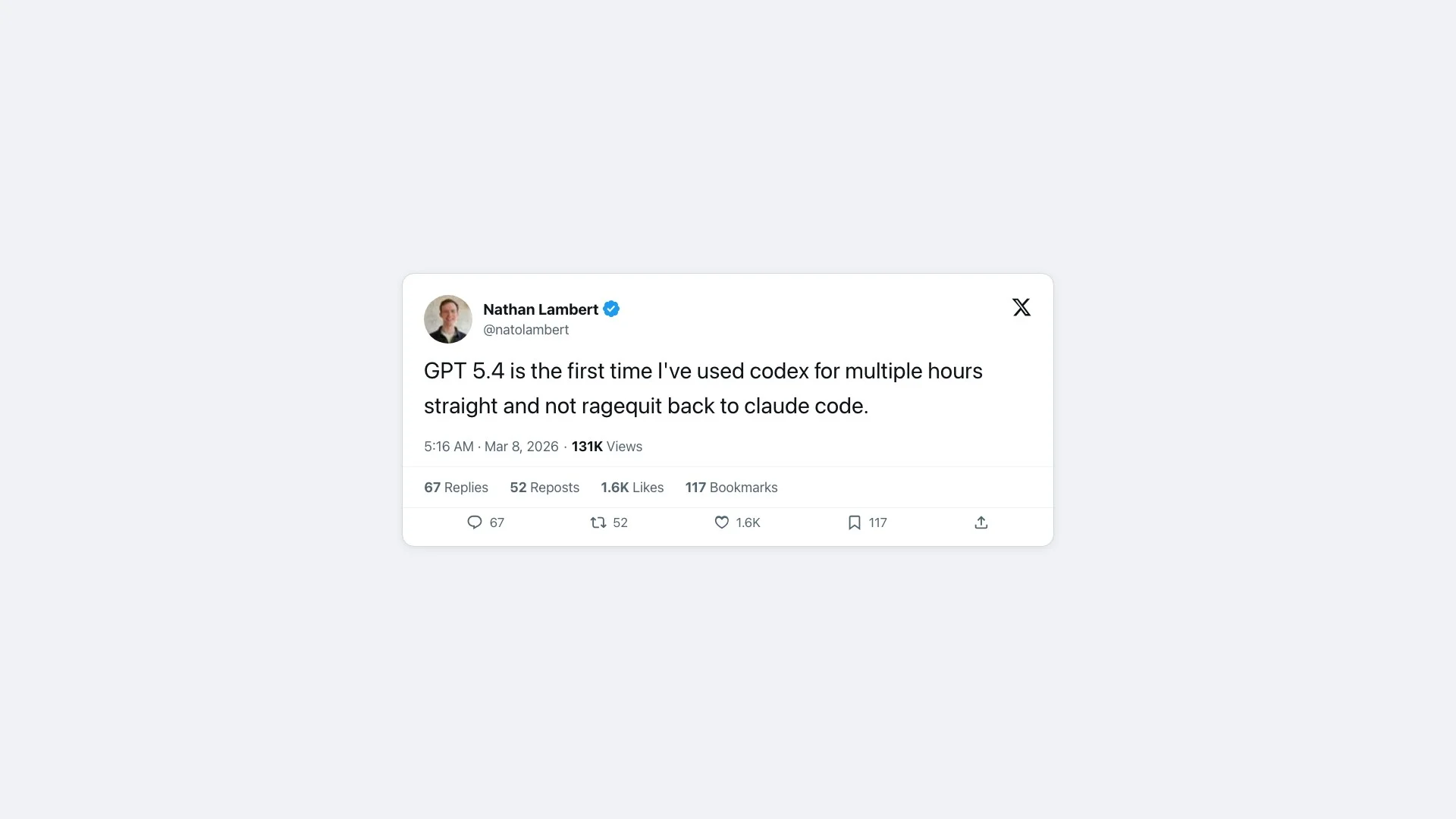 @natolambert on X, March 8, 2026
Output quality and speed: what the benchmarks show
At the frontier, both models are roughly tied. Benchmarks support that reading, and so do the community debates: the replies to Karpathy's January thread, where he described going from 80 percent manual coding to 80 percent agent coding in a single month, split exactly evenly between Claude Code and Codex advocates. Here are the published numbers from primary OpenAI and Anthropic posts.
| Benchmark | Model | Score | Source |
|---|---|---|---|
| SWE-bench Verified (n=500) | GPT-5.1-Codex-Max (xhigh) | 77.9% | OpenAI |
| SWE-bench Verified (n=500) | GPT-5.1-Codex (high) | 73.7% | OpenAI |
| SWE-bench Verified | Claude Opus 4.6 | 78.3% | Anthropic |
| SWE-Lancer IC SWE | GPT-5.1-Codex-Max | 79.9% | OpenAI |
| SWE-Lancer IC SWE | GPT-5.1-Codex (high) | 66.3% | OpenAI |
| Terminal-Bench 2.0 (n=89) | GPT-5.1-Codex-Max | 58.1% | OpenAI |
These numbers move every quarter, and they are vendor-reported. The story underneath them is that the harness matters as much as the base model. The same model in two different agents gives different results, and the wrapper is doing real work. Firecrawl's explainer on what an agent harness is covers the reason.
Internal adoption looks the same on both sides. OpenAI says 95 percent of its engineers use Codex weekly, shipping roughly 70 percent more PRs since adoption. The frontier is real on both products, and arguing about which one is two benchmark points ahead misses what changed.
The cleanest outside data point on Codex's capability came from a project Anthropic, of all people, helped surface. In early 2026, Austrian developer Peter Steinberger spun up OpenClaw, a personal AI agent harness that briefly grew faster on GitHub than React. The detail nobody talks about: most of OpenClaw was built using Codex itself. When Anthropic's legal team sent a cease and desist over the project's Claude-adjacent original name, OpenAI's Codex PM Alexander Embiricos went public.
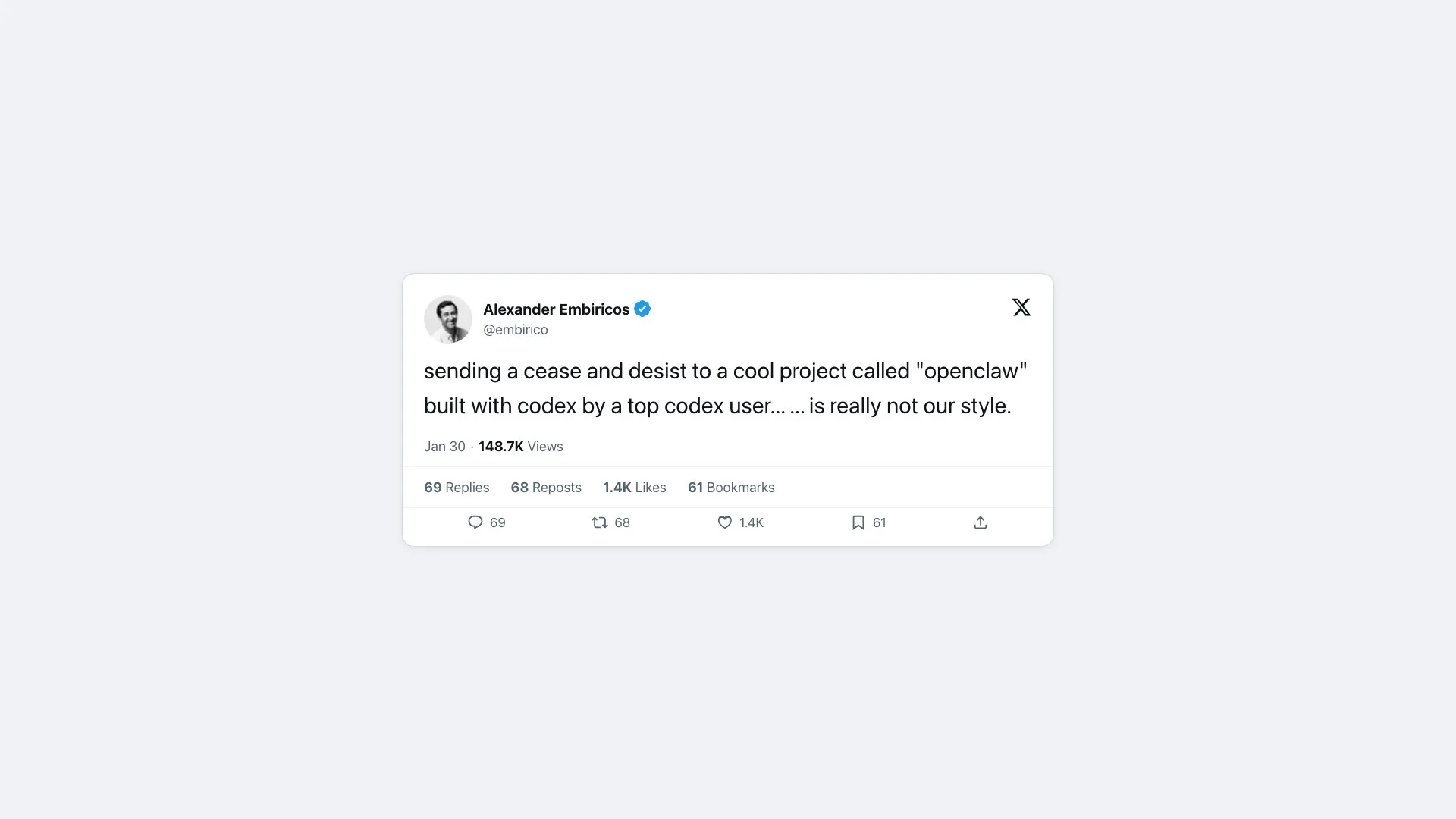 @embirico on X, January 30, 2026
sending a cease and desist to a cool project called "openclaw" built with codex by a top codex user...... is really not our style.
Steinberger joined OpenAI's Codex team on Valentine's Day 2026. The best Codex demo of the year wasn't an OpenAI launch post. It was an outside agent project built with Codex that scaled fast enough to draw a trademark letter.
When Claude Code is the right call
Reach for Claude Code when:
- You live in a terminal and want the deepest programmable harness: Skills, Hooks, Plugins, Subagents, Dynamic Workflows, Plan mode, Auto mode.
- You are doing frontend or UI work, where Claude Code's MCP and skill ecosystem consistently produces better results than Codex.
- You need fast iteration loops where the 1-to-3-second turnaround on Opus 4.7 or Sonnet 4.6 matters more than autonomous depth.
- You want hierarchical, layered memory through CLAUDE.md, with
@pathimports and auto-memory. - You have already invested in MCP servers, skills, and plugin ecosystems and you want that compound interest.
- You want to orchestrate tens of subagents in one session through Dynamic Workflows.
When Codex is the right call
Reach for Codex when:
- You want one product across CLI, IDE, Cloud, ChatGPT app, mobile, and Chrome. The cross-surface continuity is real.
- You are doing long-horizon autonomous runs. GPT-5.1-Codex-Max is the first model trained for compaction, enabling 24-plus hour runs.
- You prefer kernel-level sandbox guarantees over hook-based policy.
- You want AGENTS.md, the open standard, over CLAUDE.md, the proprietary version.
- You are already on ChatGPT Plus and want coding-agent access without paying for a separate $100 Anthropic subscription.
- You want native PR and code-review automation with
@codex reviewmentions. - You want to start a refactor on your phone and finish at your desk.
Can you run Claude Code and Codex together?
This is what most heavy users actually do. The pattern: Claude Code for interactive iteration where you stay in the loop, Codex Cloud for overnight work where you do not. Claude wins on getting context fast and reasoning quickly; Codex wins on grinding through hard problems unsupervised. Even the engineers who insist they have picked a side tend to keep both installed, and the rebound stories are common enough to be a genre on their own.
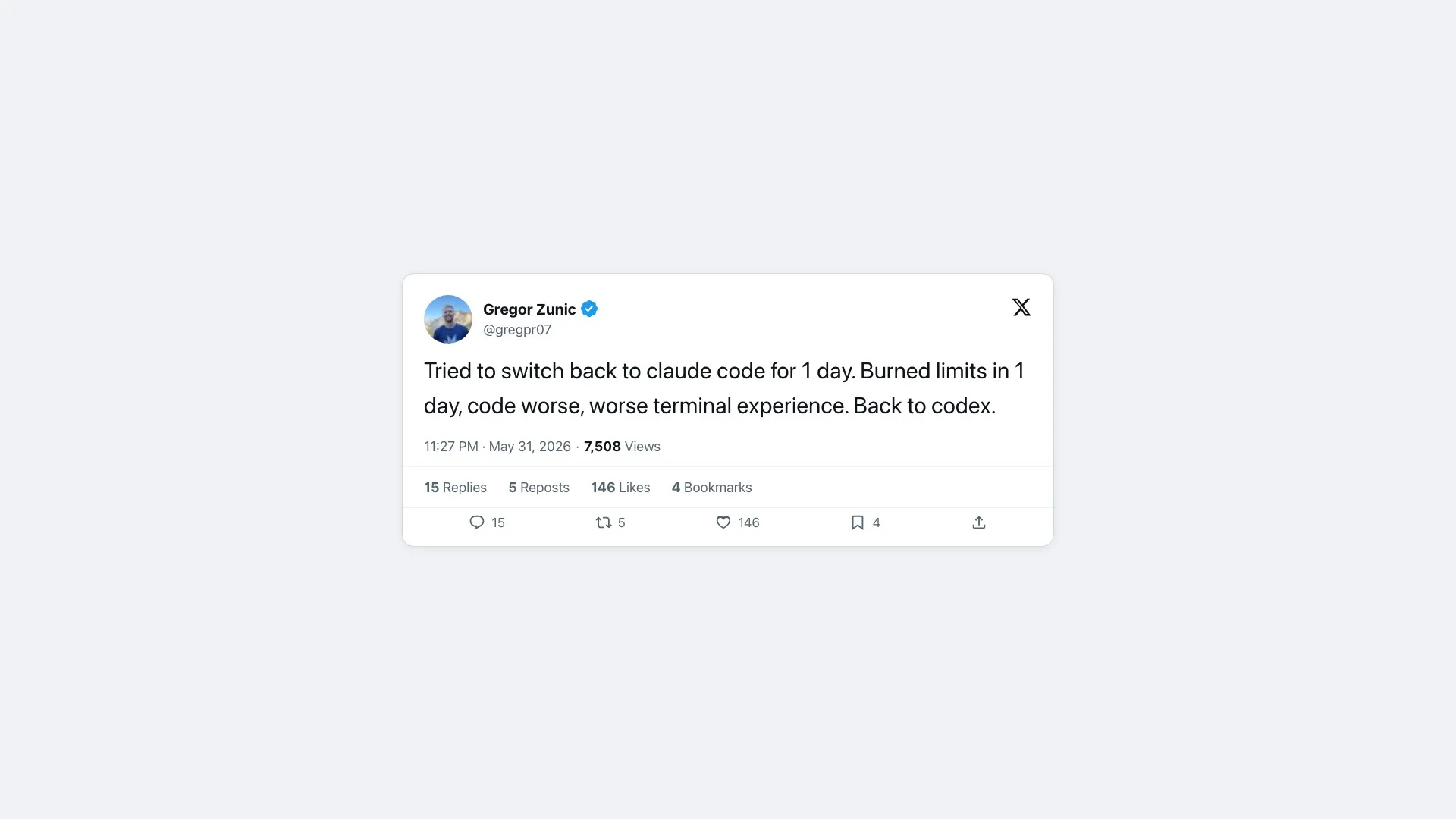
Both agents speak MCP, so anything you build on the MCP layer (Firecrawl, Linear, Postgres, Sentry, Playwright) works on both. AGENTS.md and CLAUDE.md are different files, but Claude Code will read AGENTS.md if you point it there, and Codex will respect a basic CLAUDE.md if it looks like AGENTS.md. The friction is lower than it sounds.
If you are also considering OpenCode (which the managed-vs-open decision is upstream of this one), many people end up running three agents and routing work by task type: Claude Code for fast terminal iteration, Codex Cloud for autonomous overnight runs, OpenCode for cheap or local-model work that does not need Anthropic or OpenAI.
How do you give either agent live web access?
Here is a gap both Claude Code and Codex share. Out of the box, neither agent can see the live web. Yesterday's library release, the breaking change in a dependency, and the current docs are invisible to a model trained six months ago. Codex CLI ships with internet disabled inside the sandbox. Claude Code has WebFetch, but it is a single-URL primitive, useful for grabbing one page rather than a real search-and-browse capability.
Because both speak MCP, the fix is the same on either side. A Firecrawl MCP server gives the agent search and scrape, so it can pull clean, current context from the web before it writes code. The capability is tool-agnostic: the same setup works whether you are in Claude Code or Codex. Firecrawl's piece on agentic search covers why cached training data is not enough, and Claude web fetch vs Firecrawl shows the difference live data makes in practice.
The fastest way to wire it up is the Firecrawl CLI. One command installs it and registers Firecrawl as a skill across every coding agent it detects on your machine (Claude Code, Codex, OpenCode, Gemini CLI, and others), with no manual configuration needed:
npx -y firecrawl-cli@latest init --all --browserYou can try it free at firecrawl.dev. For more on the broader MCP ecosystem, see Firecrawl's 10 Best MCP Servers for Developers in 2026, or the best MCP servers for Claude Code and Codex for copy-paste claude mcp add and codex mcp add commands for each server.
Also read: How to Add Web Search to Codex CLI Using Firecrawl and Best Claude Code Skills to Try in 2026.
Claude Code vs Codex: Which should you choose?
For interactive depth on hard tasks with the deepest harness you can program (Skills, Hooks, Plugins, Subagents, Dynamic Workflows, hierarchical memory), Claude Code is the pick. It is faster in the terminal, more programmable, and tuned for developers who want to shape their own agent rather than use a managed one.
For long-running autonomous work, cross-surface continuity, kernel-level sandboxing, and a lower entry price, Codex is the pick. It is the more managed product, runs across more surfaces, and gives you a lot of agent for $20.
Both tools crossed the coherence threshold in late 2025. The decision is no longer which model is smarter. It is which workflow you are in.
Do you want a terminal that thinks fast, or a workspace that thinks long?
If you are comparing more than these two, Firecrawl's best AI coding agents ranks eight tools side by side, including Cursor, Devin, OpenCode, and GitHub Copilot.
Frequently Asked Questions
What's the pricing difference between Codex and Claude Code?
Codex is bundled into ChatGPT Plus at $20 per month, with Pro 5x at $100 and Pro 20x at $200 (as of June 2026). Claude Code Pro at $20 is limited, so the credible-volume tier starts at Max 5x at $100 and Max 20x at $200. For the same $20, Codex gives more coding-agent runtime. Both have an API-key alternative billed per token.
Which is faster, Claude Code or Codex?
Claude Code is faster on simple-to-medium tasks; Codex is slower but more thorough on complex ones. This is the dominant pattern in community comparisons on Reddit and Hacker News. If you want tight pair-programming loops, Claude Code's terminal experience is the more responsive option.
Which produces better code quality on complex tasks?
Mixed. OpenAI's GPT-5.1-Codex-Max scores 77.9 percent on SWE-bench Verified, and Anthropic's Opus 4.6 scored 78.3 percent. On hard real-world work, several Reddit and HN threads tilt slightly toward Codex; for frontend and UI work, Claude Code wins. The model layer is roughly tied at the frontier.
Can I use both Claude Code and Codex together?
Yes, and many heavy users do. The common hybrid pattern: Claude Code for interactive pair-programming and frontend work, Codex Cloud for long-running background tasks and PR review. Both speak the Model Context Protocol, so MCP servers like Firecrawl work in either tool.
Does Codex support MCP servers like Claude Code?
Yes. Codex supports MCP over STDIO and Streamable HTTP, including OAuth. Claude Code originated MCP and ships a deeper extensibility stack on top of it, including Skills, Hooks, Plugins, Subagents, and Dynamic Workflows. The base MCP capability is comparable.
What's the difference between Codex CLI and Codex Cloud?
Codex CLI runs locally on your machine inside an OS-level sandbox (Seatbelt on macOS, bubblewrap on Linux, Windows sandbox on PowerShell). Codex Cloud runs in a hosted, sandboxed container preloaded with your repo, accessible at chatgpt.com/codex, the mobile app, and the Chrome extension. They share the same ChatGPT account and AGENTS.md config.
Can I use Claude Code through ChatGPT Plus, or Codex through Claude Pro?
No. Claude Code requires an Anthropic subscription or an Anthropic API key. Codex requires a ChatGPT subscription or an OpenAI API key. The accounts and billing are separate, and there is no cross-subscription path.
Which has better sandboxing, Claude Code or Codex?
Different philosophies. Codex enforces sandboxing at the kernel layer using Seatbelt, Landlock via bubblewrap, and the Windows sandbox. Claude Code enforces policy at the application layer using 26 programmable hook events plus Auto mode. Kernel is more deterministic; hooks are more expressive.
Should I switch from Claude Code to Codex?
Depends on your workflow. If you live in a terminal and want the deepest programmable harness, stay on Claude Code. If you want one product across CLI, IDE, Cloud, ChatGPT app, mobile, and Chrome at a lower entry price, Codex is the move. The common Reddit verdict is to run both and route work by task type.
How do I give either agent live access to the web?
Both agents are blind to the live web by default. Codex CLI has internet disabled inside the sandbox; Claude Code's WebFetch is a single-URL primitive. A Firecrawl MCP server or skill adds search and scrape to either one, with the same setup since they both support MCP. Install with: npx -y firecrawl-cli@latest init --all --browser.
