TL;DR: Claude Code vs. OpenCode
| Dimension | Claude Code | OpenCode |
|---|---|---|
| Models | Anthropic-first | Model-agnostic, 75+ providers |
| Cost model | $20–$200/mo subscription | Bring your own key, or Zen pay-as-you-go |
| Terminal UX | Simple, managed; VS Code + JetBrains extensions | Polished TUI + Tauri desktop app (macOS/Windows/Linux) |
| Extensibility | Skills, hooks, plugins, weekly releases | Highly configurable, thinner marketplace |
| Output quality | Strongest on hard tasks | Close on simple work, depends on model |
| Autonomous runs | Agent View fleet + /goal + instant rewind | Background subagents, manual undo |
| Open source | Closed, deeply integrated | Open, inspectable, self-hostable |
Short version: reach for Claude Code when you want managed speed and the best instruction-following. Reach for OpenCode when you want model freedom, a better terminal experience, and control over your workflow. Plenty of people run both.
One morning in early January 2026, a lot of developers opened their terminal and watched OpenCode break. Routing a Claude Max subscription through it suddenly failed, and a GitHub issue titled "Broken Claude Max" filled up within hours. Anthropic had blocked third-party tools from using subscription credentials.
That single change reframed the whole decision and kicked off what became the claude code debate. The question stopped being "should I run an AI coding agent in my terminal" and became something sharper: managed or open?
I have spent weeks with both Claude Code and OpenCode. They look similar from across the room, two coding agents living in a terminal. They feel very different in the hand. This is a sourced, hands-on comparison. Both are excellent. They are built for different people.
What is Claude Code?
Claude Code is Anthropic's agentic coding tool. It reads your codebase, edits across files, runs tests, and commits code from the terminal. It also runs in VS Code, JetBrains, the desktop app, and the web, and uses Anthropic's Claude models by default.
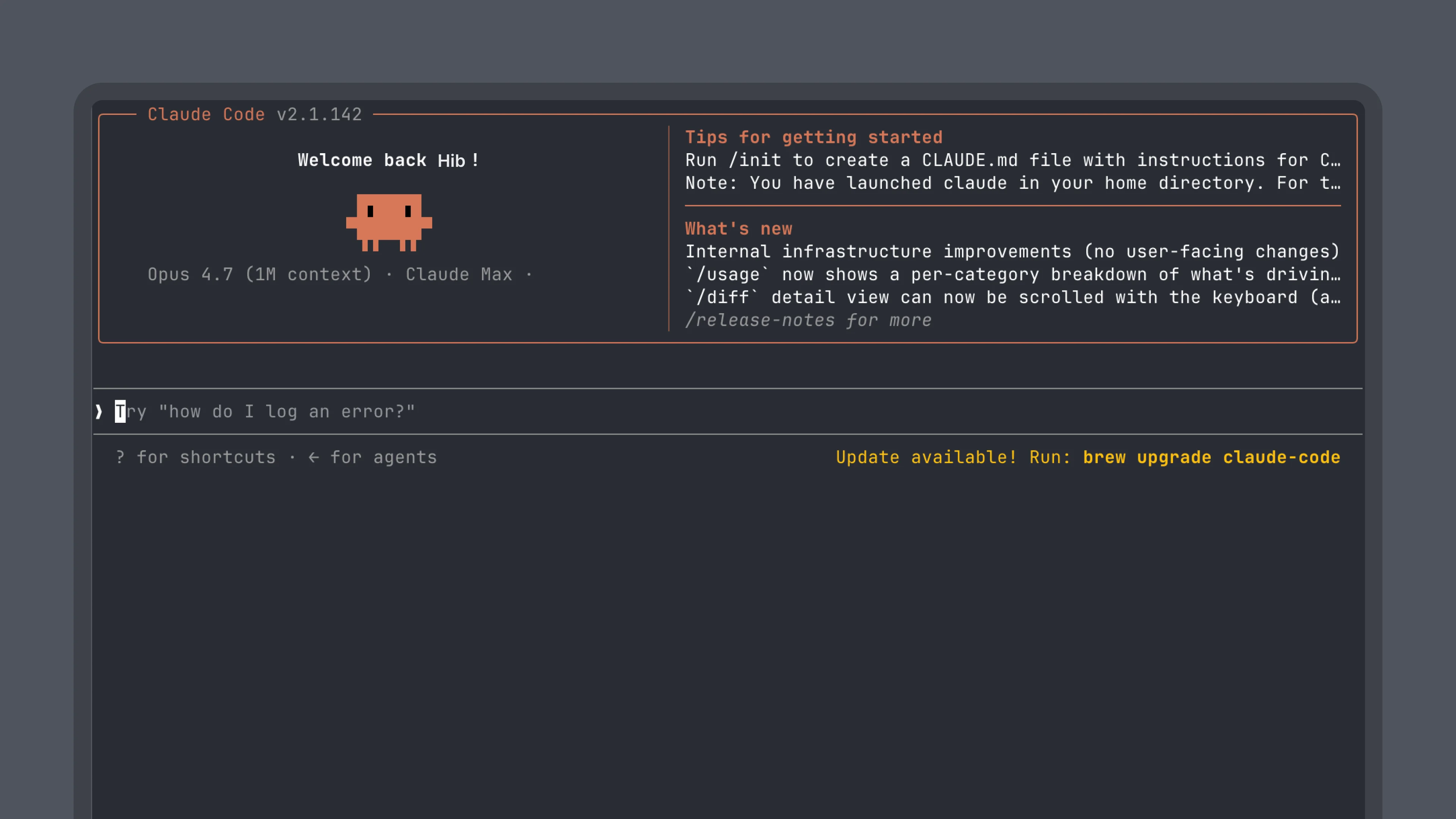 Claude Code's terminal welcome screen, running Opus 4.7 on a Claude Max plan.
If you want the background on why so many agents now live in the terminal rather than an IDE, Firecrawl's take on why CLIs are better for AI coding agents covers it well.
What is OpenCode?
OpenCode is an open-source coding agent that connects to any model from any provider, including Claude, GPT, and Gemini. It runs as a polished terminal UI and as a full Tauri desktop app on macOS, Windows, and Linux — with MCP connection status visible in the UI — making it the more versatile surface of the two when it comes to how you actually run it. It is maintained by Anomaly, founded by the SST creators Dax Raad and Frank Wang. As of late May 2026, the repo sits at roughly 171,000 stars and around 1.38 million npm downloads in a week.
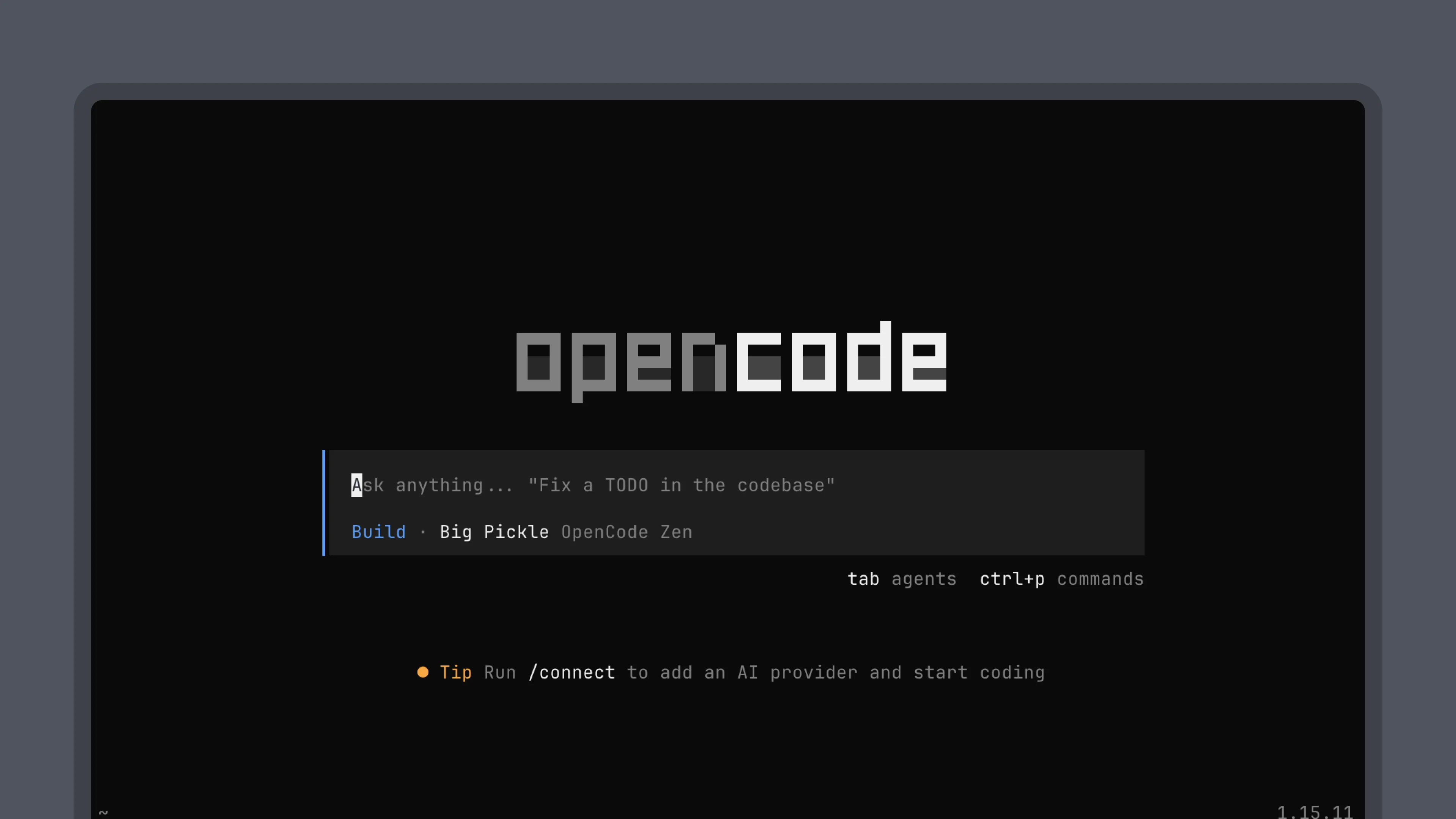 OpenCode's terminal welcome screen, in Build mode on OpenCode Zen.
OpenCode vs. Claude Code: What are the differences?
Models: locked in versus model-agnostic
This is the cleanest split between the two tools.
Claude Code is built around Anthropic's models. Its CLI and VS Code surfaces document some third-party provider routing, but the product is tuned for Claude and assumes Claude.
OpenCode goes the other way. It connects to 75+ providers through Models.dev, including Anthropic, OpenAI, xAI, Moonshot's Kimi, GLM, local models via Ollama, and any OpenAI-compatible endpoint, all listed in its provider docs. You can switch models without leaving your session, and for many developers that flexibility is the whole point. (See GLM-5.2 vs. Kimi K2.7 Code for a head-to-head coding comparison.)
That openness scales up to the enterprise. Because OpenCode is open source and connects to local or self-hosted models, teams under strict data or compliance rules can keep source code and prompts on their own infrastructure. A closed, cloud-only tool cannot offer that.
being able to completely swap providers/models mid-chat is absolutely nuts. Honestly, that's the killer feature imo
— u/Sensitive_Song4219 on r/opencodeCLI
The flip side is lock-in, and developers feel it. A thread on r/opencodeCLI puts it bluntly:
anthropic is trying to lock users into their ecosystem whereas opencode is the literal opposite.
If model flexibility matters to you, OpenCode wins here.
Cost and cost visibility
Claude Code charges via subscription or API key; OpenCode charges nothing for the software — you pay providers directly. The models cost the same either way; the difference is the wrapper. Here is how the plans line up as of May 2026:
| Tool | Plan | Price | Models |
|---|---|---|---|
| Claude Code | Pro | $20/month | Claude |
| Claude Code | Max 5× / 20× | $100 / $200/month | Claude |
| Claude Code | API key | pay per token | Claude |
| OpenCode | Go | $5 first month, then $10/month | open models (GLM, Kimi, Qwen, MiniMax, DeepSeek) |
| OpenCode | Zen | pay-as-you-go | hosted gateway, many models |
| OpenCode | Bring your own key | provider rates | any provider |
Claude Code bills two ways. The common one is a Claude subscription: as of May 2026, that is Pro at $20/month, and Max at $100/month (5x) or $200/month (20x), with usage shared across Claude and Claude Code against the same limits. The other is an Anthropic API key: set ANTHROPIC_API_KEY and Claude Code charges per token through the Console, pay-as-you-go, with no subscription. For heavy users the flat subscription rate is the appeal. For systematic techniques to cut those token costs by 77–91%, Firecrawl's Claude Code token efficiency guide documents 12 approaches including CLAUDE.md trimming, path-scoped rules, and model routing.
On Hacker News, a developer estimated that a $200/month Max plan absorbs a volume of tokens that "would have cost you more than $1,000 if you'd paid via the API."
OpenCode bills nothing for the software itself; you pay for model access through one of three routes:
- Bring your own key: pay providers directly at their posted rates.
- Zen gateway: pay-as-you-go, hosted by OpenCode, many models.
- OpenCode Go: $5 for the first month, then $10/month. Trades frontier models for capable open-source ones (GLM-5.1, Kimi K2.6, Qwen3.7 Max, MiniMax M2.7, DeepSeek V4) with generous per-5-hour request limits, usable from any agent, not just OpenCode.
That range makes spend visible and controllable, and it is why developers report running the same workload for less:
I was using claude code with pro membership and always came to my limits. Now with opencode go and deepseek v4 flash I have the same results and it's much cheaper.
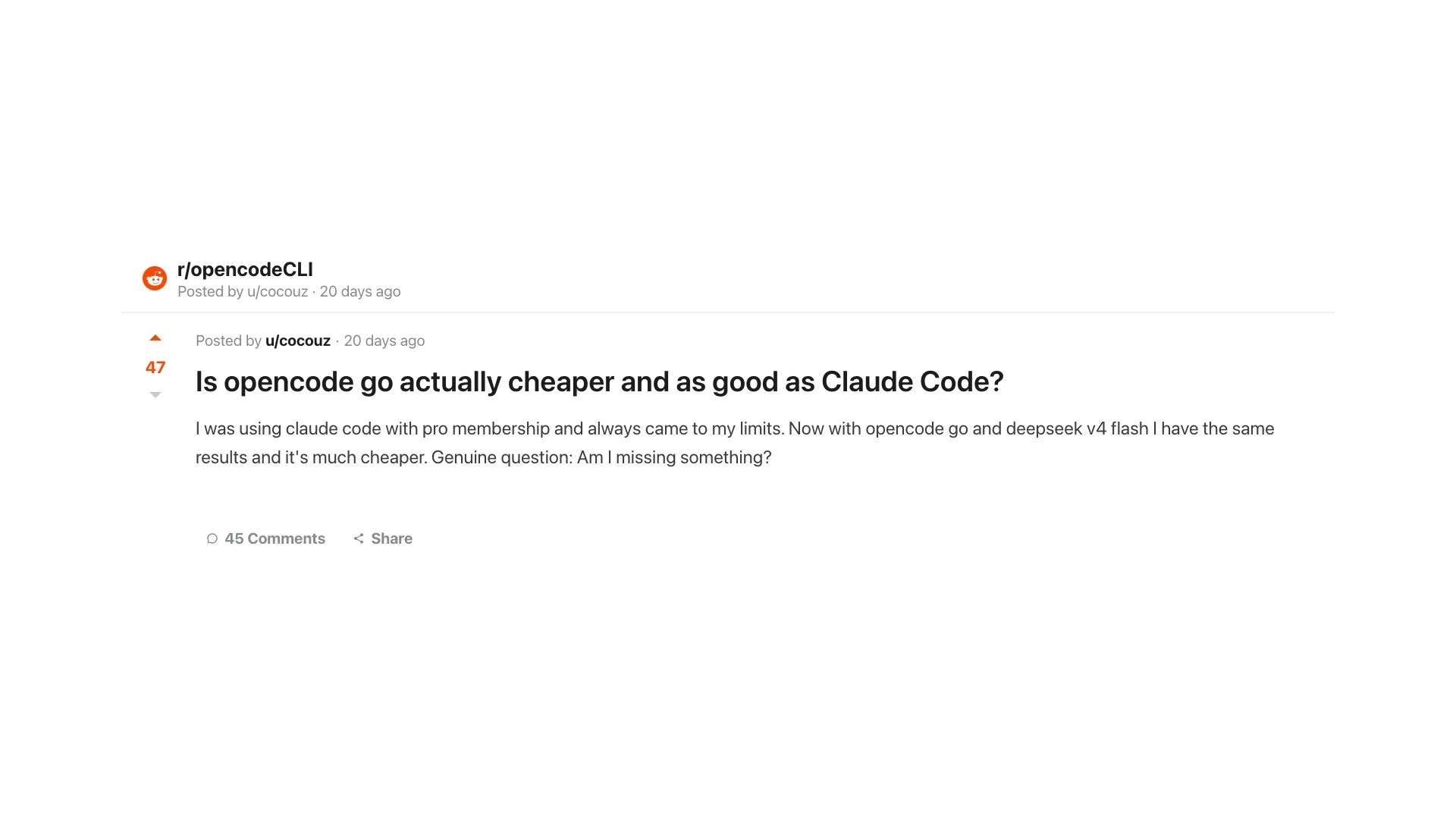 r/opencodeCLI: "Is opencode go actually cheaper and as good as Claude Code?"
There is an honest counterpoint, though. Cost visibility helps when you are counting. Once you settle onto a flat Max plan, the math changes. A developer in r/ClaudeAI put it well: "the cost visibility advantage of OpenCode disappears when you're not counting anymore."
Where the Claude-in-OpenCode restriction stands now
The OpenCode Anthropic subscription standoff is the part that changed the math, and it deserves a clear, current answer.
As of May 2026, using a Claude Pro or Max subscription inside OpenCode is not a sanctioned option. API-key billing is the only supported path for Claude models. OpenCode's own provider docs say it plainly: "There are plugins that allow you to use your Claude Pro/Max models with OpenCode. Anthropic explicitly prohibits this," and note the bundled plugins were dropped "as of 1.3.0."
Here is how it unfolded:
- January 8 to 9, 2026: the OAuth block hits OpenCode users. VentureBeat reports the crackdown, and an Anthropic engineer says on X that the goal was to stop tools "spoofing the Claude Code harness."
- Week of February 20, 2026: Anthropic revises its legal docs to spell out the ban, as The Register details.
- March 19, 2026: OpenCode merges PR #18186, "Remove anthropic references per legal requests," authored by Dax Raad. A widely shared Hacker News post titled it "Anthropic takes legal action against OpenCode," but the link is that pull request, not a lawsuit. No court filing exists. It reads as compliance with legal requests, not litigation.
- April 4, 2026: a separate billing change. Anthropic tells subscribers they can no longer use subscription limits for third-party harnesses without paying extra, per TechCrunch. Claude Code lead Boris Cherny said "subscriptions weren't built for the usage patterns of these third-party tools."
The official line lives in Anthropic's Claude Code legal and compliance docs: OAuth login is "intended exclusively" for native subscription use, and Anthropic "does not permit third-party developers to ... route requests through Free, Pro, or Max plan credentials on behalf of their users." If you want Claude in OpenCode today, you pay per token. That is the rule, and it is not bending.
OpenCode vs Claude Code: Which tool has the better terminal experience?
Here OpenCode tends to win, and it wins on feel.
Its TUI is the repeated favorite in nearly every thread. The terminal does not flicker on each update, sections scroll independently, and planning prompts are easy to answer. Laravel maintainer Nuno Maduro captured the first impression: "the CLI UI genuinely feels a lot better.. individual sections are scrollable... without the whole terminal flickering." On r/opencodeCLI, the verdict is blunter: one user calls OpenCode's UI "genuinely the BEST."
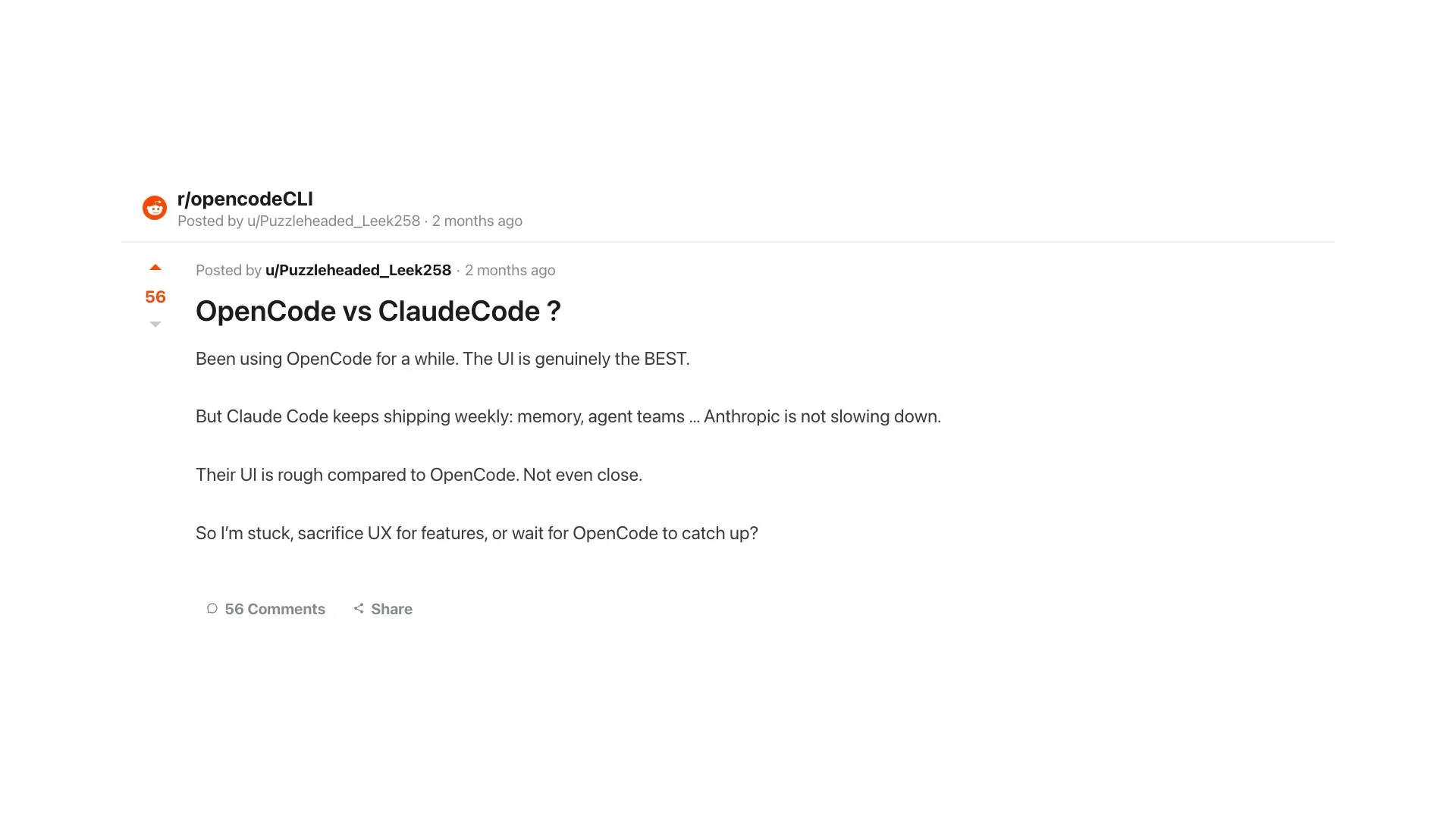 r/opencodeCLI: "OpenCode vs ClaudeCode?"
OpenCode also ships a standalone Tauri desktop app for macOS, Windows, and Linux. It exposes MCP connection status in the UI, has a dedicated Plan mode for read-only architecture analysis before any code is written, and lets you switch between Build and Plan without dropping into the terminal at all. Claude Code's non-terminal surfaces are its VS Code and JetBrains extensions and the web app — useful, but not a purpose-built desktop client.
Claude Code has a defender's case, and it is a real one. It does not take over the alternate screen, so your chat history stays in the terminal scrollback, which some prefer. It is simpler and more managed, which is exactly what a lot of people want. But if a polished terminal experience — or a proper desktop app — is what you optimize for, OpenCode is the nicer place to spend your day.
Extensibility: MCP, skills, plugins, and release cadence
Both tools speak the Model Context Protocol, so they can share the same MCP servers. If you are weighing how to wire either one into your stack, Firecrawl's MCP vs CLI breakdown is a useful primer, and its list of MCP servers for developers is editor-agnostic.
Where they diverge is ecosystem depth and pace. Claude Code ships fast. It has skills, hooks, subagents that coordinate as teams, and a growing plugin marketplace, with new capabilities landing weekly.
Firecrawl's roundups of the best Claude Code skills and top Claude Code plugins show how deep that catalog already runs, and how SKILL.md files work explains the format both agents borrow from.
OpenCode is highly configurable through opencode.json, but its marketplace is thinner. A comparison thread on r/opencodeCLI notes that "opencode's support for plugins and marketplaces doesn't quite match that of Claude Code." That said, because OpenCode reads Claude-compatible and Agent-standard skill directories, the best OpenCode skills worth installing include most of the top skills built for Claude Code and Codex, unchanged. OpenCode's own pace cuts both ways: it iterates quickly, but one Hacker News comment warns that it can "add, remove, refine, change, fix, and break features constantly at that accelerated pace."
Under the hood: harness, prompts, and tools
The same Claude model behaves differently in each tool because the harness wraps it differently: the system prompt, tool set, sub-agents, and context handling all vary. Most comparisons skip this. Here is what each one actually ships.
How does each build its system prompt?
Claude Code's system prompt is closed and known only through reverse-engineering. The most complete extraction, Piebald-AI's mirror (tracking v2.1.152), shows it is not one block but roughly 110 conditionally-included strings assembled per session, with the volatile parts (git status, environment) appended last so the cacheable prefix stays stable. OpenCode takes the opposite approach: the prompt files sit in the open-source repo, and it picks a different one per model family.
| Claude Code | OpenCode | |
|---|---|---|
| Prompt visibility | Closed; known only via reverse-engineering | Open; prompt files in the repo |
| Shape | ~110 conditional strings, assembled per session | One prompt file selected per model family |
| Model-specific prompts | Single prompt, tuned for Claude | 8 model-family files (Claude, a GPT‑4/o‑series "beast mode," GPT, Codex, Gemini, Kimi, Trinity, default) |
| Core prompt size | ~2,900 tokens (per the extraction) | Varies by model file |
| Prompt caching | Stable prefix; ephemeral cache breakpoints | Cache breakpoints on the first 2 and last 2 messages |
| Editability | Not user-editable | Override default.txt or set a custom prompt: |
The tradeoff is real. OpenCode's openness lets you read and replace the prompt, but its defaults draw fire from its own users for being heavy. One developer proxied the traffic and found the first "hello world" call shipped a 171KB JSON payload, calling the built-in prompts "way too general, opinionated, and bloated." Claude Code's prompt is tuned for one model family and you cannot touch it.
What tools does each agent ship?
Both expose a similar core: run commands, read and write files, search, fetch the web, manage a task list, and spawn sub-agents. The differences sit at the edges, where Claude Code carries a much wider built-in surface.
| Capability | Claude Code (reference) | OpenCode (reference) |
|---|---|---|
| Shell | Bash, PowerShell | bash |
| Read / write / edit | Read, Write, Edit | read, write, edit, apply_patch (GPT) |
| Find files / search | Glob, Grep | glob, grep |
| Code intelligence | LSP | lsp (experimental) |
| Web | WebFetch, WebSearch | webfetch, websearch (Exa AI) |
| Task list | TaskCreate/TaskUpdate (TodoWrite legacy) | todowrite |
| Skills | Skill | skill |
| Spawn sub-agent | Agent | task |
| Ask the user | AskUserQuestion | question |
| Jupyter notebooks | NotebookEdit | not built in |
| Deferred tool loading | ToolSearch | none |
| Background watching | Monitor | none |
| External repo research | none | repo_clone, repo_overview (Scout, experimental) |
| Scheduling | CronCreate, ScheduleWakeup, RemoteTrigger | none |
| Worktree isolation | EnterWorktree, ExitWorktree | none |
| Agent teams | TeamCreate, SendMessage | none |
| Instant rewind | Esc×2 to last checkpoint | manual Git / /undo |
| Fleet management | Agent View dashboard (v2.1.139+) | none |
| Autonomous goal mode | /goal + validator model (v2.1.139+) | none |
How does Claude Code's tool search cut token use?
This is one of the clearest architectural wins, and it is fully documented. Every MCP tool's definition normally loads into context up front, before you type anything. Anthropic's own numbers show how fast that adds up: five servers with 58 tools cost about 55,000 tokens before the first prompt, and their heaviest internal setup hit 134,000 tokens of tool definitions. Tool Search defers those definitions and lets the model look them up on demand, keeping the cacheable prefix intact.
| Tool definitions loaded | Tokens |
|---|---|
| 5 MCP servers, 58 tools, loaded up front | ~55,000 |
| Anthropic's heaviest internal setup | 134,000 |
| Worked example: ~77K up front, with Tool Search | ~8,700 |
Anthropic reports an 85% reduction in tool-definition tokens with full library access retained, and tool-selection accuracy on Opus 4.5 climbing from 79.5% to 88.1% on its internal MCP evaluations. It is on by default in Claude Code, auto-triggering when tool definitions pass 10% of the context window.
OpenCode has no equivalent: per its tools docs and source, every connected MCP tool's full schema loads on every turn, and the permission system gates whether a tool runs, not whether its definition costs you tokens.
How do sub-agents compare?
The designs are close. Both spawn sub-agents that run in their own context window and return a distilled summary, which is how a long research task avoids flooding the main conversation. Anthropic notes a sub-agent might burn "tens of thousands of tokens" exploring yet hand back only 1,000 to 2,000 tokens.
Claude Code builds on that base in several ways. An experimental fork inherits the full conversation and reuses the parent's prompt cache so it starts cheaper than a fresh sub-agent. A read-only Explore agent pins to the fast Haiku model for quick codebase navigation. Two additions that shipped in v2.1.139 change what autonomous work looks like in practice.
Agent View is a fleet dashboard that surfaces every session — running, blocked, done — in one place. You can navigate between them, peek at results, and manage parallel workstreams without losing track of what each agent is doing. It is the difference between juggling terminal tabs and having a control room. Teams that operationalize background coding agents at company scale go further still, adding intake queues, isolated sandboxes, automated verification, and explicit merge gates around each session.
/goal takes autonomy a step further. You describe a completion condition in plain language; a small, fast validator model checks after every step whether the goal has been met. If not, the main model keeps going. The result is genuine fire-and-forget execution for well-scoped tasks: set the goal, come back when it is done.
A third feature ties the two together: instant rewind. Hit Esc twice and the session restores to the last stable checkpoint. That safety net is what makes aggressive autonomous runs practical — you can let /goal run without being afraid of a bad intermediate step. OpenCode has no equivalent; reverting means a manual git revert or the /undo command, which steps back one action at a time.
OpenCode exposes hidden system agents (compaction, title, summary) and a Scout agent for cloning and reading external dependency repos, with each sub-agent able to run a different model. Background subagents (v1.14.51) keep running while you continue working in the foreground, and sessions persist server-side so they survive a terminal close.
Output quality and speed: what the benchmarks actually show
This is where people want a number, so here is the most rigorous one I found.
Builder.io ran a controlled test: the same model (Claude Sonnet 4.5) in both tools, fresh Docker containers, a medium TypeScript codebase, four tasks.
| Metric | Claude Code | OpenCode |
|---|---|---|
| Total time, 4 tasks | 9 min 9 sec | 16 min 20 sec |
| Tests written | 73 | 94 |
| Test suite run | Its own work only | Full existing suite |
Their summary fits what I saw: "Claude Code is built for speed. OpenCode is built for thoroughness." It is a vendor's blog, so weigh it accordingly, but the model was held constant and the method is transparent.
One specific finding from that test deserves a separate callout. All three models tested inside OpenCode tried to reformat existing code without being asked, producing noisy diffs that bury meaningful changes during code review. There is an open GitHub issue tracking this, and you will find a lot of discussion online around it. MorphLLM frames it precisely: "a harness-level issue, not model quality." It is not a knock on the underlying model — it is a quirk in how OpenCode processes files — but it is worth knowing before you point it at a codebase where clean diffs matter.
A second, lighter data point comes from engineer Matthieu Napoli, who posted that Claude wrote "better code, 2× faster, 30% cheaper" on Opus 4.5, with Claude finishing in 14 minutes to OpenCode's 27. He was careful to caveat it: quality was close, OpenCode wrote more tests, some of Claude's edge came from his own rules, and "test for yourself." Treat it as one developer's single run, not a benchmark.
Now the contrarian part, because it matters. The harness-advantage question is the sharpest edge of the claude code debate: is Claude Code actually smarter, or just familiar? That question went semi-viral when researcher Jack Morris asked why Claude Code seems more effective than running the same Claude model elsewhere. The replies split sharply.
Some pointed to a genuine harness advantage; others, including ML author Joel Grus, said the two "feel pretty equally effective" on Opus 4.5. At least one head-to-head refactor found OpenCode beating Claude Code with the same model. If you want to understand why the wrapper matters this much, Firecrawl's explainer on what an agent harness is is the right next read.
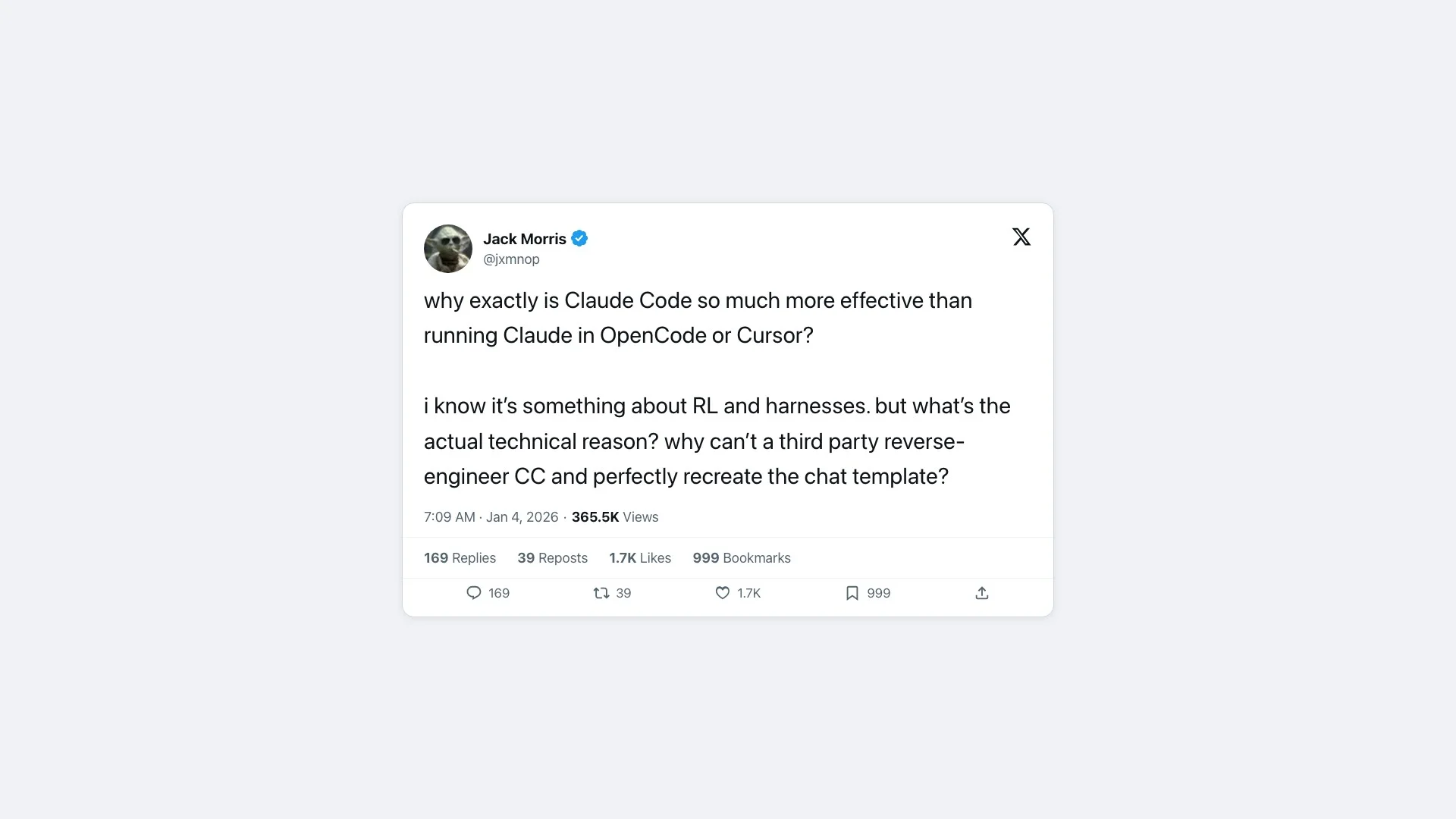 @jxmnop on X, the post that kicked off the harness-advantage debate.
The honest synthesis: on hard tasks with Claude's own models, Claude Code is the safer bet. On simpler work, or with the right open model, OpenCode holds its own. As one developer summed it up, "nothing is as good as opus ... but with opencode you can get a lot more work done even with the dumber models ... the ceiling is much higher."
Open source and lock-in
OpenCode is open source. You can read it, fork it, self-host it, and you are never gated by one vendor's decision. Claude Code is closed and tightly integrated, which is what makes it feel so smooth, and also what left those January users stranded when the rules changed.
That openness shows up in the star count. OpenCode's GitHub repo climbed past 171,000 stars, with the steepest growth landing in early 2026.
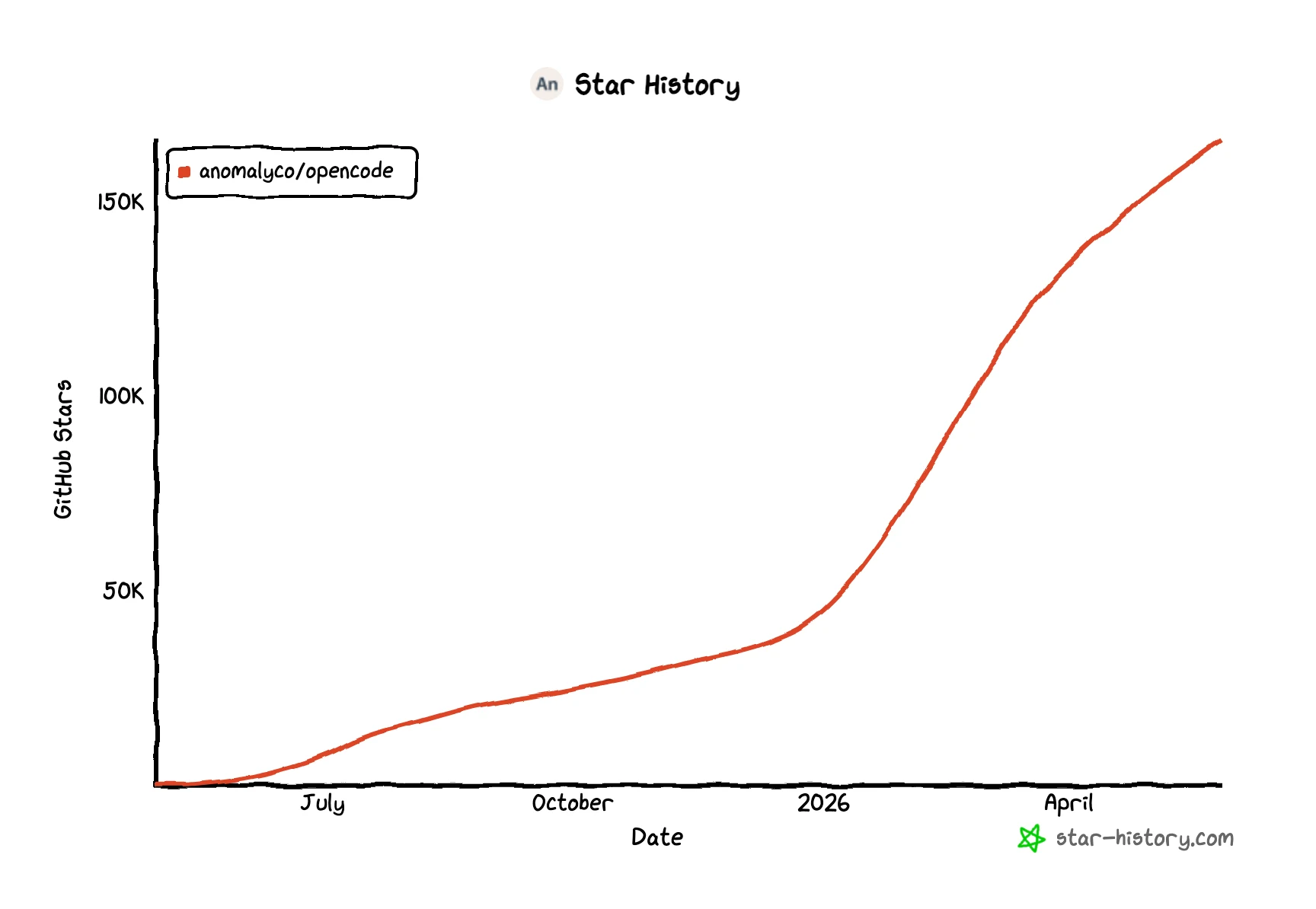 OpenCode's GitHub star history for anomalyco/opencode, via star-history.com.
One Reddit one-liner frames the whole comparison better than a spec sheet: "OpenCode treats you like a developer. Claude Code treats you like a user." Neither is an insult. Some days I want to be treated like a user and just ship. Some days I want the keys.
One caution on the open side: freedom includes the freedom to misconfigure. Developers on Hacker News flag that OpenCode's agent permissions are broad by default. Check opencode.json before you point it at anything sensitive.
When Claude Code is the right call
- You are on Anthropic's models anyway and want the strongest instruction-following.
- You prefer managed defaults and a steady stream of new features over tuning your own setup.
- Speed and "it just works" matter more to you than per-request cost.
- You are on a team or enterprise plan and value the shared, predictable usage limits.
When OpenCode is the better fit
- You want model freedom: GLM, Kimi, DeepSeek, Qwen, or a local model, swapped at will.
- The terminal experience matters to you, and you want to own your workflow.
- You want cost control through your own keys or local inference.
- Your team has data or compliance constraints that require self-hosted or on-prem models, so code never leaves your network.
- You need to run an agent headless without subscription-terms friction.
Running OpenCode and Claude Code together
Most heavy users land here, and so did I. The pattern that keeps showing up: run claude code with opencode in your toolkit — OpenCode for the bulk of day-to-day work, often with cheaper or flexible models, and Claude Code for the hard moments. A developer on r/opencodeCLI sums up the pattern: "I use oc for most of the tasks and cc when things need some real firefighting." In r/LocalLLaMA, another describes mixing agents across Gemini, Qwen, and a local model, each with different blind spots. The tools are not mutually exclusive, and treating them as a toolkit beats picking a side.
One footnote: Anthropic owns the runtime under both
Worth a mental note, not a deciding factor: in December 2025, Anthropic acquired Bun, the JavaScript runtime that ships both Claude Code and OpenCode. In practice it changes little. Bun stays open-source and MIT-licensed, the same team maintains it, and OpenCode keeps running on it just as before.
 @bunjavascript announcing the acquisition, December 2, 2025.
OpenCode vs. Claude Code: Which should you choose?
For the smoothest path to good code on Anthropic's models, Claude Code is the pick. For flexibility, a better terminal, and freedom from one vendor's roadmap, OpenCode is the pick. The deciding question: do you care more about the result or the control?
The January block made that choice less about saving money and more about philosophy. You are no longer choosing a cheaper way to run Claude. You are choosing whether you want a managed product or an open one. Both are good answers. They are just answers to different questions.
Giving either agent live web data with Firecrawl
Here is a gap both Claude Code and OpenCode share, and it is easy to forget. Out of the box, neither agent can see the live web. They know what their model was trained on, which means yesterday's library release, the breaking change in a dependency, or the current docs are invisible to them.
Because both speak MCP, the fix is the same for either one. A Firecrawl MCP server or skill gives the agent search and scrape, so it can pull clean, current context from the web before it writes code. The capability is tool-agnostic: the same setup works whether you are in Claude Code or OpenCode. Firecrawl's piece on agentic search covers why cached results are not enough, and Claude web fetch versus Firecrawl shows the difference live data makes for an agent.
The fastest way to wire it up is the Firecrawl CLI. One command installs it and registers Firecrawl as a skill across every coding agent it detects on your machine — Claude Code, OpenCode, Codex, Gemini CLI, and others — no manual configuration needed:
npx -y firecrawl-cli@latest init --all --browserYou can try it free at firecrawl.dev.
Also read: How to add web search to Codex CLI using Firecrawl · Best AI coding agents in 2026: harness, cost, and accuracy compared
Frequently Asked Questions
Can I use my Claude Pro or Max subscription with OpenCode?
Not through a sanctioned path. Anthropic prohibits routing Pro, Max, or Free plan credentials through third-party tools, and OpenCode removed the bundled Claude subscription auth plugin in v1.3.0. The supported way to run Claude models in OpenCode is an Anthropic API key or OpenCode's own Zen gateway. Community workarounds that re-enable subscription login violate Anthropic's Consumer Terms and risk an account ban.
Is OpenCode actually cheaper than Claude Code, and is it as good?
It can be cheaper, because you bring your own key and can run inexpensive or local models. On quality, the consensus is that nothing matches Claude's own models for hard tasks, but capable open models close much of the gap on simpler work. A controlled benchmark found Claude Code faster and OpenCode more thorough using the same model.
Which open models come closest to Claude in OpenCode?
Developers report good results with GLM 4.7, Kimi K2, DeepSeek, and Qwen3-Coder for everyday tasks. The common advice is to use spec-driven prompting with open models: be specific and break work into smaller steps, since they plan less autonomously than Claude's models.
Does OpenCode support skills and plugins like Claude Code?
Both speak the Model Context Protocol, so they share MCP servers. Claude Code has a more mature skills, hooks, and plugin marketplace ecosystem that ships new features weekly. OpenCode is highly configurable through opencode.json, but its plugin and marketplace coverage is thinner.
Why did Anthropic block third-party tools from using Claude subscriptions?
Anthropic says subscription OAuth login is meant for native use of Claude Code, not for routing Pro or Max usage through other harnesses. An Anthropic engineer said the change stopped tools from spoofing the Claude Code harness. Developers building on Claude are expected to use API-key billing through the Console.
Can I run a local LLM with OpenCode?
Yes. OpenCode connects to local models through Ollama and any OpenAI-compatible endpoint, alongside 75+ hosted providers. Claude Code is built around Anthropic's models, though its CLI and VS Code surfaces document some third-party provider routing.
Is OpenCode safe to use given its permissive defaults?
OpenCode is configurable, but several developers flag that its agent permissions are broad by default and that it can fetch provider config from the web. Review opencode.json and tighten permissions before pointing it at a sensitive codebase. Claude Code gates risky actions unless you pass a skip-permissions flag.
Should I use both Claude Code and OpenCode?
Many heavy users do. The common pattern is OpenCode for most day-to-day work with flexible or cheaper models, and Claude Code for hard architecture or debugging where instruction-following and model quality matter most.
Can Claude Code and OpenCode search the live web and scrape pages?
Not out of the box. Both agents are limited to what their model was trained on, so recent docs, library changelogs, and live pages are invisible to them by default. Adding a Firecrawl MCP server or skill gives either agent the ability to search and scrape the live web mid-task, pulling clean, current content before writing code. The setup is the same for both tools since they both support the Model Context Protocol.
How do I give my coding agent access to live web data for web extraction tasks?
Install Firecrawl as an MCP server or agent skill. Once connected, Claude Code or OpenCode can call Firecrawl's scrape, search, and crawl tools to pull structured data from any URL at runtime, including JavaScript-rendered pages that break simple fetch calls. This is useful for tasks like extracting API docs, scraping competitor pages, or pulling in the latest library reference before generating code.