TL;DR
- A data connector links a system to a data source. ETL connectors copy data into a warehouse on a schedule. Data connectors for AI agents let the agent query a source at the moment a question needs it.
- Agents usually reach outside data in one of three ways: a vendor's own API, a vendor's MCP server, or a catalog that puts many sources behind one key.
- Firecrawl Alexandria is that kind of catalog. Discovery is free, every tool shows its price in credits, and execution runs through the same
/scrapecall you already use. - Firecrawl is SOC 2 Type II compliant and has served more than 5 billion requests to date. Enterprise plans add a DPA, SAML SSO and custom concurrency.
- In Firecrawl's September 2026 tests across 845 tasks, agents using Firecrawl Alexandria scored 21% higher on answer quality than the same agents with built-in web tools.
| Approach | Setup per source | Billing | Best when |
|---|---|---|---|
| Vendor API | Account, key, client code, schema mapping | One bill per vendor | You need one source in depth |
| Vendor MCP server | Account, key, server config | One bill per vendor | You already license that vendor |
| Firecrawl Alexandria | None after one Firecrawl key | Firecrawl credits at each tool's listed price | Your agent's questions span many sources |
Ask an AI agent for a company's last four quarters of revenue and it will probably search the web, open an investor relations page and read numbers out of a PDF. Sometimes it gets them right. Ask it for the head of support at that company and their work email, and the web usually has no answer.
That data sits with providers that sell financial statements, contact records, newswires and podcast transcripts through their own APIs. A data connector is what lets an agent reach those sources, and the term now means something different from what it meant in data engineering. Firecrawl works as one data connector for AI agents across many use cases, from sales prospecting and financial research to news monitoring and podcast sponsorships, with every source returning structured records your agent can use directly.
What are data connectors?
Data connectors are software components that link a system to a data source so records can move between them without custom integration code. In data engineering, a connector reads from a source such as Salesforce or Postgres and writes to a destination such as a warehouse. For AI agents, a data connector lets the agent query an outside source while it works on a task.
In the older, data engineering sense, tools like Fivetran and Airbyte sell hundreds of prebuilt connectors that extract records from SaaS apps and databases, then load them into Snowflake or BigQuery on a schedule. Analysts query the warehouse later.
A schedule doesn't suit an AI agent. An agent answering a question about a company can't wait for a nightly sync of a dataset it didn't know it needed. It has to find the right source, call it with the right inputs and read the result in the same turn. Agent use at work has nearly doubled in a year. In a Stack Overflow survey of 1,100 developers in April 2026, 59% said they use AI agents at work, up from 31% in 2025. Firecrawl Alexandria handles that step, with official data providers and Firecrawl's own indexes behind the same API key an agent uses for Firecrawl search and scraping.
How are data connectors for AI agents different from ETL connectors?
ETL data connectors move whole datasets on a schedule into storage a human picked in advance. Data connectors for AI agents fetch a few records on demand, chosen by the agent at run time, and return them straight into the model's context. The agent also needs a description of each source so it can decide which one fits the question.
| ETL data connector | Data connector for AI agents | |
|---|---|---|
| Who picks the source | An engineer, at setup time | The agent, per question |
| When data moves | On a schedule | During the task |
| How much moves | Full tables or incremental syncs | The records one question needs |
| Where it lands | A warehouse or lake | The model's context window |
| What the agent needs to know | Nothing | What the source holds, its inputs and its price |
An agent picks a connector from its description, so a good one states its inputs, response shape and cost in plain language. The model can then choose the right tool and call it correctly the first time.
Companies want agents working this way. In Box's 2026 State of AI in the Enterprise survey, run by The Harris Poll with 1,640 IT leaders, 79% said it is important or critical that agents connect directly to systems, APIs and data sources without a human interface.
Which kinds of data connectors can an AI agent use?
An AI agent can reach third-party data through a vendor's own API, through a vendor's MCP server, or through a catalog like Firecrawl Alexandria that exposes many providers behind one key. Each option trades setup work against control over a single source.
Vendor APIs. You sign up with each provider, store its key, write a client and map its response format. This gives you full control over one source. It also means every new source is a small integration project, with its own auth, rate limits, pagination and invoice. In a 2026 Deloitte survey of 501 US senior managers and executives, 67% said integration is too costly and complex, and 72% said they lack unified, accessible data.
Vendor MCP servers. Many data vendors publish a server for the Model Context Protocol, which turns their API into tools an agent can call. It removes the client code. You still hold a separate account, credentials and bill for each vendor, and your agent's tool list grows with every server you add. Our guide to MCP servers covers how they plug into coding agents.
Catalogs. A catalog puts many providers behind one interface. The agent searches the catalog for a tool that fits, reads its contract and runs it. Billing and auth happen once, at the catalog. Firecrawl Alexandria works this way.
Why does an AI agent need data connectors beyond web search?
Web search returns pages written for people, and a lot of useful data never appears on a public page in a clean form. Data connectors give an AI agent structured records from providers such as Apollo, Fiscal.ai and Benzinga, including contact details, standardized financial statements, analyst ratings and wire news.
The gaps fall into three groups:
- Data that isn't public. A person's work email or a company's employee count by department sits in licensed databases.
- Data that's public but scattered. Earnings figures appear across press releases, slide decks and filings in different formats. A provider that standardizes them saves the agent from reconciling three documents.
- Data that needs to be exact. An agent comparing two companies' gross margins needs both figures defined the same way. Fiscal.ai's standardized statements map each company's line items to a common definition, and show which reported lines they used.
Most organizations haven't connected those sources yet. In the same Box survey, 96% said agents need access to company-specific content, but only 36% had connected agents to trusted content across many use cases.
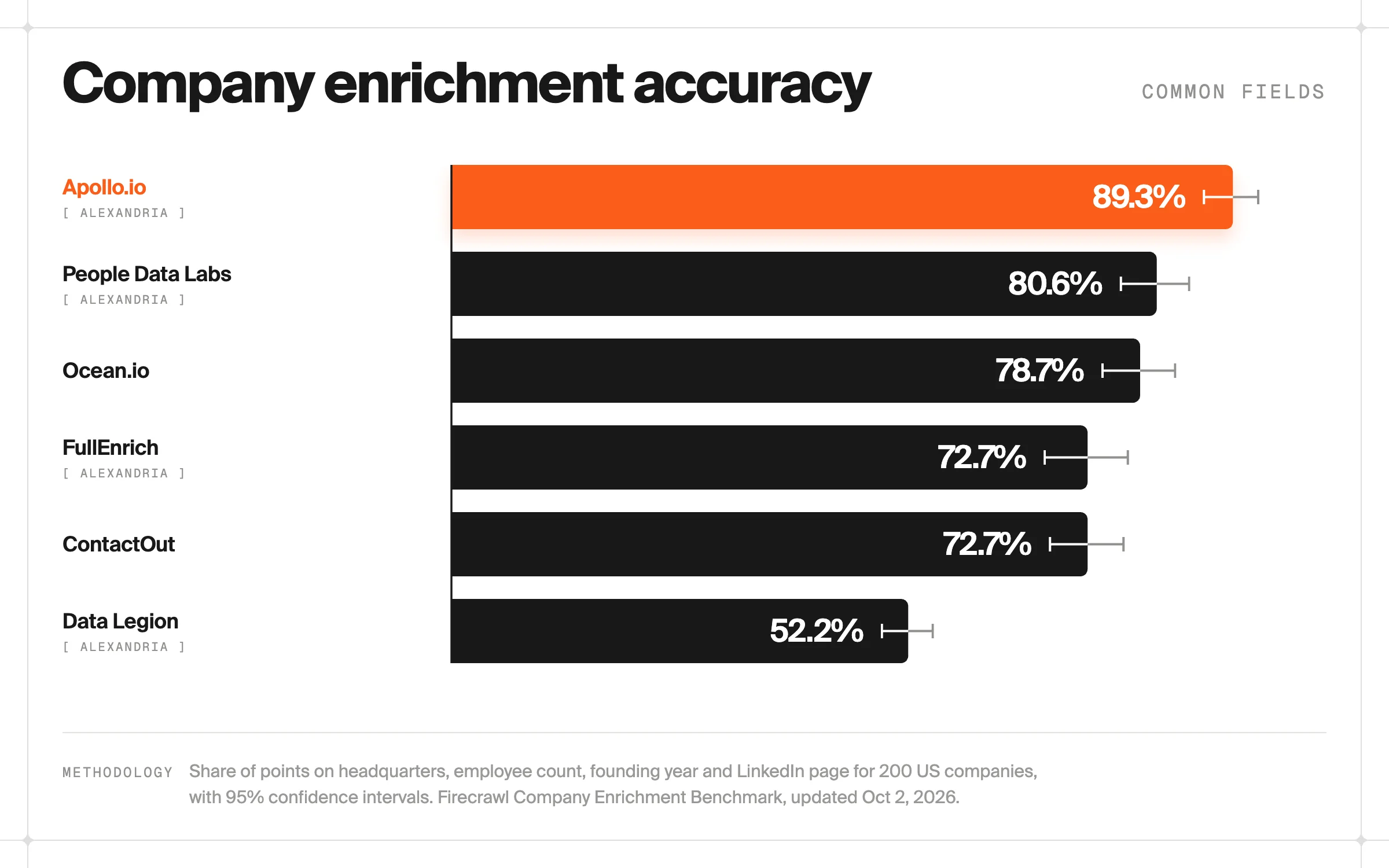
Third-party company data is one place where those connections already exist. In Firecrawl's company enrichment benchmark, six providers filled in profiles for 200 US companies, scored against SEC filings, federal records and company websites. Apollo.io ranked first at 89.3% on the four common fields, 8.7 points ahead of the next provider. Four of the six, Apollo.io, People Data Labs, FullEnrich and Data Legion, are available in Firecrawl Alexandria. Your agent reaches all four with one API key, and one /scrape request can call up to 10 provider tools at once.
Firecrawl measured the difference in September 2026. Across 845 tasks with the same model and prompts, agents using Firecrawl Alexandria scored 21% higher on answer quality, judged blind, than agents using built-in web tools.
How does Firecrawl Alexandria work as a data connector?
Firecrawl Alexandria gives AI agents one way to find a data source, see what it holds and pull from it through the Firecrawl API. Your agent searches for tools, reads a tool's inputs, response shape and credit price, then runs it with /scrape. Discovery is free, and execution costs the price listed on the tool.
You can connect Firecrawl Alexandria in three ways:
- API and SDKs. Call
/searchand/scrapefrom your own code in Python, Node.js or cURL. The walkthrough below uses this route. - MCP server. Add the Firecrawl MCP server to Claude Code, Cursor, Codex or another MCP client. The same flow runs through its
firecrawl_search,firecrawl_find_toolsandfirecrawl_scrapetools. - ChatGPT plugin or Claude connector. Install Firecrawl in ChatGPT or Claude and ask in plain language. The assistant finds the right Firecrawl Alexandria tool and calls it for you.
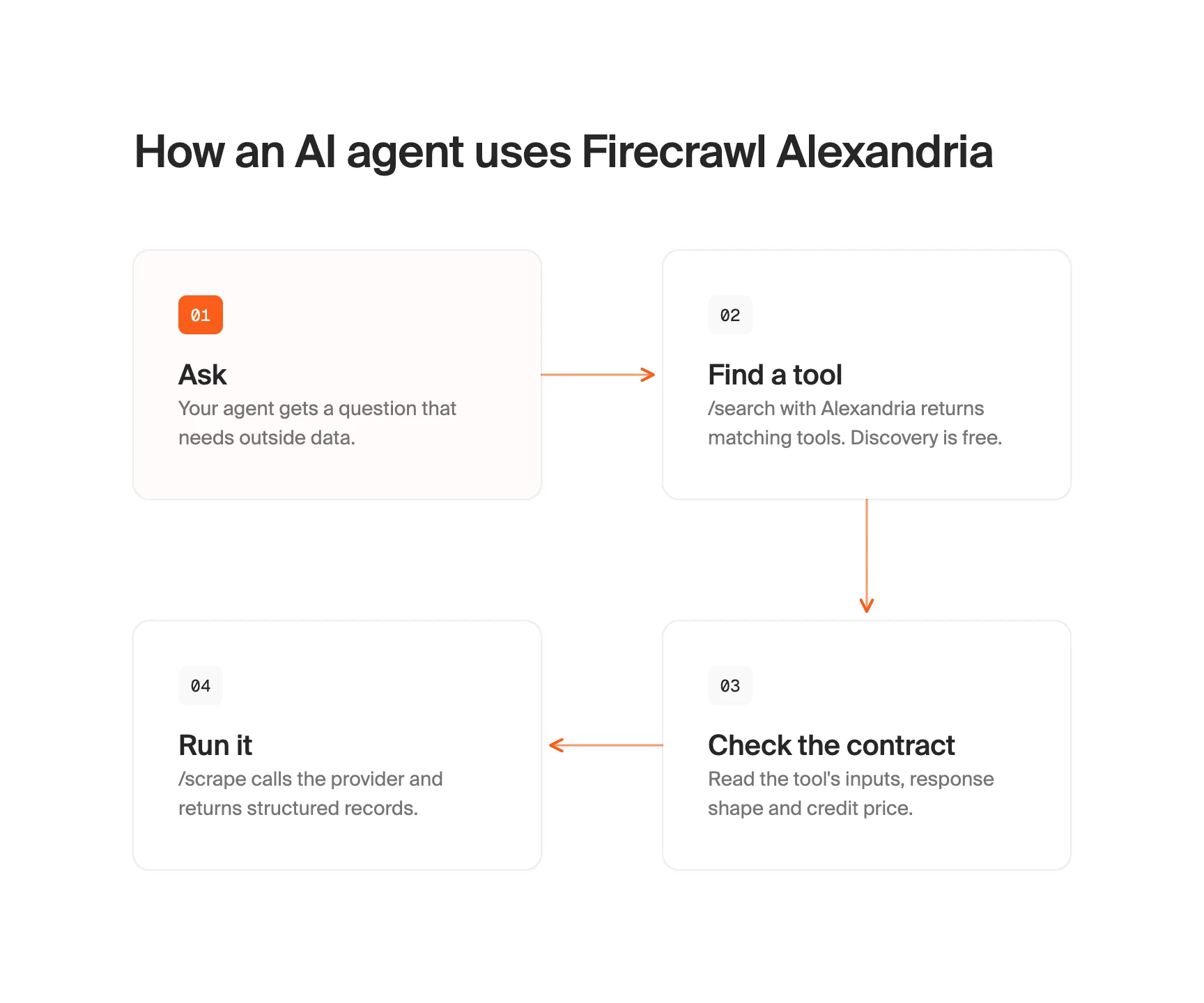
1. Find a tool. Add alexandria to the sources of a /search call. Results include web pages plus ranked tools, each with its provider, capability, inputs and price.
from firecrawl import Firecrawl

firecrawl = Firecrawl(api_key="fc-YOUR-API-KEY")

result = firecrawl.search(
    "Microsoft quarterly income statement",
    sources=["web", "alexandria"],
    limit=3,
)
2. Check what it needs. Each tool returns its options and response contract. Fiscal.ai's income statement tool, for example, takes a ticker and exchange (or another identifier) and an optional periodType such as quarterly. It costs 15 credits per call.
3. Get the data. Call the tool through /scrape with the provider and capability. No URL is needed.
statement = firecrawl.scrape(
    alexandria={
        "provider": "fiscal-ai",
        "capability": "financials/income-statement",
        "options": {
            "ticker": "MSFT",
            "exchange": "NASDAQ",
            "periodType": "quarterly",
        },
    },
)

print(statement.alexandria[0].data)
The same three steps work from the Firecrawl CLI. Firecrawl's /agent endpoint can also call your team's connected providers by itself while it researches a question.
Firecrawl Alexandria runs through the same Firecrawl API that has served more than 5 billion requests to date. Firecrawl is SOC 2 Type II compliant, and Enterprise plans add a DPA, SAML SSO and custom concurrency for teams with procurement requirements. The security page has the details.
Which data sources can you connect through Firecrawl Alexandria?
Firecrawl Alexandria connects AI agents to official data providers, including Apollo, FullEnrich, Fiscal.ai, Benzinga and Particle, plus Firecrawl's own Research, Developer and Government indexes and the live web. Providers are paid under agreement when agents pull their data. Every tool lists its credit price before you call it.
The table below shows a few of them. Firecrawl Alexandria gives your agent 100+ data providers and specialized indexes, grouped into the categories listed after it.
| Provider | What your agent can get | Example price (Oct 2026) |
|---|---|---|
| Apollo | Company search and enrichment, people search, contact details, job postings | People search 0 credits; person match 30 |
| FullEnrich | Company lookup and search, work and personal contact details | Company lookup 5 credits per record |
| Fiscal.ai | Standardized financial statements, earnings call transcripts, ownership, fund letters | Income statement 15 credits; transcript 30 |
| Benzinga | Wire news, press releases, analyst ratings, M&A calendar | Press releases 15 credits; news search 30 |
| Particle | Podcast episodes, mentions, sponsors and ad placements | Company directory 5 credits; sponsor profile 25 |
| Wikipedia | Wikipedia articles and Wikidata items through our Wikimedia Enterprise agreement | Article lookup 1 credit per record |
Firecrawl Alexandria groups its providers and indexes into these categories:
| Category | What your agent can get |
|---|---|
| Companies | Company records, filings, funding and firmographics |
| People | The people at a company, their roles and contact details |
| Jobs | Job postings by role, location and posting date |
| Finance | Market prices, financial statements, ownership and macro rates |
| News | News articles, newswires and their archives |
| Podcasts | Episodes, transcripts, guests and sponsors |
| Research | Scientific papers, abstracts, full-text passages and citations |
| Developer | Developer documentation, repositories, code and agent skills |
| Software | Package versions, licenses, downloads and dependents on npm, PyPI, crates.io and Maven Central |
| AI models | Model and dataset cards, licenses, downloads and files |
| Knowledge | Encyclopedic articles, entity facts and definitions |
| Government | Federal funding and procurement opportunities, eligibility and deadlines |
| Political science | Democracy and regime indices by country and year, with codebooks |
| Health | Population health statistics such as life expectancy, mortality and immunization coverage |
| Healthcare | Healthcare provider and facility records, specialties, licenses and locations |
| Life sciences | Proteins and their structures, gene expression data, bioactive molecules and drug targets |
| Education | Official indicators on schooling, literacy and education spending |
| Energy | Official energy supply, demand, generation, emissions and price series |
| Agriculture | Crop and livestock production, producer prices, trade and food security data |
| Marketing | Website traffic, search trends, audience insights and podcast sponsorships |
| Digital intelligence | Website traffic, audience and competitive search data |
| Apps | App Store and Google Play listings, ratings, reviews, charts and version history |
| Places | Local businesses near an address, with hours, phone, website, rating and review count |
| Restaurants | Restaurant locations and opening hours |
| Travel | Hotels, guest ratings, destination rankings and public reviews |
| Real estate | Property records and home valuation comparables |
| Automotive | Cars for sale from dealers and private sellers, with listing details and book values |
| Shopping | Products, prices and customer reviews |
| Sports | Tournament calendars, match results and player rankings |
| Entertainment | Ratings, cast and release dates for films, TV shows, books and games |
| Skills | Instructions that help agents use specific websites |
Browse every category and its providers on the Firecrawl Alexandria page. For contact data in more depth, see the people enrichment launch and our company enrichment API comparison.
Some providers ask an org admin to accept their terms once in the Firecrawl dashboard. Until then, a call returns an error with a link to the terms page. Accepting binds your team to that provider's terms of service.
What can you ask ChatGPT and Claude to do with Firecrawl Alexandria?
With the Firecrawl plugin in ChatGPT or the Firecrawl connector in Claude, you can ask for data from Firecrawl Alexandria providers in plain language. The assistant finds the matching tool, shows its credit price and runs it. In ChatGPT, start the prompt with @firecrawl. In Claude, start it with "Use Firecrawl".
Find someone's work email with FullEnrich and Apollo:
Use Firecrawl to find Jane Doe's work email at example.com through
Firecrawl Alexandria. Try FullEnrich first, then Apollo's free people
search, and show me each tool's price before you run it. Return the
email, the status the provider gave it and her current title.
Full walkthroughs: ChatGPT and Claude.
Brief yourself on a public company with Fiscal.ai:
Use Firecrawl Alexandria to pull NVIDIA's last four quarterly income
statements from Fiscal.ai, plus three quotes from management on the
latest earnings call. Tell me what each tool costs first, and use only
numbers the tools return.
Full walkthroughs: ChatGPT and Claude.
Track analyst rating changes with Benzinga:
Use Firecrawl to list every analyst upgrade, downgrade and price target
change on AAPL in the last 30 days, using Benzinga's data in Firecrawl
Alexandria. Include the date, firm and old and new rating, and show tool
prices before running anything.
Full walkthroughs: ChatGPT and Claude.
Find sponsors for a podcast with Particle:
Use Firecrawl to find ten advertisers that sponsor shows like Pivot but
haven't sponsored it yet, using Particle's podcast advertising data in
Firecrawl Alexandria. Include when each one last ran an ad, and show tool
prices first.
Full walkthroughs: ChatGPT and Claude.
How do you choose a data connector approach for your agent?
Choose a vendor API when one source matters most and you need every endpoint it offers. Choose a vendor's MCP server when you already license that vendor. Choose a catalog like Firecrawl Alexandria when your agent's questions range across companies, people, finance and news, and you'd rather not maintain an integration and invoice per source.
Four questions narrow it down:
- How many sources will the agent touch in a month? One or two favors direct integration. Five or more favors a catalog.
- Does the agent know the source in advance? If a human always picks the source, a fixed integration works. If the agent decides per question, it needs discovery and tool descriptions.
- Who pays, and how? Per-vendor contracts suit steady, high-volume use of one source. Per-call credits suit agents whose usage moves between sources.
- Do you already hold a license? If your team pays a vendor today, keep using that contract through its own API or MCP server.
The approaches also combine. You can call one licensed vendor directly and route everything else through Firecrawl Alexandria, alongside web search and scraping for anything that lives on a public page.
How much do data connectors cost in Firecrawl Alexandria?
Firecrawl Alexandria charges nothing for discovery and charges each tool's listed credit price when it runs. Prices range from free lookups, such as Apollo people search, to higher-priced records, such as mobile numbers. Every response reports the credits it used, and calls that return an error report 0.
Credits come from your Firecrawl plan. The Free plan includes 1,000 credits a month, and the Hobby plan is $19 a month (or $16 a month billed annually) for 5,000 credits. Firecrawl Alexandria needs an API key, so it isn't available on keyless requests.
Getting started with Firecrawl Alexandria
You can try Firecrawl Alexandria inside an assistant you already use. Install the Firecrawl plugin for ChatGPT or the Firecrawl connector for Claude, then ask for something the web alone can't answer, such as "Use Firecrawl to pull Microsoft's last four quarterly income statements and compare gross margin."
To give your own agent the CLI and skills, ask it to run:
npx -y firecrawl-cli@latest init --all --browserThen restart the agent. The Alexandria docs cover the SDKs, the MCP tools and provider terms.
Frequently Asked Questions
What is a data connector in simple terms?
A data connector is software that links one system to a data source so the two can exchange records without custom code each time. In data engineering it usually copies data into a warehouse. For AI agents it gives the agent a way to look something up in an outside source while it answers a question.
Is an MCP server a data connector?
An MCP server is one way to package a data connector. It exposes a source's actions as tools an AI agent can call over the Model Context Protocol. You still need an account, credentials and billing for each source behind it, so an agent that uses many sources is simpler to run through one catalog.
Do I need a contract with each data provider to use Firecrawl Alexandria?
You use one Firecrawl API key and pay in Firecrawl credits at each tool's listed price. Some providers ask an org admin to accept their terms in the Firecrawl dashboard before the first call, and accepting those terms binds your team to that provider's terms of service.
How much does a data connector call cost in Firecrawl Alexandria?
Discovery is free. Each tool lists its credit price before you run it, and you pay that price only when the tool runs. Calls that return an error report 0 credits used.
Can ChatGPT or Claude use data connectors?
Yes. ChatGPT and Claude both support connectors and plugins. With the Firecrawl plugin or connector installed, either assistant can find a Firecrawl Alexandria tool for your question and call it, alongside regular web search and scraping.