TL;DR: Best Company Enrichment APIs
| Provider | Best for | Firecrawl benchmark (common fields) |
|---|---|---|
| Firecrawl Alexandria | Calling Apollo, People Data Labs, FullEnrich, and Data Legion from every agent with one key | Includes the top scorer |
| Apollo.io | The most accurate company records | 89.3% |
| People Data Labs | Deep firmographic schema, SQL search | 80.6% |
| Ocean.io | Lookalike accounts and industry labels | 78.7% |
| FullEnrich | Company context alongside contact waterfalls | 72.7% |
| ContactOut | Company and contact data from one vendor | 72.7% |
| Data Legion | Cheap identity matching, never the wrong company | 52.2% |
| PredictLeads | Matching every domain in a list | Not tested |
| Explorium | Employee band accuracy | Not tested |
| ZoomInfo | Enterprise teams already on contract | Not tested |
| Clay | Waterfalls across many providers in a table | Not tested |
You hand an API a company domain and ask for the basics: where is it headquartered, how many people work there, when was it founded, what is its LinkedIn page. The answers look clean until you load them into your CRM and find a 30-person startup tagged as a 5,000-person enterprise, a subsidiary filed under its parent, and a headquarters that moved two years ago.
For a long time there was no way to know which vendor got this right more often, because every vendor tested itself. That changed in 2026, when two public benchmarks scored company enrichment providers on the same inputs against a reviewed answer key:
- Firecrawl's company enrichment benchmark ran six providers on 200 US companies (150 public, 50 private) and scored seven fields against SEC filings, federal labor and pension records, and company websites. Apollo.io came first at 89.3% on the four headline fields, 8.7 points ahead of the next provider.
- The independent Openbenchmarks company enrichment board ran 11 APIs on 282 companies, including subsidiaries and recent rebrands. People Data Labs had the highest enrichment success rate (89.0%), and Apollo the highest accuracy on the fields it returned (92.6%).
- Employee count was the hardest field in Firecrawl's run, averaging 57% across providers. When providers missed, they mostly guessed low.
This post ranks the best company enrichment APIs using those two benchmarks. Vendors that neither benchmark tested, such as Clay, are included based on how popular they are and how often users recommend them in online reviews and GTM community threads.
What is a company enrichment API?
A company enrichment API turns a company identifier into a company profile. The identifier is usually a website domain, sometimes a name, ticker, or LinkedIn URL. The profile is firmographic data: headquarters, industry, employee count, founding year, LinkedIn page, and depending on the vendor, revenue, funding, tech stack, and headcount growth.
Most providers sell two calls:
- Enrichment: you know the company and want its profile, so you send a domain and get one record back.
- Search: you know the shape of the company you want (industry, size, location, technology) and want a list of matches. This is how teams build account lists for outbound or LinkedIn Ads targeting.
Company enrichment is a different product from contact enrichment (finding a person's work email or phone). Many vendors sell both, and both benchmarks in this post measure only the company side. If you need people, our people enrichment launch post covers Apollo, FullEnrich, and Data Legion for contacts.
How the two benchmarks measure accuracy
The two boards use different companies and different metrics, which moves some providers up or down.
Firecrawl's benchmark gives each provider only a company's website, one lookup per company. The answer key was built from primary sources and frozen before any provider was called. Four common fields make up the headline score: headquarters, employee count, founding year, and LinkedIn page, all scored by code. Three extra fields (industry, stock ticker, revenue) count toward an all-fields score. A missing answer counts as wrong, so the score reflects coverage as well as accuracy. The harness and a 102-company public sample are on GitHub.
Openbenchmarks uses a harder cohort: well-documented large companies, small international companies, subsidiaries, and companies that recently rebranded. It scores five fields and reports several metrics side by side without a single overall rank. Enrichment success rate counts correct fields over all fields with a verified reference. Field accuracy counts correct fields over the fields a provider actually returned, which tells you how often a returned value is wrong.
The table lists the providers discussed here that were tested on either board.
| Provider | Firecrawl: common fields | Firecrawl: all fields | Openbenchmarks: success rate | Openbenchmarks: field accuracy |
|---|---|---|---|---|
| Apollo.io | 89.3% | 81.6% | 88.6% | 92.6% |
| People Data Labs | 80.6% | 72.0% | 89.0% | 91.2% |
| Ocean.io | 78.7% | 64.9% | Not tested | Not tested |
| FullEnrich | 72.7% | 59.6% | Not tested | Not tested |
| ContactOut | 72.7% | 60.6% | Not tested | Not tested |
| Data Legion | 52.2% | 54.1% | Not tested | Not tested |
| PredictLeads | Not tested | Not tested | 80.6% | 86.5% |
| Explorium | Not tested | Not tested | 70.5% | 87.6% |
| ZoomInfo | Not tested | Not tested | 63.9% | 70.4% |
Sources: Firecrawl company enrichment benchmark (updated October 7, 2026) and the Openbenchmarks company enrichment board (updated September 15, 2026).
Apollo and People Data Labs come first on both boards. Below them the order depends on which fields you care about, which is why each provider section below names the job it fits.
The best company enrichment APIs in 2026
1. Firecrawl Alexandria
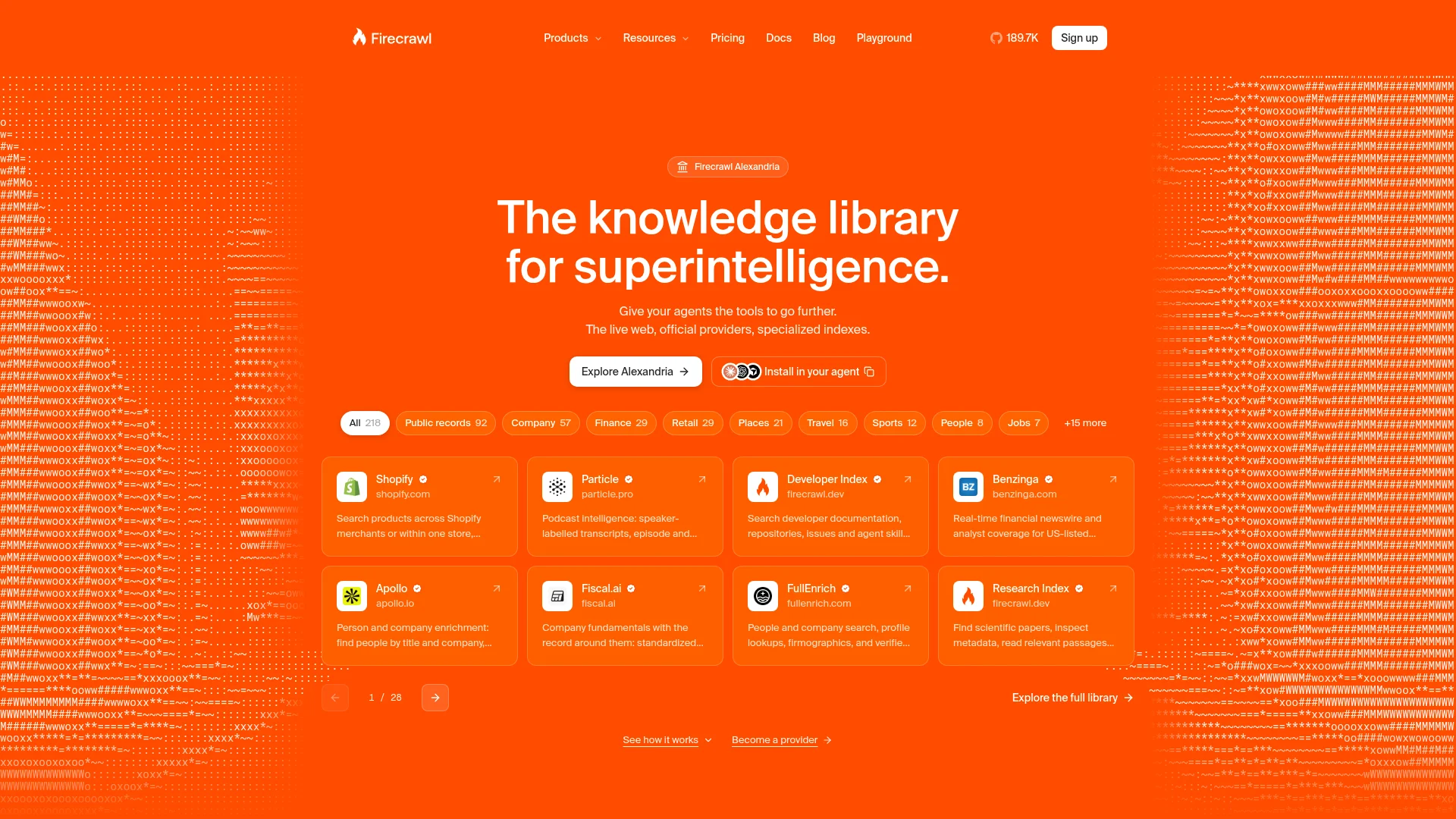
Firecrawl Alexandria is a library of official data providers your agent can search and call through the same Firecrawl API it uses for web search and scraping, including four of the six providers in the company enrichment benchmark.
Apollo.io, People Data Labs, FullEnrich, and Data Legion are all available in Firecrawl Alexandria. That includes Apollo, the top scorer on Firecrawl's benchmark. On six of the seven fields, the best provider inside Firecrawl Alexandria scored higher than the best provider outside it; the one exception is industry, where Ocean.io leads.
Much of the work in enrichment is wiring each provider into every place your team runs agents: Claude, ChatGPT, Cursor, and whatever internal agent your RevOps team built, each with its own key and schema. With Firecrawl Alexandria you connect Firecrawl once, and every agent on that connection can find a provider, see what it costs, and call it. Ask Claude to enrich a list of accounts and it reaches the same providers your production pipeline calls.
This video shows Firecrawl in ChatGPT used for lead generation:
- Company enrichment providers: Apollo (company enrichment, bulk enrichment of up to ten companies per call, and company search), People Data Labs (company enrichment and attribute search), FullEnrich (company lookup and search), and Data Legion (base and premium company enrichment)
- Free discovery: describe the data you need and Firecrawl Alexandria returns matching capabilities, ranked, with their inputs and credit price, and you pay only when you run one
- One key, one bill: every provider is called with your Firecrawl key and billed in Firecrawl credits at the price listed on the tool, with no second API key to rotate
- Official registers next to commercial data: Companies House officers and filings sit in the same catalog, so a UK director lookup and an Apollo firmographic call go through one connection
/agent,/search, and/scrape: for the fields no database holds, such as a pricing page, a new product line, or last week's funding announcement, the same API reads the live web. Our company funding data benchmark write-up shows how that live-web read compares with stored databases on recent rounds/monitor: watch a target account's pages for changes and re-enrich when something moves
Company calls cost the following in Firecrawl credits, as listed in the catalog on October 9, 2026:
| Provider | Capability | Credits |
|---|---|---|
| Apollo | Company enrichment | 30 per call |
| Apollo | Bulk company enrichment (up to 10) | 30 per matched company; unmatched are free |
| People Data Labs | Company enrichment | 50 per call |
| FullEnrich | Company lookup | 5 per record |
| Data Legion | Company enrichment (base / premium) | 10 / 40 per call |
Install:
# CLI and skills, wired into Claude Code, Codex, Cursor, and other agents
npx -y firecrawl-cli@latest init --all --browser

# Python SDK
pip install firecrawl-py

# MCP server: add this URL as a remote server in any MCP client
# https://mcp.firecrawl.dev/v2/mcp-oauth
In ChatGPT and Codex, install the Firecrawl plugin. In Claude, add the Firecrawl Claude connector.
Example:
from firecrawl import Firecrawl

firecrawl = Firecrawl(api_key="fc-...")

# Find the right provider for the job (discovery is free)
tools = firecrawl.search(
    "enrich a company from its domain: headcount, HQ, industry, revenue",
    sources=["alexandria"],
)

# Enrich up to ten accounts in one Apollo call
result = firecrawl.scrape(
    alexandria={
        "provider": "apollo",
        "capability": "companies/bulk-enrich",
        "options": {"domains[]": ["stripe.com", "ramp.com", "vercel.com"]},
    }
)
for org in result.alexandria[0].data["organizations"]:
    print(org["name"], org["estimated_num_employees"], org["city"])
An agent can do the same from a prompt such as "Enrich these 50 domains with headcount, HQ, and industry using Apollo, and flag any where the employee count looks off."
Honest take: Firecrawl Alexandria doesn't hold its own firmographic database, so the accuracy you get is the accuracy of the provider you call, which is why the benchmark matters. Where it helps is in switching and combining providers. You can run Apollo as your default, fall back to People Data Labs when Apollo misses, and test a third provider on 50 accounts, all without building a new integration.
Cons: Firecrawl Alexandria needs a Firecrawl account; it isn't available in keyless sessions.
Full reference at firecrawl.dev/alexandria, the docs at docs.firecrawl.dev/features/alexandria, and the provider catalog at firecrawl.dev/app/alexandria.
2. Apollo.io
Apollo.io is a sales platform with a company and contact database, and the most accurate company enrichment API on both benchmarks.
Apollo scored 89.3% on the four common fields in Firecrawl's benchmark, 8.7 points ahead of the next provider, and had the highest score on six of seven fields. Its biggest lead is employee count: 77.2%, 20.7 points ahead of Ocean.io. It is also the only provider whose revenue figures for public companies landed within 5% of the filed number most of the time (82.8%; no other provider scored above 8%). On Openbenchmarks it had the highest field accuracy (92.6%), which means when Apollo returns a value, it's right more often than anyone else's.
Organization Enrichment: domain, name, website, or LinkedIn URL in; industry, revenue, employee count, department headcounts, technologies, funding events, and full HQ address outBulk Organization Enrichment: up to ten companies per callOrganization Search: filters on headcount, location, revenue, technologies, funding, job postings, headcount growth, and lookalikes of companies you name- Free tier: 900 credits per seat per year, with API access
- Database claim: 30M+ accounts, per Apollo's homepage
Install:
# Direct
curl "https://api.apollo.io/api/v1/organizations/enrich?domain=stripe.com" \
  -H "x-api-key: $APOLLO_API_KEY"

# Or through Firecrawl Alexandria with your Firecrawl key
npx -y firecrawl-cli@latest init --all --browser
Honest take: If you're picking one company enrichment API today, the evidence points to Apollo. It leads on the fields that drive routing and scoring (headcount and HQ), and its revenue numbers are the only ones in the benchmark close enough to use for public companies. The free tier with API access makes it easy to test.
Cons: Industry is its weak spot. It ranked last of six at 53.4%, mostly because it returns broad labels like "information technology & services". If you segment by industry, pair it with Ocean.io or People Data Labs. Free API access requires an account registered with a work email.
Reference: docs.apollo.io.
3. People Data Labs
People Data Labs is a data provider with a deep company schema and a search API you can query in SQL.
People Data Labs scored 80.6% on the common fields in Firecrawl's benchmark, statistically tied with Ocean.io for second, and returned the correct LinkedIn page 98.8% of the time. On the independent Openbenchmarks board it had the highest enrichment success rate of all 11 APIs (89.0%) and the fastest median response (274 ms). Firecrawl's benchmark also found it guessed low on employee count for about half the companies where it returned one.
Company Enrichment: match on website, name, ticker, or social profile; returns employee count (including by country), industry, NAICS and SIC codes, location, founding year, ticker, LinkedIn URL, and funding totals- Premium fields: inferred revenue, funding details, headcount growth and churn, job postings, and parent and subsidiary companies
Company Search: Elasticsearch or SQL queries (SELECT * FROM company WHERE ...), up to 100 records per request- Free tier: up to 100 company records a month
Install:
curl "https://api.peopledatalabs.com/v5/company/enrich?website=stripe.com" \
  -H "X-Api-Key: $PDL_API_KEY"
Honest take: People Data Labs is the provider I'd pair with Apollo. It covers the long tail and international companies well (that's where its Openbenchmarks lead comes from), its schema includes corporate hierarchy and headcount by country, which few providers here return, and SQL search is a pleasure if your team thinks in queries.
Cons: Revenue is a premium field, and the base revenue ranges almost never matched filed figures within 5% (4.8%). The free tier is rate-limited to 10 enrichment requests per minute, and company search defaults to 10 requests per minute.
Reference: docs.peopledatalabs.com.
4. Ocean.io
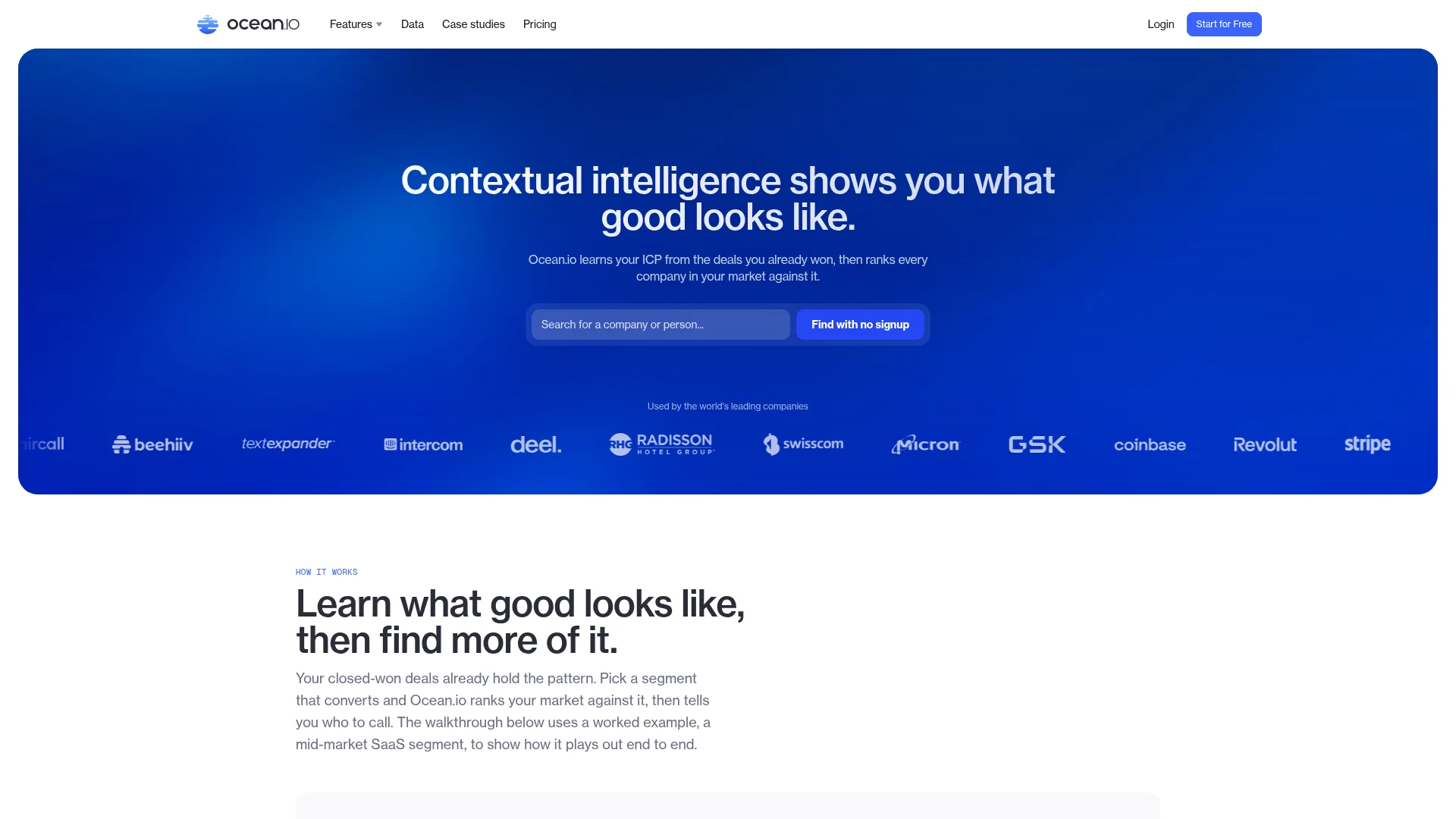
Ocean.io is a company data platform built around lookalike search, which finds companies similar to the customers you give it.
Ocean.io scored 78.7% on the common fields in Firecrawl's benchmark, tied with People Data Labs for second, and had the best industry labels of any provider (69.2%). It returns fields the others don't, such as web traffic, department sizes, and EU legal-entity data.
Enrich Companies: domain, name, or LinkedIn URL in; up to 10,000 companies per request, delivered to a webhook- Fields include industries, employee count, revenue, founding year, technologies, web traffic, funding round, headcount growth over 3, 6, and 12 months, and department sizes
Lookalike search: seed with domains, then filter by industry, size, technology, location, and revenue- Database claim: 67M company profiles, per Ocean's API page
Install:
# Ocean.io API: sign up for a key at ocean.io/api, then see the reference at
# https://app.ocean.io/docs/enrichCompanies
Honest take: Ocean is the best choice when the job is finding new accounts that look like your best customers, which is the starting point for most ABM and LinkedIn Ads lists. Its industry labels are the most accurate measured, which matters if you segment campaigns by vertical.
Cons: Enrichment is asynchronous (webhook only), so it doesn't fit a request-response flow. Dollar pricing isn't public. Revenue landed within 5% of the filed figure only 2.1% of the time in the benchmark. It isn't available in Firecrawl Alexandria.
Reference: ocean.io/api.
5. FullEnrich
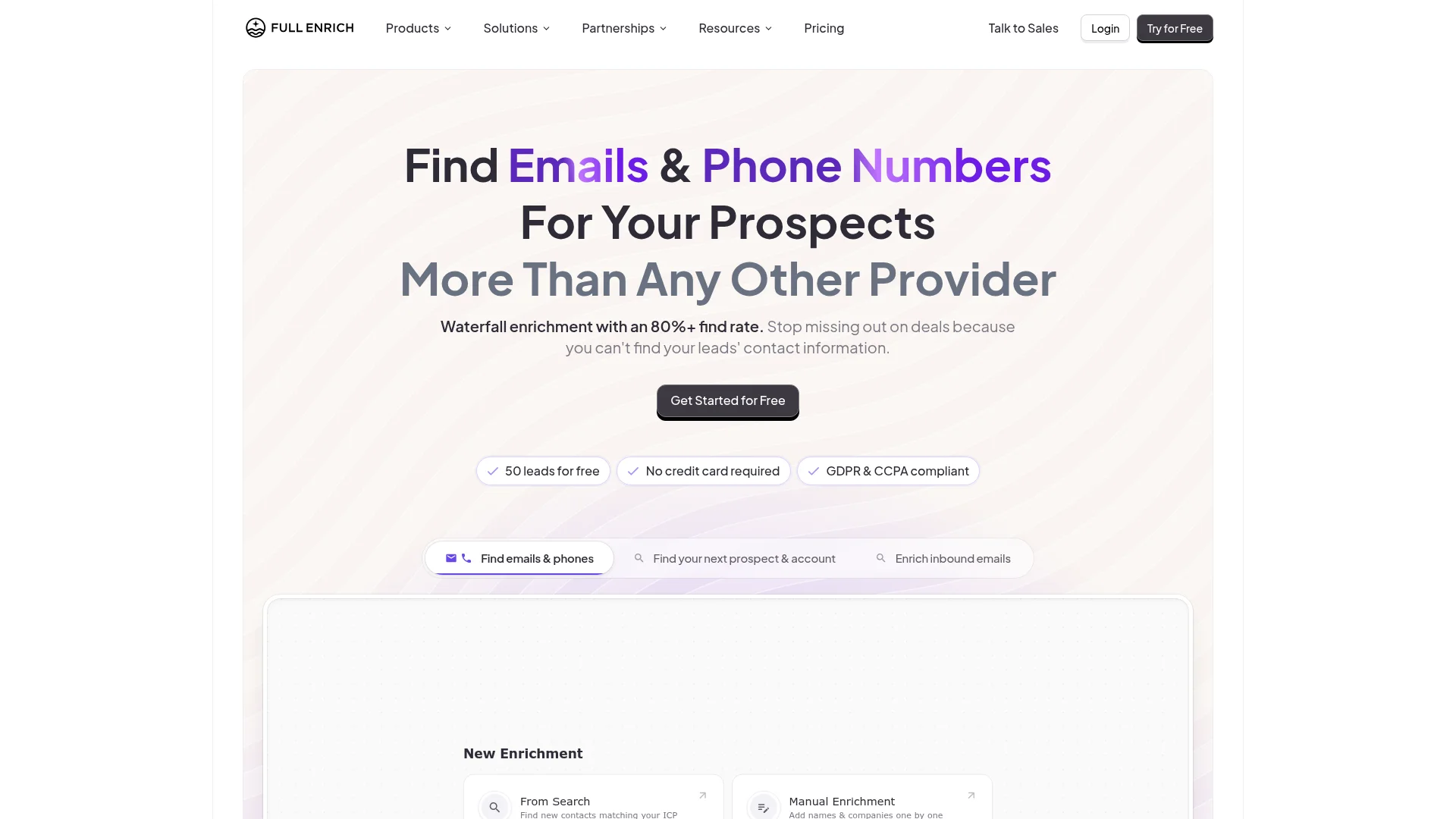
FullEnrich is a contact enrichment waterfall across 20+ data sources that also returns company profiles.
FullEnrich scored 72.7% on the common fields, tied with ContactOut for fourth. Its main product is contact data, found by querying many providers in sequence for emails and phone numbers and charging only when it finds one. Company lookup and search come with the same account.
Company search: filter by industry, technologies, headquarters location, founding year, and headcount, up to 100 results per call- Company fields: description, founding year, headcount and range, company type, locations, social profiles, technologies, and industry
- Through Firecrawl Alexandria, company lookup costs 5 credits per record, the cheapest company call in the catalog
- Pricing: Pro with API access starts at $29 a month for 500 credits
Install:
# Through Firecrawl Alexandria
npx -y firecrawl-cli@latest init --all --browser

# Direct API reference
# https://docs.fullenrich.com/api/v2/company/search/post
Honest take: Use FullEnrich when the company record is a step toward a contact, such as finding the right person at an account and their work email. As a standalone firmographic source, it trails Apollo by about 17 points.
Cons: The documented company output has no revenue or funding fields. The free trial doesn't include API access.
Reference: docs.fullenrich.com.
6. ContactOut
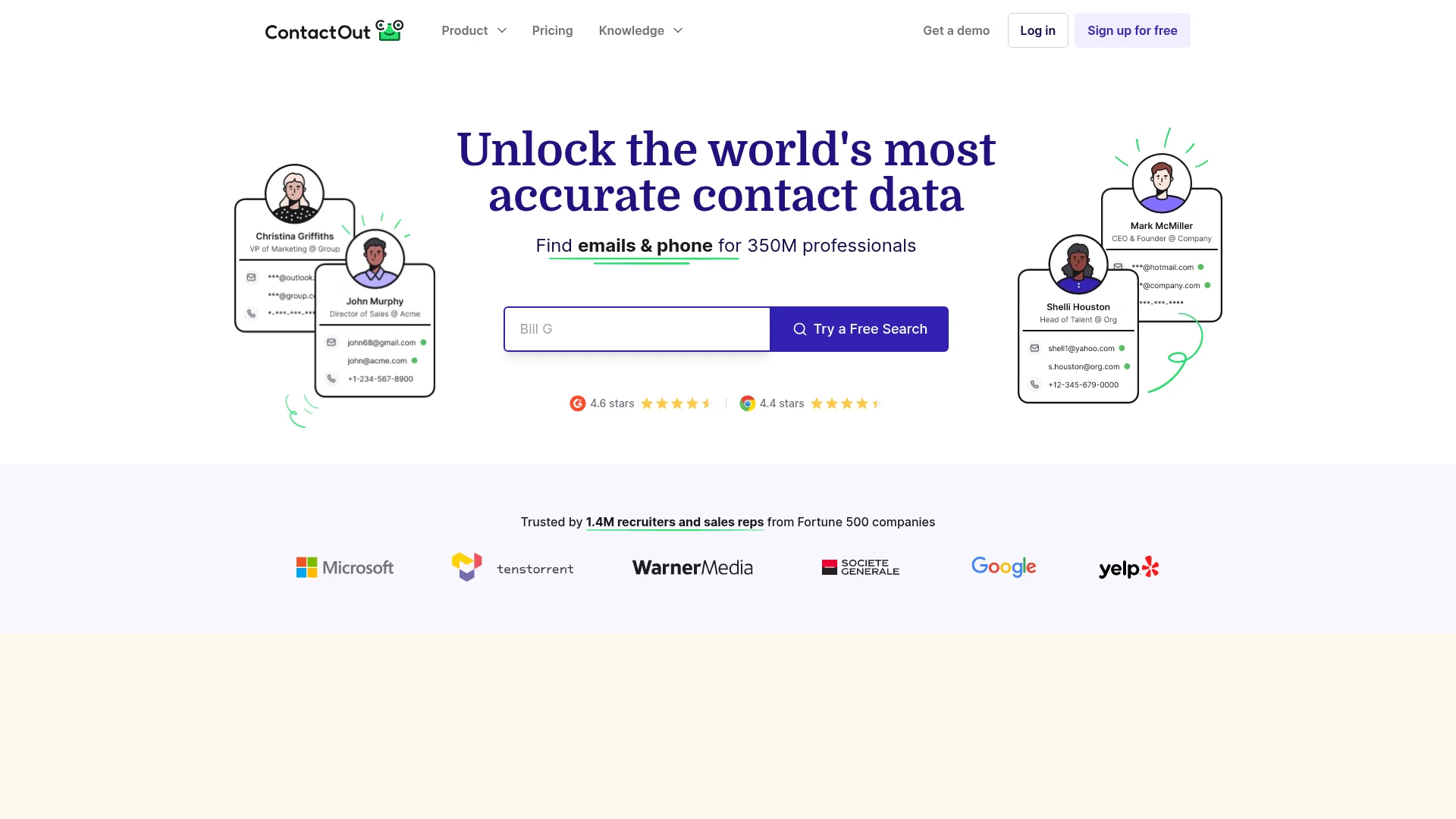
ContactOut is a contact data provider for recruiters and sales teams, with a company API that returns funding and revenue alongside firmographics.
ContactOut tied FullEnrich at 72.7% on the common fields. It was strong on LinkedIn pages (95.9%) and founding year (78.9%), and weakest on headquarters (64.7%).
Enrich Domain: up to 30 domains per call; returns HQ, size, founding year, industry, specialties, technologies, revenue, employees, and funding roundsCompany Search: filter by size, location, industry, technologies, revenue range, and founding year- Costs one search credit per company found
Install:
# API keys are issued after a call with ContactOut's team
# Reference: https://api.contactout.com/
Honest take: ContactOut fits teams that already use it for recruiting or contact data and want company context from the same vendor. On company data alone, it doesn't beat Apollo or People Data Labs on any common field.
Cons: There's no self-serve API pricing; you get a key by booking a meeting. Enrichment is capped at 30 domains per request. It isn't available in Firecrawl Alexandria.
Reference: api.contactout.com.
7. Data Legion
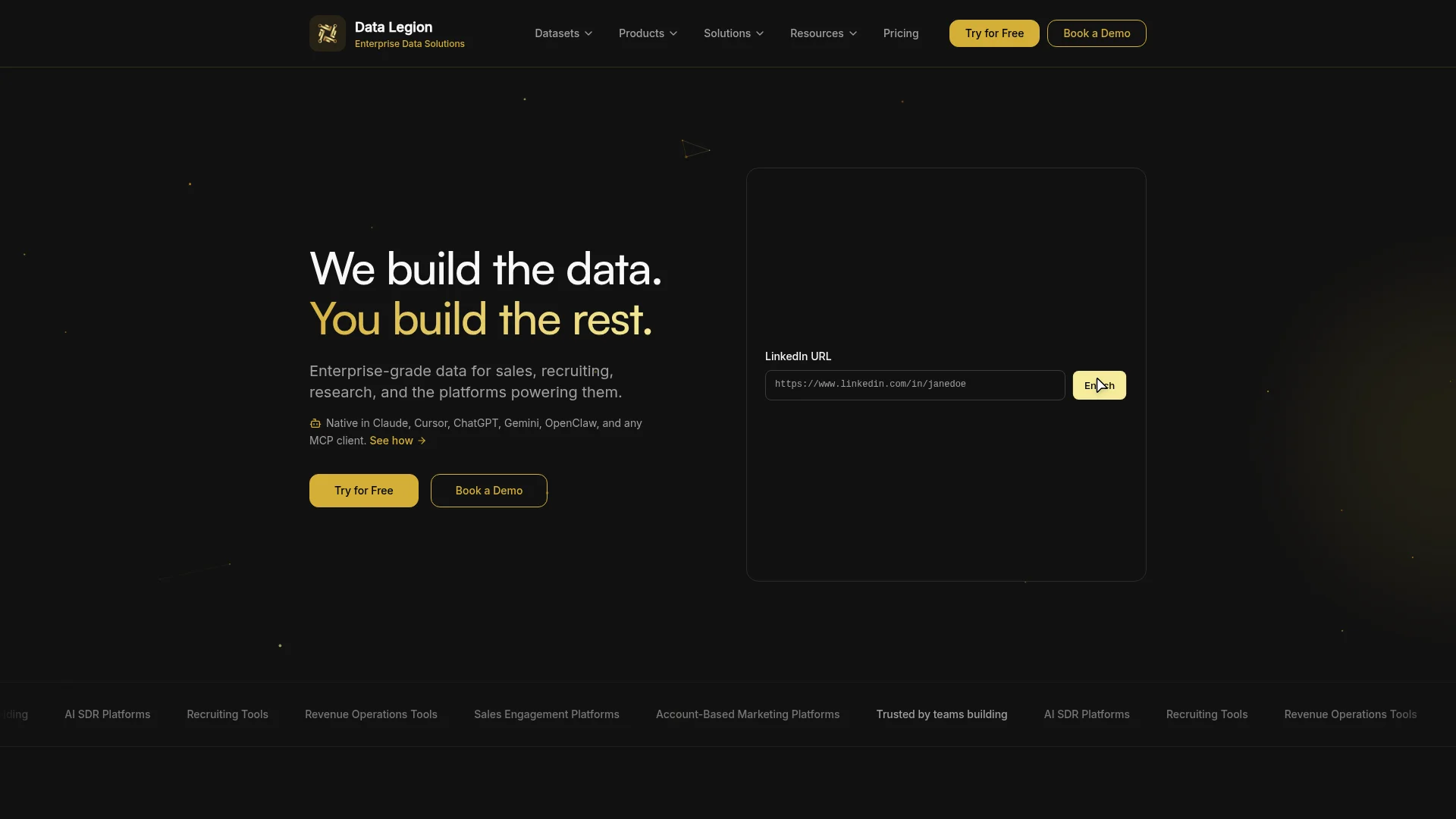
Data Legion is an identity-matching data provider with flat per-record pricing and the cleanest match record in the benchmark.
Data Legion scored last on the common fields (52.2%), largely because it doesn't return headquarters at all and a missing field counts as zero. On the fields it does return it scored well, with 95.9% on LinkedIn pages and 89.3% on stock tickers. It was also the only provider that never returned the wrong company out of 200.
Company Enrichment: six matching methods (domain, name, LinkedIn ID, social URL, ticker, Legion ID); returns 50+ firmographic and workforce data points, including headcount history and growth- Pricing: $0.01 per company record, $10 minimum, credits valid for 12 months
- Through Firecrawl Alexandria: base enrichment at 10 credits, premium at 40
- Database claim: 71M+ companies
Install:
# REST: POST https://api.datalegion.ai/company/enrich with an API-Key header
# CLI
datalegion-cli company enrich --domain stripe.com
Honest take: Data Legion is the provider to reach for when getting the identity right matters more than filling every field, such as deduplicating accounts or matching a messy list to clean records. It's also the cheapest per record of the providers with public pricing.
Cons: No headquarters field. Employee counts ran low for full credit at 72% of the companies where it returned one. Company search and natural-language discovery are enterprise-only.
Reference: datalegion.ai.
8. PredictLeads
PredictLeads is a company intelligence API built for AI agents, focused on company signals like hiring, news events, and technology changes.
PredictLeads wasn't in Firecrawl's benchmark. On Openbenchmarks it matched 100% of the 282 domains to a company, the best match rate on the board, with an 80.6% enrichment success rate. Its weakest field was headquarters (68.4%).
Extended companies dataset: one domain per request, returns firmographics plus signals- Delivered over API, MCP, webhooks, and flat files
- Pricing: 100 free API requests, then $0.04 per credit with a $40 monthly minimum (per Openbenchmarks' pricing review)
Install:
# One domain per request:
# GET https://predictleads.com/api/v3/extended_companies/{domain}
# Auth and setup: https://docs.predictleads.com
Honest take: If your list has a lot of obscure domains and the first problem is getting any match at all, PredictLeads resolves more of them than anyone measured. Its signals (job openings, news events) are useful triggers on top of the static profile.
Cons: It trails Apollo and People Data Labs on overall accuracy, and the $40 monthly minimum applies even at low volume.
Reference: docs.predictleads.com.
9. Explorium
Explorium is a B2B data platform for AI SDR and agentic GTM workflows, with business match and enrichment APIs.
Explorium wasn't in Firecrawl's benchmark. On Openbenchmarks it had the best employee-band accuracy of all 11 APIs (88.9%) and solid field accuracy (87.6%). Its overall success rate (70.5%) is lower because it returned nothing scorable for founding year.
Match businessesthenEnrich businesses: a two-step flow, domain to Explorium ID to profile- Pricing: $0.04 per credit on the entry paid tier (per Openbenchmarks' pricing review)
Honest take: If headcount bands drive your routing and territory design, Explorium measured best on exactly that field. Treat it as a specialist rather than your only source.
Cons: The two-step match-then-enrich flow adds a call per company, and it returns no founding year.
Reference: explorium-api.readme.io.
10. ZoomInfo
ZoomInfo is the incumbent enterprise B2B data platform, with company search and enrichment APIs sold under contract.
ZoomInfo's docs claim 100M+ companies, and its fields go beyond the basics into department budgets and growth rates. On Openbenchmarks' measured fields it scored 63.9% success rate and 70.4% field accuracy, behind the self-serve APIs above, with employee band its weakest field (47.9%). It was also the most expensive per new company record on that board ($0.35).
Search CompaniesthenEnrich Companies: search returns previews, enrich returns the full profile- Fields: employee count and growth, revenue, department budgets, industry with NAICS and SIC codes, HQ address, technology tags, and funding
- Pricing: not published; API access is through a sales contract
Honest take: If your company already pays for ZoomInfo, its API is worth wiring up before buying another source. If you're starting fresh and the job is firmographic accuracy, the measured numbers favor the self-serve APIs above.
Cons: No self-serve pricing, usage capped by contract, and the legacy API is being deprecated in favor of a new GTM API.
Reference: docs.zoominfo.com.
11. Clay
Clay is a GTM workflow platform that runs enrichment waterfalls across 150+ data providers inside a spreadsheet-like table.
Clay isn't a single enrichment API, so neither benchmark scores it directly. Its "Enrich Company by Domain" step tries one provider, then the next, until it finds a valid result. You can bring your own provider API keys to skip Clay's data credits.
- Waterfalls across 150+ providers, with no charge for a failed lookup
- Audiences for company search, from the Launch plan up
- Pricing: free tier with 100 data credits a month; Launch starts at $185 a month; data credits start at $0.05
Honest take: Clay is the right tool when a person, usually a GTM engineer, is building and inspecting lists by hand. Its accuracy is the accuracy of whichever providers you put in the waterfall, so the benchmark results above tell you which ones to put first.
Cons: It's priced on two meters (actions and data credits), which makes costs hard to predict. HTTP API integrations start on the Growth plan, and programmatic Clay API access is Enterprise-only, so it's an awkward fit for agents or production pipelines.
Reference: clay.com/pricing.
What about Clearbit?
Clearbit is now HubSpot's Breeze Intelligence, which enriches contacts and companies inside the HubSpot CRM. Clearbit sunset its free tools on April 30, 2025 and its Logo API on December 1, 2025, according to Clearbit's own announcement. If your stack is HubSpot, Breeze enrichment doesn't consume HubSpot credits. If you need enrichment outside HubSpot through a standalone API, Apollo and People Data Labs are the measured replacements.
Questions GTM teams ask about company and contact enrichment
These come from threads on r/SaaS, r/gtmengineering, r/LeadGeneration, r/CRM, r/n8n, r/datasets, and r/ClaudeAI.
What's the best enrichment provider for B2B? For company data, Apollo, then People Data Labs, based on two benchmarks that agree at the top. For contact data, no public benchmark exists yet, so test on your own list. The most common advice in r/LeadGeneration and r/gtmengineering is a waterfall across several providers, followed by email validation before you send, and stale records are the top complaint about every large database.
Where can I find a reliable API for company information, including the parent company? For general firmographics, Apollo or People Data Labs. For corporate hierarchy, People Data Labs exposes parent and subsidiary relationships as premium fields. Wrong-company records were rare in Firecrawl's benchmark (at most 3 of 200 per provider), and when they happened they usually described the parent or a similarly named company. Spot-check hierarchy fields before writing them to your CRM.
How do I find company director details? Use the official register. Companies House publishes UK officers and their appointments, and it's available as a provider in Firecrawl Alexandria. For US public companies, directors are listed in SEC proxy statements. Commercial databases carry executives, but the register is the source of record.
Can I get B2B company data from the Google Places API? Partly. Places returns name, address, phone, website, and category, which is enough to build a list of local businesses. It doesn't return headcount, revenue, industry codes, or LinkedIn pages, and as one r/B2BSaaS poster found, matching on messy company names breaks down at scale. Build the list from Places, keep the website, and send each domain to an enrichment API; a domain is a far more reliable key than a name.
Where do I get company lists for LinkedIn Ads ABM? Use a company search API to build the list (Apollo, People Data Labs, or Ocean.io's lookalike search), then upload it as a LinkedIn matched audience. Sales Navigator works for small lists but caps search results and has no export API. One r/PPC advertiser reported 80%+ match rates when the upload included company name, country, and website, all fields an enrichment API returns. Ocean's industry labels were the most accurate measured, which helps if you split campaigns by vertical.
What are the best datasets to match companies on size and turnover? Size: Apollo leads on employee count by 20 points in Firecrawl's benchmark, and Explorium leads on employee bands in Openbenchmarks. Turnover: Apollo is the only provider whose public-company revenue landed within 5% of the filed figure most of the time. Most others return revenue ranges, which are fine for bucketing and wrong for anything more precise.
How do teams use enrichment data in their CRM? Routing inbound leads by size and region, scoring accounts, building territories, and keeping records current. Enrich on record creation and again on a schedule, and never let a low-confidence enriched value overwrite something a rep typed. Apollo's high field accuracy matters most here, because a wrong value written back to the CRM is worse than a blank one.
Is there an API for people search, or a way to query LinkedIn's API for granular searches? LinkedIn's official APIs don't offer people or company search to general developers; profile and Sales Navigator data require partner approval. For people search by title, company, and location, Apollo's person search is free and FullEnrich searches by skills and past employers. Both are in Firecrawl Alexandria; see the people enrichment post for the details. Recruiters sourcing candidates can use the same pattern, searching by skills and work history and enriching only the shortlist.
How do I enrich HubSpot contacts with Claude without burning tokens? In the r/ClaudeAI thread, the poster traced the cost to Claude re-reading every contact on every step instead of working in batches. Two changes fix most of it: process records in small batches so each step carries only the rows it needs, and get firmographics from a structured enrichment call instead of having the model research each company on the web. Connect Claude to Firecrawl's MCP server, let it call Apollo's bulk enrichment (ten companies per call), and write the fields back to HubSpot, so the model reads a short JSON record per company instead of a full web page.
Building the top company enrichment APIs into your workflow
I'd run two providers. Apollo as the default, because it leads both benchmarks on accuracy and has the best headcount and revenue data. People Data Labs as the fallback for the long tail, international companies, and corporate hierarchy. Add Ocean.io if industry segmentation or lookalike prospecting drives your campaigns.
Then decide where enrichment runs. If it runs in one pipeline, a direct integration is fine. If it runs in Claude for your SDRs, in Codex for your GTM engineers, in Cursor for whoever is building the internal tool, and in a production job, connect Firecrawl Alexandria once and every one of those agents can reach Apollo, People Data Labs, FullEnrich, Data Legion, and the Companies House register with the same key and the same bill.
Before you commit, run your own list. Both benchmarks publish their harnesses: Firecrawl's and Openbenchmarks'. Your accounts may be more international, more private, or more recently rebranded than either cohort. For a curated view of top company enrichment APIs with every field broken out, the full benchmark page has per-field rankings and confidence intervals.
For related reading, the company funding data API benchmark covers the funding fields that most enrichment APIs get wrong on recent rounds, the B2B data enrichment guide walks through the full enrichment pipeline, and the AI SDR guide shows how to wire enrichment into an agent that writes outbound.
Frequently Asked Questions
What is a company enrichment API?
A company enrichment API takes a company identifier, usually a website domain, and returns a structured company profile: headquarters, industry, employee count, founding year, LinkedIn page, and often revenue, funding, and tech stack. Sales, marketing, and data teams use it to fill in CRM records, score and route leads, and size markets.
What is the best company enrichment API in 2026?
On Firecrawl's company enrichment benchmark of 200 US companies, Apollo.io scored highest at 89.3% on the four common fields, with People Data Labs and Ocean.io statistically tied for second. On the independent Openbenchmarks board of 282 companies, People Data Labs had the highest enrichment success rate (89.0%) and Apollo the highest field accuracy (92.6%). Apollo and People Data Labs are the two safest defaults.
What is the best B2B data enrichment provider for sales teams?
For company records, Apollo.io leads both measured benchmarks on accuracy and has a free tier with API access. For contact data on top of company data, Apollo, FullEnrich, and People Data Labs cover work emails and phone numbers. All three are available through Firecrawl Alexandria with one API key, so a team can test them side by side before committing to one.
How do teams use enrichment data in their CRM?
The common uses are lead routing (send an inbound lead to the right rep by company size or region), lead scoring (weight accounts by headcount, industry, and funding), territory and segment design, and keeping records current as companies grow, rebrand, or move. The safest pattern is to enrich on create, re-enrich on a schedule, and never let a low-confidence value overwrite a field a rep entered by hand.
Can I get a company's parent company from an enrichment API?
Some providers return it. People Data Labs exposes parent and subsidiary relationships as premium company fields, and Crustdata and ZoomInfo carry corporate hierarchy data. Wrong-company records were rare in Firecrawl's benchmark, and when they happened they described a parent or a similarly named company, so spot-check hierarchy fields before you trust them.
Can I use the Google Places API for B2B company data?
Only for part of the job. Google Places returns a business's name, address, phone number, website, and category, which works for local businesses. It does not return headcount, revenue, industry codes, funding, or LinkedIn pages. A common pattern is to build the list from Places, then send each website domain to a company enrichment API for the firmographics.
How do I find a company's directors?
For UK companies, Companies House publishes officers and their appointments for free, and Firecrawl Alexandria exposes that register as a provider. In the US, directors of public companies are listed in SEC filings such as the proxy statement. Commercial enrichment APIs return leadership contacts, but the official register is the source of record for directors.
Does LinkedIn have an API for company or people search?
Not for general developers. LinkedIn's open APIs cover Sign In with LinkedIn and sharing posts; profile data and Sales Navigator, Talent, and Marketing APIs require LinkedIn partner approval. An enrichment provider can return a company's LinkedIn page and headcount instead, and Apollo and People Data Labs both scored above 98% on returning the correct LinkedIn page in Firecrawl's benchmark.
Are company enrichment APIs free?
Several have free tiers. Apollo includes 900 credits per seat per year with API access, People Data Labs allows up to 100 company records a month, and PredictLeads includes 100 free API requests. ZoomInfo, ContactOut, and Crustdata sell API access through sales. Firecrawl Alexandria lets you call Apollo, People Data Labs, FullEnrich, and Data Legion with Firecrawl credits and shows the price of each call before you run it.
Is Clearbit still available as an enrichment API?
Clearbit is now part of HubSpot as Breeze Intelligence, which enriches contact and company records inside the HubSpot CRM. Clearbit sunset its free tools in April 2025 and its Logo API in December 2025. If you need enrichment outside HubSpot, through a standalone REST API, you will need another provider.