TL;DR: Best free web search APIs for AI agents
- Firecrawl keyless: Zero config, no signup or key, 1,000 free credits a month
- Exa: $20 signup plus $10 monthly in credits, no card
- Brave Search API: Independent web index, but a card is now required
- Diffbot: 10,000 free credits a month across a knowledge-graph stack, no card
A free web search API can mean two very different deals. One is hard-capped and simply stops when the credits run out; the other sits on a card and switches to metered billing the moment an agent overruns. Same label, different risk, and the gap shows up as a surprise invoice or a rate-limit wall halfway through a build.
This guide compares four of them on what actually decides a free tier: whether a card is required, whether the allowance refills, where the throughput ceiling sits, and how far each credit goes. These are the best free web search APIs for AI agents I would hand someone starting today, with an honest read on where each one runs out.
What "free" actually means for a search API
"1,000 free queries" tells you almost nothing on its own. Six things under the headline decide whether a free tier is actually usable:
| What to check | Why it matters | The green flag |
|---|---|---|
| Setup friction | Signup and key steps get in the way of quick tests and small jobs | Zero config: no account, no key to start |
| Is a card required? | A no-card tier cannot bill you if an agent loops overnight | No payment method on file |
| Does it refill, and is it stable? | Recurring credit sustains a project (usually no rollover); flat free tiers keep getting cut | Monthly refill from an established offer |
| Concurrency and rate limits | Throughput, not the credit count, stalls a free tier first, often at 2 concurrent requests | Enough requests per second for your fan-out |
| Where the index comes from | An owned index means continuity; a reformatted SERP inherits another engine's risk | Provider runs its own web index |
| Token efficiency | Dense output resolves a question in fewer calls, so the allowance lasts and the token bill stays low | Query-relevant excerpts, not thin snippets |
Why token efficiency decides which free tier lasts
Tokens are the currency that matters for an agent today. Every search result is fed straight into the model's context window, so each one you retrieve is counted and billed as input tokens and takes up room in a finite context. Bloated results do double damage: they run up the token bill and crowd out the context the agent needs to reason, which is why the volume of tokens a search API returns now matters as much as the quality of its results.
That cost is measurable. OpenBenchmarks runs the same coding agent against every provider and changes only the search API, then ranks them by the median number of tokens each task pushes into the model context. That token count, not the API's list price, is the bill that scales with your usage.
On the search-only ranking, Firecrawl is the most token efficient web search API tested, at a median of 7,456 task tokens: fewer than Perplexity, Brave, and Exa, while completing more tasks than most of them.
| Provider | Median task tokens (search-only) | Task completion | API list price |
|---|---|---|---|
| Firecrawl | 7,456 | 70.3 | $0.005 / search |
| Perplexity | 8,765 | 77.3 | $0.005 / search |
| Brave | 14,103 | 38.0 | $0.005 / search |
| Exa (fast) | 22,344 | 66.3 | $0.007 / search |
Source: OpenBenchmarks, most token-efficient search API for coding agents. Median task tokens are the LLM bill for the agent loop, not the search-API list price.
The gap is the whole argument for reading this table before the pricing page. Exa's per-search list price is close to Firecrawl's, but each Exa result carried roughly three times the tokens into context on this task, and tokens are what you actually pay for at scale. A free tier stretches much further when every result is dense. It is the same dynamic that makes web research so token-hungry inside coding agents: raw page dumps are what fill the context window fastest.
1. Firecrawl keyless
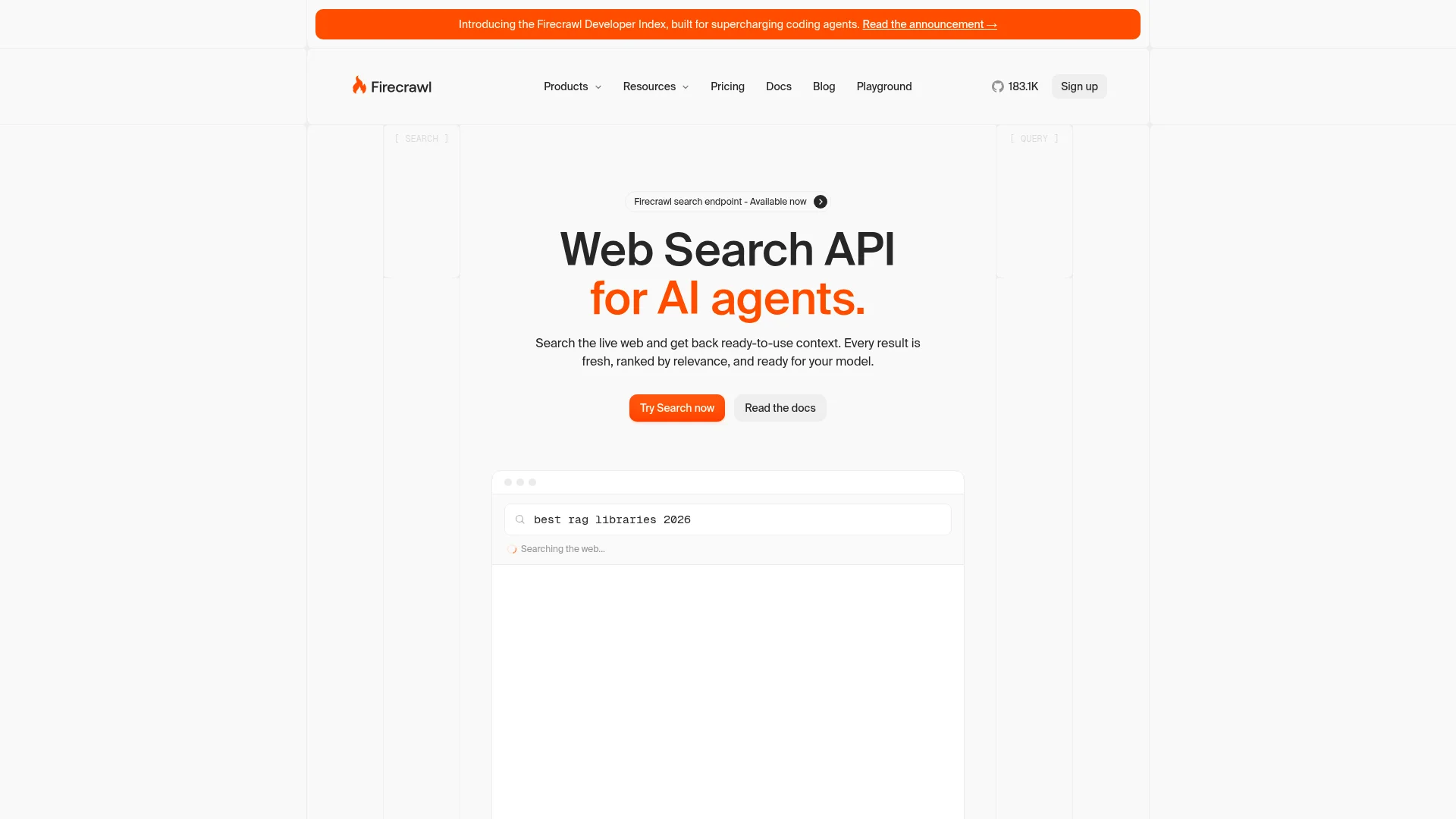
Firecrawl is the zero config web search API on this list: it runs with no signup and no API key, and gives every developer 1,000 free credits a month automatically.
The edge here is not the size of the free tier, it is that Firecrawl is the only option in this category that removes the account. Every other provider gates its free usage behind a signup and an API key, so you cannot point a cold agent at them and have it work. Firecrawl keyless can be reached with zero credentials, which makes it the only one an unattended agent can adopt by itself: you point a client or a single CLI command at the endpoint and it runs, rate-limited per IP, with 1,000 credits a month applied automatically and no card in the flow.
That advantage compounds Firecrawl's other structural edge rather than standing on its own. The reason 1,000 free credits go so far is that one Firecrawl call does what takes several elsewhere: search returns full-page content with automatic scraping in a single request, so a keyless user gets discovery and extraction together where an Exa user is still stitching a search vendor to a separate scraping vendor. Search costs 2 credits per 10 results, so the allowance stretches to roughly 5,000 results a month, and the same credits cover scraping and the rest of the web-data toolkit. It also tops the OpenBenchmarks token-efficiency ranking above, so each of those credits resolves more of a question than a thin-snippet API would.
firecrawl search: web search that returns clean, query-relevant markdown in one step, JavaScript-heavy pages included. See the search endpoint.keyless MCP: point any MCP client athttps://mcp.firecrawl.dev/v2/mcpfor Search, Scrape, and Parse with no account, rate-limited per IP.scrapeandparse: clean markdown from any URL, and structured parsing of PDFs and documents, on the same free credits.crawlandmap: follow links across a whole site or list every URL on a domain when a single search is not enough.agent: hand off a multi-step research task and get structured results back.purpose-built indexes: beyond the general web, Firecrawl runs specialized indexes for queries a plain SERP handles poorly, including the Developer Index over GitHub issues, PRs, READMEs, and docs, and the Research Index over academic and scientific sources.
Install:
# Keyless: search works from the terminal with no signup
npx -y firecrawl-cli@latest search "best free web search apis 2026"

# Or add the keyless MCP server to Claude Code
claude mcp add --transport http firecrawl https://mcp.firecrawl.dev/v2/mcp
Example:
"Search the web for the latest pricing on the top agent search APIs"
"Scrape this docs page and give me the parameters as a table"
The Firecrawl free plan in detail. Keyless is one way in; the free plan is the account-based version of the same allowance, and it is worth understanding on its own because it is where most people settle once a prototype works. Signing up still costs nothing and requires no credit card, and the free plan keeps the same 1,000 credits a month, but the account unlocks the parts keyless holds back.
- Same allowance, still no card: 1,000 credits a month, renewed monthly, no payment method required to create the account.
- What a credit buys: scraping is 1 credit per page and search is 2 credits per 10 results, so the 1,000 credits cover roughly 1,000 scraped pages or about 5,000 search results, and any mix in between. A request that returns nothing is not charged.
- The full toolkit, not just three tools: where keyless exposes only Search, Scrape, and Parse, the free account adds Crawl, Map, Agent, and the /interact endpoint, plus OAuth for interactive clients like Claude and Cursor and an API key for scripts and CI.
- Account-level limits: the free plan runs 2 concurrent requests, which suits a personal agent or a research script but not heavy parallel fan-out.
- When you outgrow it: the Hobby plan starts at $16 a month billed annually (or $19 billed monthly) and lifts the credit ceiling and concurrency, on the same API and output format.
Honest take: Keyless is the fastest possible start, and for prototyping it is hard to beat: no account, no key, dense output that keeps token cost down. The real constraint is the same one every free tier has, concurrency. The free tier runs two concurrent requests, which is fine for a personal agent or a research script but rules out heavy parallel fan-out. When you outgrow the per-IP limits, connect an OAuth account or an API key for the full tool surface and higher limits.
Cons: The keyless endpoint intentionally exposes only Search, Scrape, and Parse; Crawl, Map, and Agent need an account. Sustained or high-concurrency use will hit the per-IP rate limit before it hits the credit ceiling, which is the point at which you should move to a key.
Repo: github.com/firecrawl/firecrawl. Docs: docs.firecrawl.dev.
2. Exa
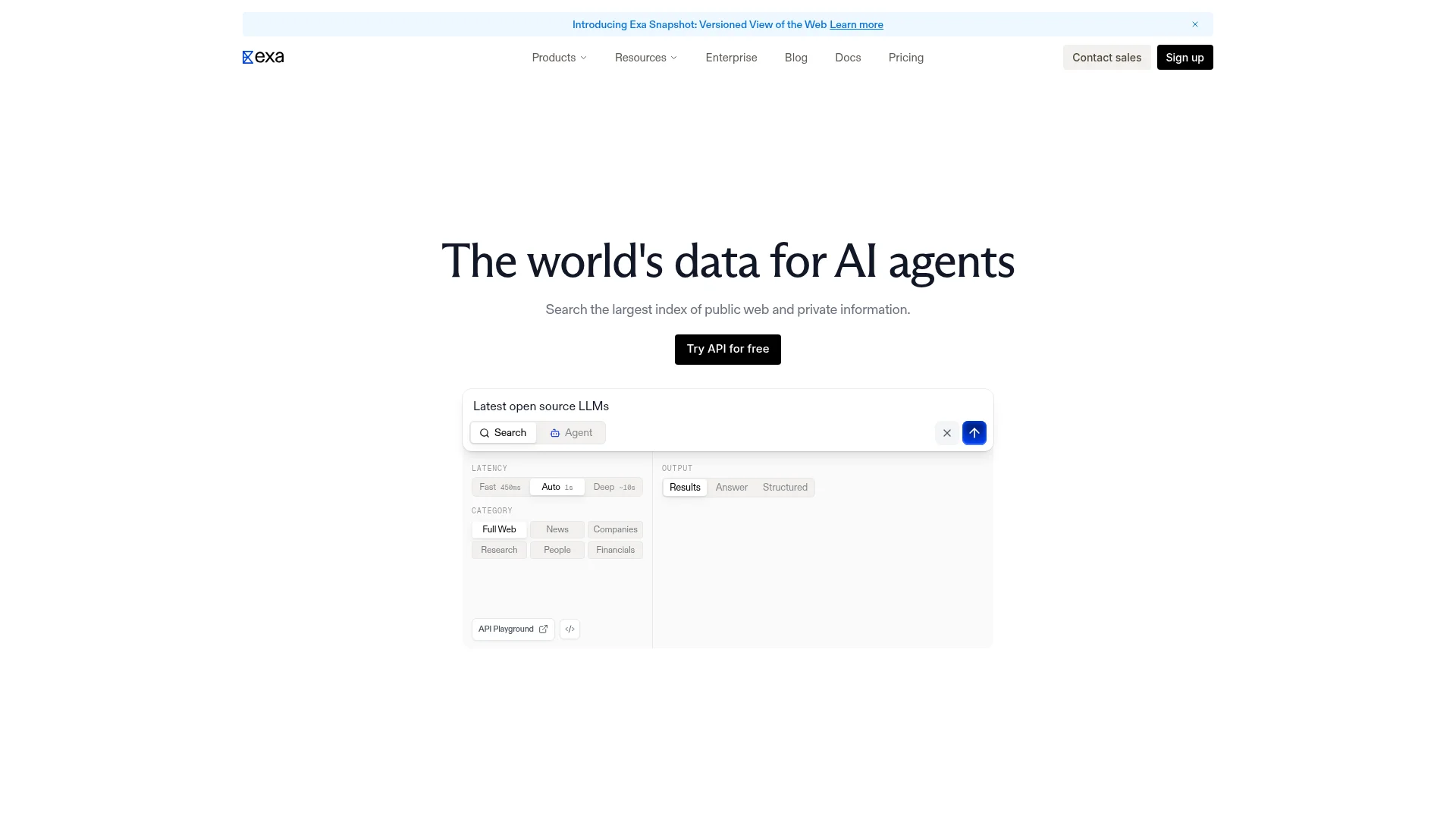
Exa offers a recurring dollar allowance with no card required, running on its own embeddings-based index.
Exa gives new accounts $20 in credits on signup plus $10 in free credits every month, with no payment method required. Because there is no card, requests simply stop when the balance runs out and the account cannot incur a charge. Exa's search base price is $7 per 1,000 requests, so the recurring $10 covers a meaningful amount of monthly exploration. It pairs the API with prosumer tools like Websets, which makes it a good fit if you want to poke around interactively as well as programmatically.
search: neural and keyword search over Exa's own index, with fast and auto modes.contents: fetch page contents and AI summaries alongside results.no card required: $20 on signup plus $10 recurring monthly, overage impossible by construction.Websets: an interactive surface for building and refining result sets outside code.
Honest take: Exa's free allowance is forgiving, with no card on file so overage is impossible, and the embeddings-based index fits exploratory, semantic-style queries where you are not sure of the exact keywords. The trade-off shows up in the token table above: Exa's results carried noticeably more tokens into context than Firecrawl's on the coding-agent benchmark, so measure cost per answer, not just the attractive signup number.
Cons: The index is smaller and more specialized than providers running general web-scale crawls, so broad, high-recall queries can miss pages a larger index would surface. Heavier per-result token cost eats into the effective value of the free credits at scale.
If you are weighing Exa against the field, our roundup of Exa alternatives covers where it fits and where other options pull ahead.
3. Brave Search API
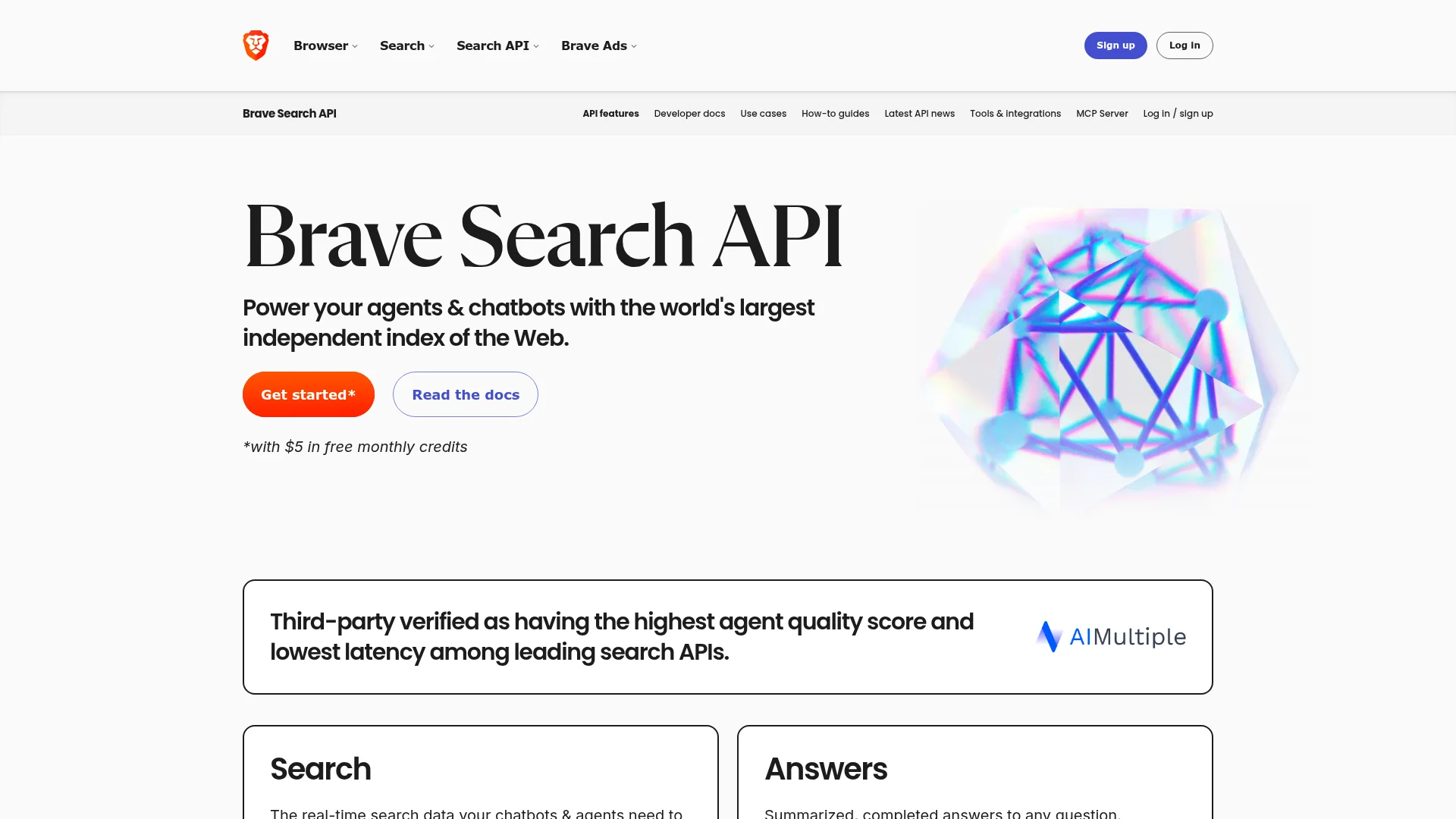
Brave runs its own independent web index of 30B+ pages, but the free tier that made it a hobbyist default is gone.
Brave is one of the few Western providers that crawls and ranks the web itself rather than reformatting another engine's results, and, in its own words, "is not a scraper that simply uses bots to query Google or Bing." That independence is the reason to consider it. The catch is what changed in early 2026: as recently as August 2025 Brave offered up to 5,000 free queries a month with no billing, and by February 2026 that plan was withdrawn for new users. In its place, new accounts get $5 in monthly credits (roughly 1,000 queries at $5 per 1,000 requests) and must put a card on file at signup, which Brave describes as an anti-fraud identity check that is not charged while you stay in credit. Existing free-plan subscribers keep their 2,000 queries a month.
web/search: ranked organic results from Brave's independent index as structured JSON, updated with millions of new pages daily.llm/context: an LLM-oriented endpoint that returns query-relevant context for grounding.own index: results come from Brave's own crawl and ranking models, not a reformatted consumer SERP.Goggles: re-rank or filter results with custom rules for more control over the response.
Honest take: If index independence matters to you, for continuity or for not depending on a consumer engine, Brave is the one to reach for, and the daily-refreshed 30B-page index is a real asset. But it returns search results, not page content: if your agent needs to read the article it found, you bolt a separate scraping layer on top, which is exactly the stitching Firecrawl keyless avoids by returning content in the same call. The mandatory card also means it cannot offer the "a bill is impossible" guarantee that Exa and Firecrawl keyless can.
Cons: No genuine free tier for new users since February 2026, and a card is required to claim the $5 monthly credit, so this is not a zero-risk free option. The free credit allowance is throttled to about 1 query per second, and reaching 50 queries per second requires the Pro AI plan, a steep jump for spiky workloads. Results are snippets, not full pages, so anything that reads content needs a separate extraction step. The independent index is still maturing on long-tail and niche queries where it trails Google, and raw JSON output needs post-processing before it reaches an LLM.
For a fuller comparison, see our guide to Brave Search API alternatives.
4. Diffbot
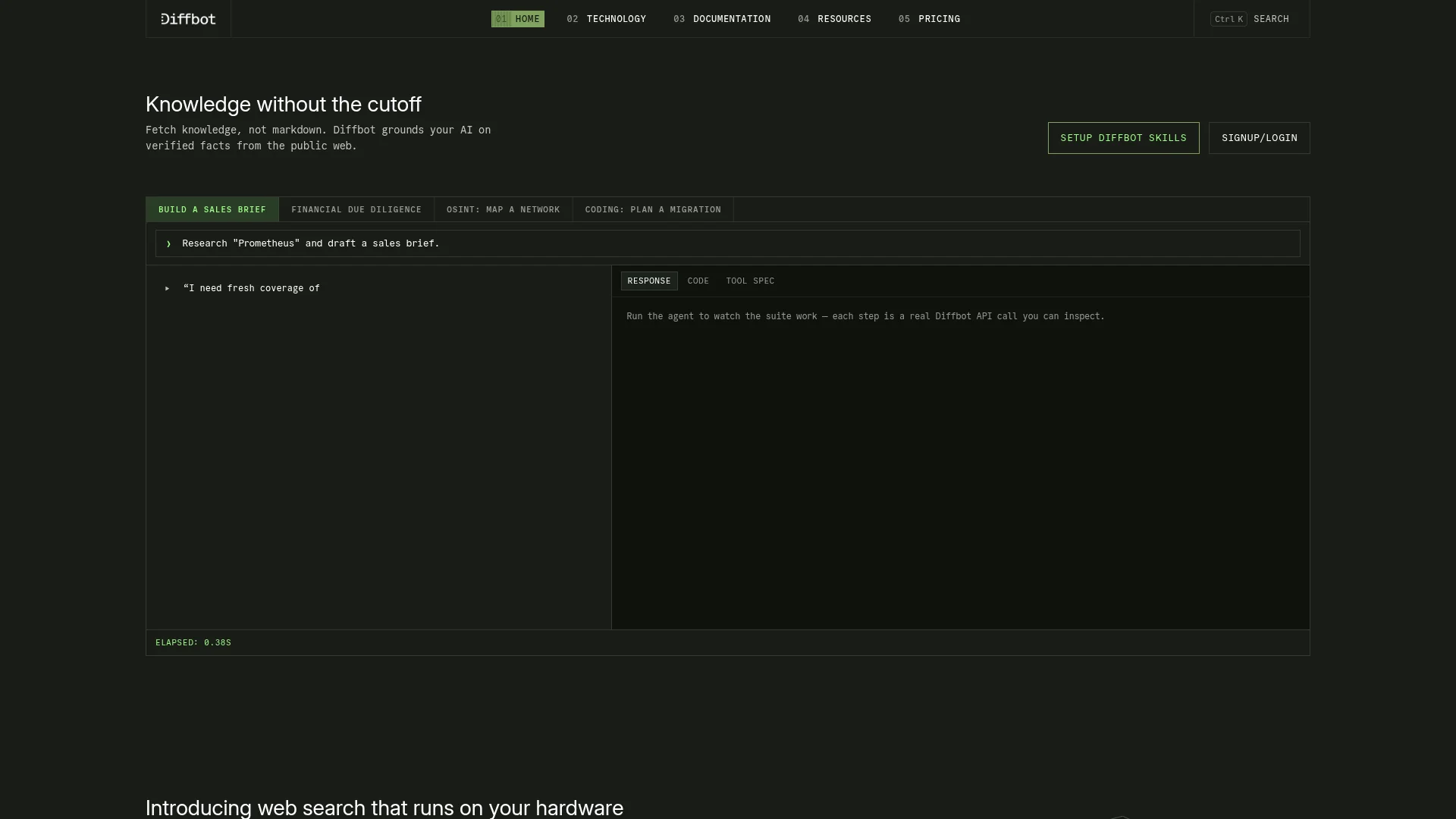
Diffbot gives 10,000 free credits a month across a knowledge-graph and extraction stack, with no card required.
Diffbot is the odd one out here, and useful precisely because it is not a pure search API. It is built around a Knowledge Graph assembled from crawling the web, and its free plan bundles four APIs together: web search, page extraction, knowledge-graph entity queries, and NLP. The free plan is $0 a month with 10,000 credits, all four APIs included, and no credit card required. Web searches cost 1 credit each, so if you spend the whole allowance on search you get up to 10,000 queries a month, or you split the budget across extraction and entity lookups.
web search: 1 credit per query, drawing on Diffbot's crawl.knowledge graph: query structured entities (companies, people, articles) at 25 credits each.extract: pull structured data from a page at 1 credit per page.NLP: entity and relationship extraction from text at 1 credit per request.
Honest take: If your problem is really "search plus structure this into entities," Diffbot's bundled free tier is a lot of capability for no card. It is overkill if all you want is a search endpoint, and the knowledge-graph queries burn credits fast at 25 each, so the 10,000-credit allowance shrinks quickly once you lean on the graph. As a plain web search API it is fine; as an entity-enrichment tool it is where the product actually shines.
Cons: The 10,000 credits are shared across all four APIs, so heavy knowledge-graph use exhausts them well before 10,000 searches. Diffbot is priced and designed for entity and enrichment workloads, so evaluating it purely as a search API undersells it and can mislead on cost.
Reference: diffbot.com/pricing.
Free tiers side by side
| Provider | What's free | Card required | Refills | Own index |
|---|---|---|---|---|
| Firecrawl keyless | 1,000 credits/month, no signup or key | No | Monthly | Yes (web + Developer/Research) |
| Firecrawl free plan | 1,000 credits/month with an account, 2 concurrent, full toolkit | No | Monthly | Yes (web + Developer/Research) |
| Exa | $20 on signup, then $10/month | No | Monthly | Yes (embeddings) |
| Brave | $5/month credits (~1,000 searches) | Yes | Monthly | Yes |
| Diffbot | 10,000 credits/month across four APIs | No | Monthly | Yes (knowledge graph) |
Check each provider's current documentation before committing; free tiers in this category change often.
Building the top free web search APIs into your workflow
The honest summary is that "free" is a spectrum of risk, not a single offer. For the fastest possible start, and the lowest chance of an accidental bill, a zero config web search API like Firecrawl keyless wins: no account, no key, dense token-efficient output, and 1,000 credits a month that go further than a raw search count suggests. For a recurring dollar allowance with no card, Exa fits, as long as you account for its heavier per-result token cost. If an independent index is the priority and a card is acceptable, reach for Brave. Diffbot is the choice when the job is really entity enrichment wearing a search API's clothes. And if a tutorial points you at Google's Custom Search JSON API, skip it: that one is closed to new customers and on its way out.
Two rules travel across all of them. First, read the rate limit before the credit count: concurrency, not credits, is what stops a free tier from carrying real traffic. Second, measure cost per resolved answer rather than cost per request, because a token efficient web search API that answers in one dense call beats a cheaper one that needs five thin ones. The OpenBenchmarks token-efficiency board is the neutral scorecard to check that against, our own write-up on token efficiency explains why dense excerpts change the math, and our guide to cutting token usage in Claude Code benchmarks the wider set of techniques.
When the free tier is a trial for something headed to production, evaluate on the paid path, not the free one: check the mode and rate limits you will actually ship on. If you want to go deeper on the category, our comparison of the best web search APIs covers the paid landscape, our breakdown of AI search engines for agents covers what each one returns and when to use it, our roundup of search tools for AI agents benchmarks latency and extraction, and the guide to web search MCP servers has the exact install commands for wiring one into Claude, Cursor, or Codex. To start searching keyless in the next sixty seconds, the Firecrawl search endpoint is one command away.
Frequently Asked Questions
What is the best free web search API for AI agents in 2026?
It depends on what free has to survive. Firecrawl keyless is a strong zero config option because it runs with no signup and no API key, giving every developer 1,000 free credits a month automatically. Exa gives $20 on signup plus $10 every month with no card required. Brave runs its own web index but now requires a card even for its free credits.
Is there a web search API that is free with no API key and no signup?
Yes. Firecrawl keyless works with no account and no API key, rate-limited per IP, and gives 1,000 free credits a month automatically. Most other providers (Exa, Tavily, Serper, Diffbot) offer free tiers without a card but still require you to create an account first.
What does zero config mean for a web search API?
Zero config means an agent can start searching without a setup step: no account creation, no API key to paste into an environment variable, and no billing details on file. You point a client or a single CLI command at the endpoint and it works. Firecrawl keyless is the clearest example in this list.
What is the most token efficient web search API?
On the OpenBenchmarks search-only ranking for coding agents, Firecrawl is the most token efficient at a median of 7,456 task tokens, ahead of every other provider tested. Token efficiency matters because the search API's list price is not your real bill: the tokens each result pushes into the model context are, and dense, query-relevant excerpts resolve a question in fewer calls than 20-word snippets do.
Can I run a production application on a free web search API tier?
Usually not for anything user-facing. Free tiers are throttled with low concurrency and no SLA, so you hit rate limits long before you exhaust the credits. A recurring monthly free tier can carry a low-volume background job, like a monitoring task or an internal bot, but plan to move to a paid path before real traffic arrives.
What happened to the free Google and Bing search APIs?
Both historical defaults are gone. Google's Custom Search JSON API is closed to new customers and existing customers must migrate by January 1, 2027. Microsoft retired the Bing Search API in 2025 and pointed developers to Azure. Most of why this category exists in its current form is that the two free defaults developers reached for by habit are no longer available.
Do free web search credits roll over if I do not use them?
Assume no unless the provider says otherwise in writing. Recurring monthly allowances from Firecrawl, Exa, and similar providers typically expire at month end. One-time signup grants generally persist until you spend them, but they do not refill.