TL;DR: best enterprise web scraping services
- Firecrawl: YC-backed and built for AI agents and apps, with MCP and CLI support baked in and a free tier of 1,000 credits/month scaling to 1,000,000 credits for $749/month.
- Bright Data: Full data suite including proxies, scraping, search, browsing, and datasets. They offer a 5,000 credit free tier and plans running past $1,999/month (G2: 4.7).
- Oxylabs: A major enterprise provider that just acquired ScrapingBee. They cover proxies, scraping APIs, and headless browsers with MCP support but no dedicated CLI. Prices start at $49/month with no permanent free tier (G2: 4.5).
- ScraperAPI: A lesser-known but MCP and CLI ready option built around ecommerce, social, and SERP scraping, priced from $49/month up to $975/month (G2: 4.3).
- Decodo (formerly Smartproxy): Decodo covers proxies and JS-rendering scraping APIs with MCP and CLI access, but no dedicated browser product. Pricing ranges from $19 to $1,499/month (G2: 4.6).
- Zyte: Zyte maintains Scrapy and is the oldest name on our list. They are strong on scraping infrastructure but AI integration requires more overhead. They run on sliding scale pricing (G2: 4.4).
- Octoparse: Octoparse offers a desktop app and scraping templates. They do provide MCP and CLI access for AI agents. However, this product comes with a high degree of vendor lockin. (G2: 4.8).
What defines enterprise web scraping?
Enterprise web scrapers run in the cloud using secure, redundant, and reliable hardware. Downtime is minimal, and data pipelines can handle a massive amount of throughput.
- Web scraping: We fetch a site, return the results, and extract the necessary data. This can be used for one-offs, and data pipelines that don't require redundancy. For instance, if you're scraping with Python, you might use Requests and BeautifulSoup to quickly extract information from a page and never look at it again. For interactive sites, you might use a headless browser like Playwright or Selenium. If you don't write code, you might hook an AI agent into the Firecrawl Model Context Protocol (MCP) and tell it verbally to scrape the site.
- Web scraping for enterprise: In enterprise scraping, we still need these tools. However, AI agents are more and more likely to be the ones operating them. The biggest differentiator is our runtime environment. Whether it's a deterministic scraper or an AI agent, enterprise scrapers should run safely in the cloud with as little downtime as possible.
To handle this best, imagine a scraper that extracts ecommerce products. If it's for personal use, you might run this daily to check the best laptop deals. However, this same workflow can also power a website. If the site is successful, it gets traffic. More traffic begets more updates. People want fresh data. At scale, this scraper might need to run once per hour or even once per minute. Every failed run is a frustrated user.
Enterprise scraping services minimize the chances of downtime and failed runs.
What should enterprise web scraping services offer?
Enterprise scraping services need to offer a variety of products to help their customers search and scrape to extract web data. Dynamic websites present their own issue: you often need a browser to interact with them. Companies need browser automation that functions at scale.
Beyond the scraping surface itself, enterprise buyers need controls that satisfy security, legal, and finance teams:
- Zero data retention: scraped content processed in memory and never persisted.
- SOC 2 Type II: independently audited controls for data protection and operational security.
- PII redaction: personally identifiable information stripped from outputs automatically.
- SSO and SCIM: SAML/OIDC sign-on (Okta, Entra ID, Google Workspace) and directory-synced provisioning.
- Static IP allowlisting: dedicated, whitelisted IPs for outbound traffic.
- Key restrictions: lock API keys to specific IPs, endpoints, or output formats.
- Pooled credits and spend limits: share credits across teams with per-key or per-team caps.
- Custom concurrency: tailored concurrent browser limits, with reserved capacity for critical workloads.
- Priority SLAs and dedicated support: named contacts, response-time guarantees, and a dedicated Slack channel.
- DPAs and custom MSAs: Data Processing Agreements and custom contracts to clear legal review.
We'll evaluate each of the best enterprise scraping services using the following criteria.
- Pricing: The best tools provide transparent and upfront pricing. Pricing should scale based on usage needs.
- Service tiers: If and when your project scales, you might be scraping hundreds of thousands of pages per month. If a pipeline breaks, you need support.
- AI-friendliness: Does the service integrate well with AI? Can you power agents using MCP, or can you give it access to a command line interface (CLI) tool?
- Reputation: What do you know about the company's reputation? You wouldn't $500 into a laptop without reading reviews. Don't put $20,000 into a data pipeline without reading reviews either.
| Feature | What this does |
|---|---|
| Pricing | Shows real per-page cost before add-ons inflate it |
| Service tiers | Scales from proof-of-concept to production volume |
| AI-friendliness | Returns LLM-ready markdown/JSON, not raw HTML |
| Reputation | Independent check on vendor claims |
What are the best enterprise web scraping services?
Now, let's go through the best enterprise web scraping services. Each provider will be evaluated on pricing, service tiers, AI-friendliness, and company reputation.
Firecrawl
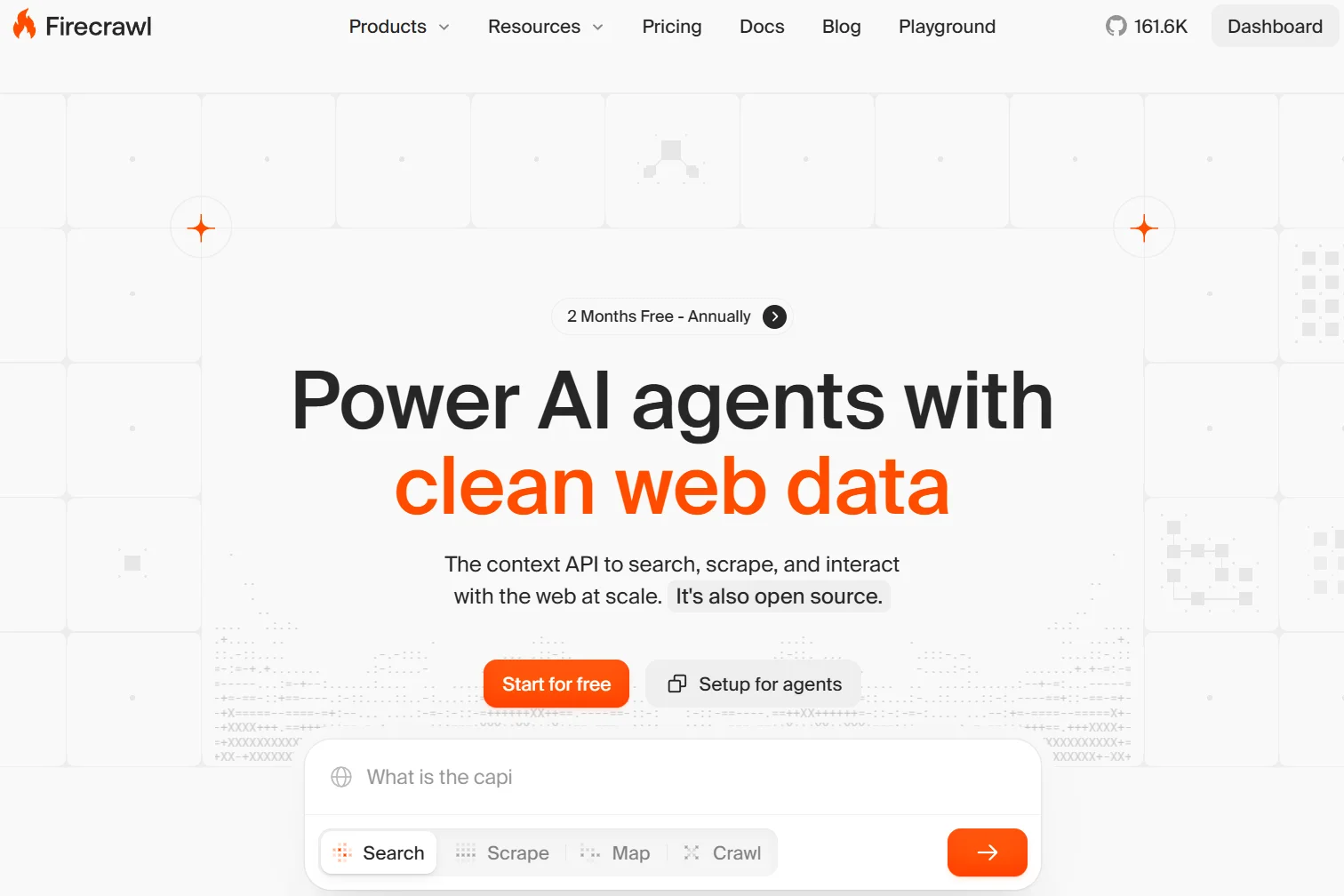
Firecrawl is a web scraping service built for AI teams: a single API that turns any URL, site, or search query into clean, LLM-ready markdown and structured JSON. Firecrawl was founded in 2024, but the team behind it initally started in 2022, backed by Ycombinator. Firecrawl is a developer/API-first product built for AI agents and apps, with scraping, crawling, search, and browser interaction exposed through a single API. In 2025, they completed their Series A funding round and they've been growing steadily since launch. Firecrawl offers both an MCP server and a CLI app that can create AI agent skills.
Firecrawl also ships Keyless, which lets agents call Firecrawl without an API key. It works out of the box in coding platforms like opencode, so you can search, scrape, and crawl from an agent session without provisioning credentials first. This is perfect for enterprises that want to test the waters before wiring Firecrawl into their whole system.
For teams past the "test the waters" phase, Firecrawl Enterprise covers the full stack of controls larger organizations need (see the docs for the complete list):
- Security and compliance: SOC 2 Type II, zero data retention (in-memory processing, nothing persisted), automatic PII redaction, DPAs, custom MSAs, and security reviews.
- Identity and access: SSO via SAML and OIDC (Okta, Entra ID, Google Workspace), SCIM directory sync, static IP allowlisting, IP-restricted API keys, and per-key restrictions on formats and endpoints.
- Scale and performance: custom credit volumes, pooled credits across teams with per-team tracking, spend limits per key or team, custom concurrent browsers, reserved concurrency for specific workloads, extended credit rollover on annual plans, and bulk discounts.
- Support: priority SLA, a dedicated Slack channel, and custom contracts through enterprise sales.
Firecrawl CTO, Nicolas Camara posted about their most recent parsing tool, pdf-inspector, which allows agents to process PDF files without waiting on OCR.
- Endpoints offered (see firecrawl.dev):
/scrape: fetch a single page and return clean markdown, HTML, links, screenshots, or structured JSON./crawl: recursively crawl a site or section and return every page in a single job./map: discover every URL on a site, with optional search filtering./search: run a web search and get results back with full page content, not just snippets./interact: drive a live browser session to click, fill forms, log in, paginate, or handle JavaScript-heavy flows./parse: convert PDFs, DOCX, XLSX, and other document formats into clean markdown./monitor: track pages for changes and get notified when content updates.
- Pricing: Their free tier comes offers 1,000 credits/month and their plans scale up to 1,000,000 credits per month ($749 monthly or $599 annually). More information can be found here.
Bright Data
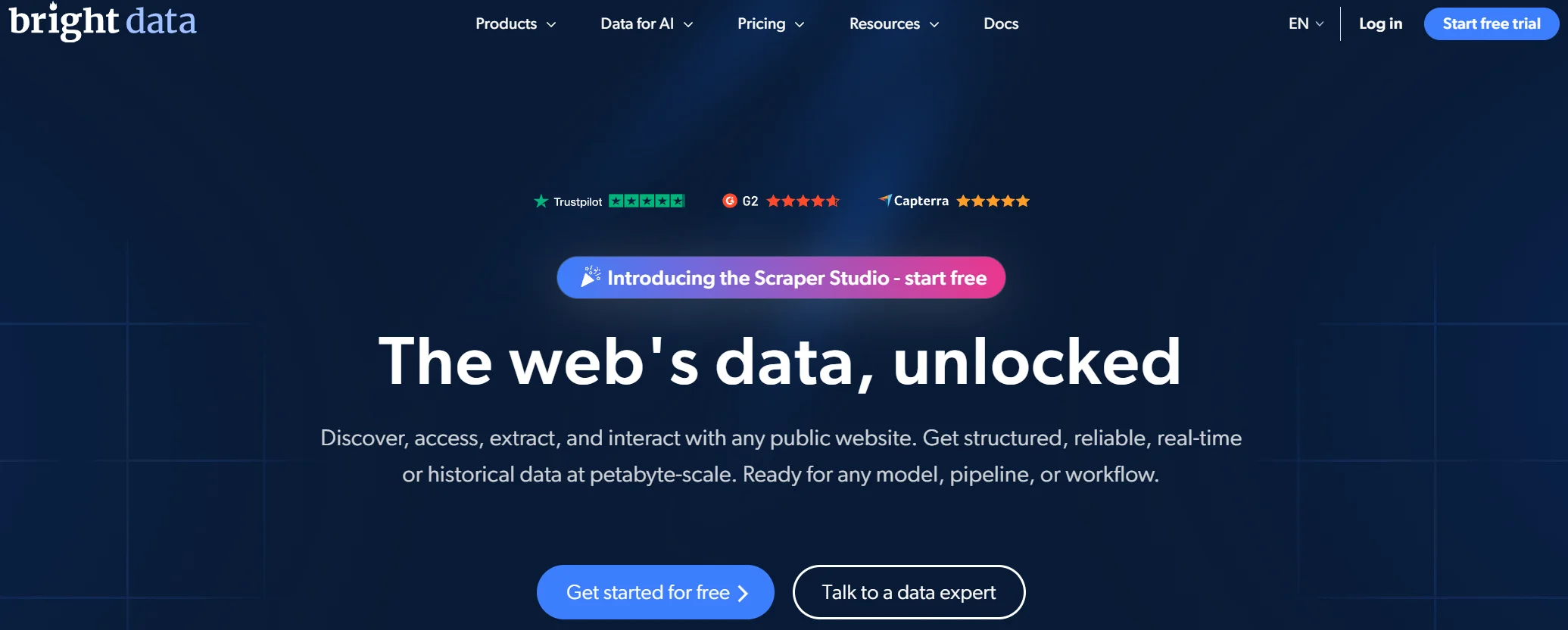
Bright Data has been around for a long time. Their tools cover proxies, scraping, search, browsing and datasets. Customers can connect their AI agents using MCP as well as their CLI.
- Services offered: Bright Data's suite includes proxies, scrapers, search APIs, browsing and datasets.
- Pricing: Their free tier offers 5,000 API credits/month. Plans scale all the way to $1,999/month, sometimes even more. Each product comes with its own pricing plan. For more information, check their site.
- G2 rating: 4.7
Oxylabs
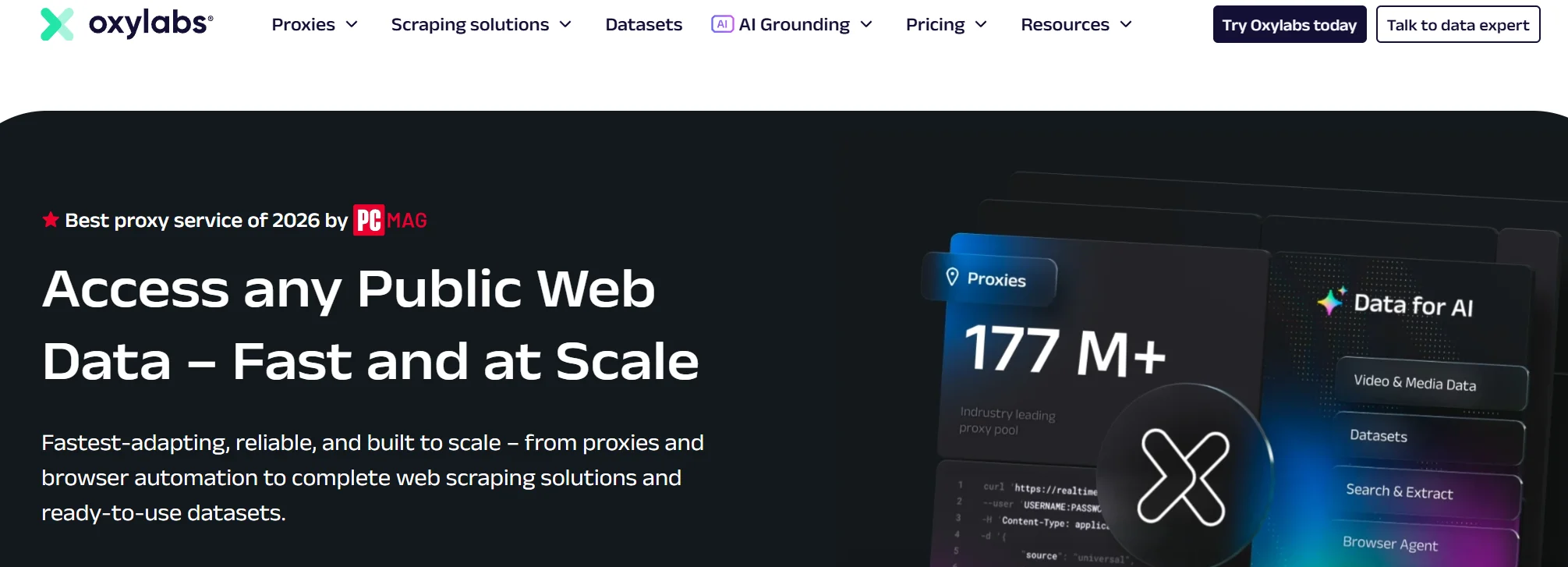
Oxylabs is another well-known enterprise scraping service. They recently acquired ScrapingBee. Oxylabs offers proxies, web scraping APIs, headless browsers and datasets. They do not offer a dedicated CLI, but they do offer an MCP server and agent skills.
- Services offered: Oxylabs provides proxies, scraping APIs, headless browsers and datasets.
- Pricing: Pricing for Oxylabs is tricky. They offer a limited trial, but no set free tier. Their web scraping API begins at $49/month for 98,000 results and scales to 8,000,000 results for $2,000/month. To check the pricing of their other offerings, visit their website.
- G2 rating: 4.5
Kevin Sahin, former CEO of ScrapingBee, wrote about the Oxylabs acquisition on X.
ScraperAPI
ScraperAPI is lesser known than the products mentioned above. They offer scrapers for ecommerce, social media and search engine results pages (SERP). They offer an MCP as well as a CLI to help power AI agents.
- Services offered: ScraperAPI offers numerous web scraping APIs for sites and products all over the internet.
- Pricing: Their lowest tier plan runs $49/month for 100,000 API credits. Their highest tier costs $975/month for 10,500,000 credits.
- G2 rating: 4.3
Decodo
Decodo, formerly known as Smartproxy, offers proxies as well as scraping APIs. For AI agents, they offer MCP connectivity as well as a CLI tool. They offer support for JavaScript rendering. However, they do not offer a dedicated cloud browser. This is fine for some projects, but for teams requiring heavy browser interaction, that can sometimes be a dealbreaker.
- Services offered: Decodo offers proxies and scraping APIs. JavaScript rendering is supported, but they do not offer a dedicated browser.
- Pricing: Decodo's lowest tier plan costs $19/month for the web scraping API. Their highest tier costs $1,499/month. More information can be found on their website.
- G2 rating: 4.6
Zyte
Zyte is one of the oldest scraping companies on the market. They maintain Scrapy. They do not offer their own MCP server or agent skills. However, their blog provides tutorials for building them yourself.
- Services offered: They offer a scraping API, headless browsing, SERP API and Scrapy Cloud.
- Pricing: Zyte's pricing is tricky. They offer tiered pricing based on the target site. On their pay-as-you-go plan, sites cost between $0.13 and $1.27 per thousand undrendered requests. On their highest tier, $500/month, the range from $0.06 to $0.61 per thousand undrendered requests. Pricing can be found here.
- G2 rating: 4.4
Octoparse
Finally, we have Octoparse. They offer scraping tools, but they're a bit different. They offer scraping APIs like other providers on this list. However, their flagship product is the Octoparse desktop app. Octoparse does provide MCP and CLI access for AI agents. The Octoparse platform does offer a degree of vendor lockin that makes it difficult to switch to other services.
- Services offered: Octoparse offers scraping APIs, scraper templates and the Octoparse desktop app.
- Pricing: They do offer a free plan for teams willing to run scrapers locally. Their lowest paid tier covers up to three concurrent cloud operations and costs $83/month with unlimited data export. Their professional plan costs $299/month and supports up to 20 concurrent cloud operations. More information on their pricing can be found here.
- G2 rating: 4.8
Choose the enterprise web scraping service that best fits your needs
Teams should choose an enterprise scraping service based on their needs. If you're focus is on simplicity and no-code/low-code workflows, Firecrawl lets you deploy scrapers easily supports up to 1,000,000 scrapes per month out of the box. Higher usage is available on custom plans. Providers like Bright Data and Oxylabs offer complete data suites. Scraping is one of the many things they offer. Teams who need access to historical datasets and massive infrastructure should consider these services. Consider your project needs and choose a service accordingly.
Frequently Asked Questions
What is enterprise web scraping?
Enterprise web scraping is a managed approach to collecting large volumes of web data reliably and at scale. It's built for organizations who need continuous access to multiple sources rather than a one-off script. It typically adds distributed infrastructure, automated pipelines, monitoring, and compliance support on top of basic scraping.
Does enterprise web scraping handle JavaScript rendered pages?
Yes, modern web scraping APIs render JavaScript automatically, so they can extract full content from single-page applications and sites built with frameworks like React, Vue, or Angular, not just static HTML.
Can web scraping APIs bypass CAPTCHA and anti-bot protection?
Most enterprise-grade providers can, using residential or mobile IP rotation, browser fingerprint management, and automated CAPTCHA solving to get past systems like Cloudflare, Akamai, and DataDome. Coverage varies by vendor. Some AI-focused tools skip CAPTCHA solving entirely and lean on stealth proxies instead.
How much does enterprise web scraping cost?
Costs vary widely by vendor and billing model. Self-serve developer APIs usually start around $16-$49 per month. Dedicated enterprise products typically start around $499 per month depending on provider and usage requirements.
What are common use cases for enterprise web scraping?
The most common uses are competitor price monitoring, market and sentiment research, lead generation, brand and compliance monitoring, and aggregating listings like real estate, jobs, or product catalogs at scale.
How is enterprise scraping different from basic web scraping?
Enterprise scraping adds the infrastructure a one-off script doesn't need: distributed proxy rotation, automated retries and self-healing when target sites change, data validation, audit trails for compliance, and dedicated support with SLAs.
Should a company build web scraping infrastructure in-house or use a managed service?
It depends on scale and maintenance requirements. Scrapers can be prototyped in quickly, but getting it production-ready monitoring, error handling, and anti-bot bypass add technical overhead. Managed platforms compress that timeline significantly.
Does Firecrawl support AI agents and MCP (Model Context Protocol) integration?
Firecrawl ships an official MCP server. AI agents in Claude, Cursor, Windsurf, and other MCP-compatible tools can search, scrape, and interact with the web directly. They also offer a CLI and agent skills for terminal-based workflows.
What does Firecrawl cost, and what's included in the free tier?
Firecrawl's free tier includes 1,000 credits per month, no card required. Paid plans start at $19/month (Hobby, 5,000 credits) and scale through Standard ($99/month, 100,000 credits), Growth ($399/month, 500,000 credits), and Scale ($749/month, 1,000,000 credits). Annual subscriptions provide additional discounts to these plans.