TL;DR
- An e-commerce scraping API turns online store pages into product records. A record holds the title, current and sale price, variants, stock status, images and reviews.
- Seven options cover most teams in 2026: Firecrawl, Bright Data, Oxylabs, Zyte, Apify, ScraperAPI and Nimble. They differ in what they return (raw HTML or parsed products) and in the unit you pay for.
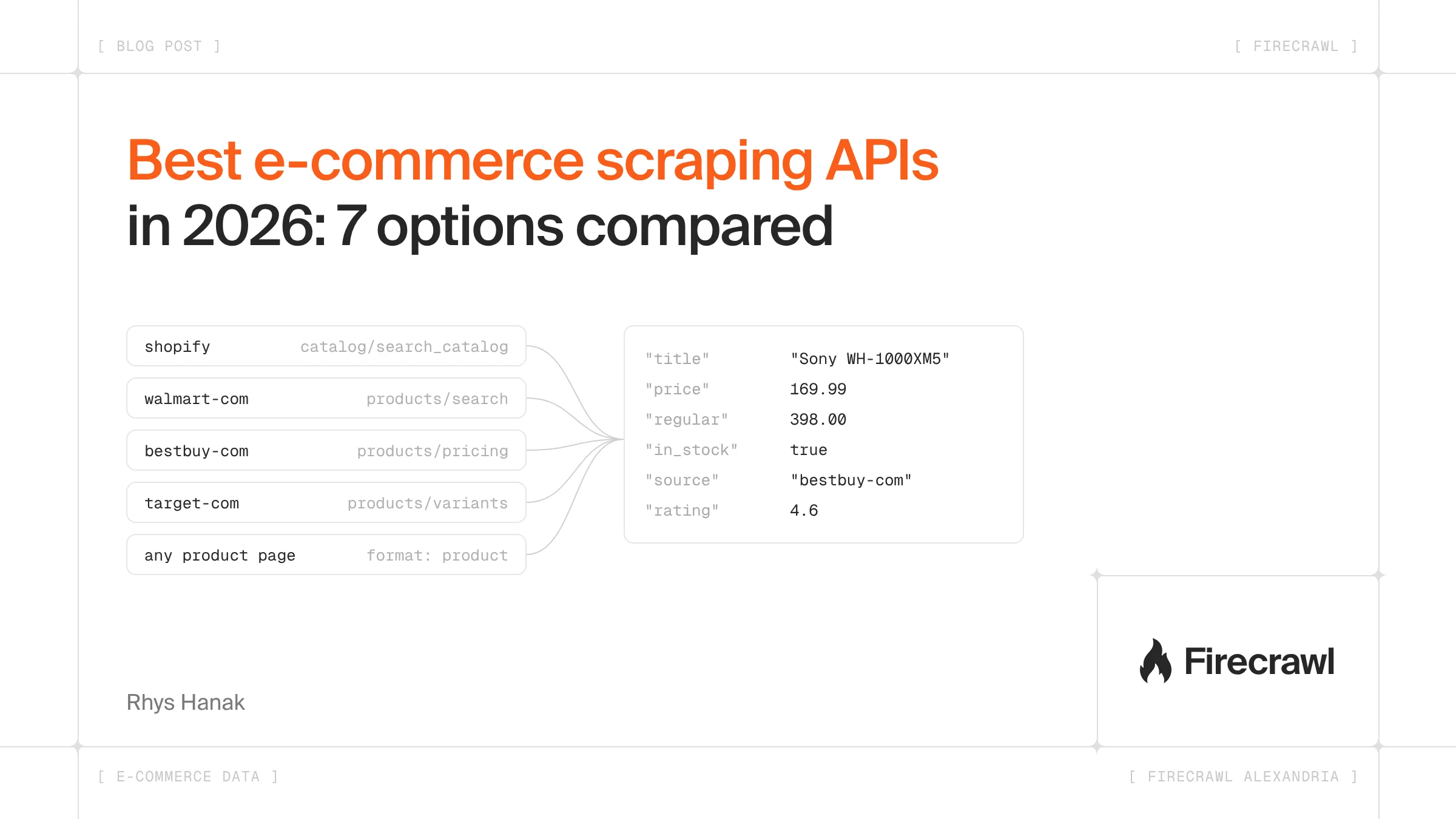
- Firecrawl covers every route to e-commerce data from one account. Firecrawl Alexandria brings retailers such as Shopify, Walmart, Best Buy, Target and Home Depot into one API. Any other product page becomes structured JSON with the Firecrawl /scrape
productformat for 1 Firecrawl credit, and Firecrawl's data team delivers bulk e-commerce datasets.
What is an e-commerce scraping API?
An e-commerce scraping API is a hosted service that fetches online store pages and returns their product data, such as price, stock and variants. You send a URL, a search term or a product ID. The API returns a page or a structured product record, so you never run browsers or maintain scrapers.
The services in this list return e-commerce data in one of three shapes:
| Shape | What you send | What you get back | Who parses it |
|---|---|---|---|
| Page fetch | Any URL | Rendered HTML or Markdown | You |
| Retailer endpoint | A query or product ID for a named store | Parsed JSON for that store | The vendor |
| Structured extraction | Any product URL | A product object with fields | The API, with or without an LLM |
Most teams need more than one shape. A price monitor might call retailer endpoints for the large marketplaces, then run structured extraction on the hundreds of smaller brand sites with no endpoint of their own.
What problems do developers hit when scraping e-commerce sites?
JavaScript-heavy product pages come back empty
A developer building a small price tracker in November found that requests and BeautifulSoup worked on one store, but "the other two just come back as an empty shell.. the tables only render after the js runs." Firecrawl /scrape renders JavaScript-heavy pages before it returns content, so the price shows up in the result instead of an empty shell.
Prices change with the shopper's location
In September, a team's Amazon price checker reported that "a ~€285 headset came back as €14,400" because the request landed in the wrong market. Firecrawl takes a location setting with a country and preferred languages, then picks a matching proxy and emulates that language and timezone, so you can pin each check to the market you track.
Costs climb with volume
Scale changes the math fast. A developer planning a product price comparison site wanted "around 500.000 pages per day" and worried about residential proxy bills. Another, scraping Amazon on free API tiers, wrote: "I constantly reach the limits and end up having to create new accounts/keys throughout the day." Firecrawl charges 1 Firecrawl credit for a product page, with Firecrawl's default proxies on every hosted request and no LLM charge for the product format. The free plan's 1,000 Firecrawl credits renew each month.
Reviews are hard to collect in bulk
Product research often starts with every review of a product in one place, ready to summarize with an LLM. Firecrawl Alexandria has review tools for retailers such as Walmart and Newegg, so an agent connected to Firecrawl can fetch reviews and summarize them in the same chat.
What should you look for in an e-commerce scraping API?
The best e-commerce scraping API for a team returns products in the shape its pipeline expects. It also covers the stores the team tracks and prices the work in a unit it can forecast. Check these before you commit:
- Output. Parsed product JSON saves you writing a parser per store. Raw HTML gives full control but adds maintenance every time a store changes its layout.
- Retailer coverage. Named endpoints for the marketplaces you track, and a fallback for every store without one.
- Price unit. Per record, per request, per credit or per compute unit. Count the cost per product you actually keep, since retries and empty pages can count too.
- Scale. Batch jobs, async webhooks and bucket delivery matter once you track thousands of SKUs.
- Change tracking. Prices move daily, so scheduled checks and alerts save you from re-scraping a whole catalog.
- Agent access. An MCP server, CLI or plugin lets ChatGPT, Claude or a coding agent call the API without glue code.
Which are the best e-commerce scraping APIs in 2026?
The best e-commerce scraping APIs in 2026 are Firecrawl, Bright Data, Oxylabs, Zyte, Apify, ScraperAPI and Nimble. Firecrawl is the one built for AI agents, with retailer providers, a product format for any store and bulk datasets in one account. The others sell retailer scrapers, extraction APIs or marketplace templates, priced in different units.
| API | What it returns for stores | How you pay | Free tier | Paid entry point |
|---|---|---|---|---|
| Firecrawl | Firecrawl Alexandria retailer providers, product JSON from any product page, Markdown, bulk datasets | Firecrawl credits | 1,000 Firecrawl credits a month | Hobby, $19 a month billed monthly ($16 billed annually) |
| Bright Data | Pre-built scrapers for named retailers, plus ready-made datasets | Per 1,000 records | 5,000 records a month | Pay as you go |
| Oxylabs | Web Scraper API with dedicated scrapers and AI parsing | Monthly subscription | $5 of credit | $15 a month |
| Zyte | Zyte API with automatic product extraction | Per 1,000 responses, tiered by site difficulty | $5 of credit | Pay as you go from $0.13 per 1,000 HTTP responses |
| Apify | Store of community and official e-commerce Actors | Platform usage plus per-result Actor prices | $5 of usage a month | Starter, $19 a month |
| ScraperAPI | Structured endpoints for Amazon, Walmart, eBay and Google Shopping | API credits | 7-day trial with 5,000 credits | Hobby, $49 a month |
| Nimble | E-commerce API with maintained templates | Per 1,000 requests, plus managed data plans | 5,000 requests a month | Data Services from $2,500 a month, billed annually |
1. Firecrawl
Firecrawl is the strongest pick for teams that pass e-commerce data to AI agents or need many retailers from one account. Firecrawl Alexandria gives agents retailer providers for Shopify merchants, Walmart, Best Buy, Target, Home Depot, IKEA and more. The Firecrawl /scrape product format turns any other store's product page into structured JSON. Firecrawl's data team also builds bulk e-commerce datasets on request.
One balance of Firecrawl credits covers Firecrawl Alexandria calls, product scrapes, Firecrawl /map, batch scrape and Firecrawl /monitor, so a price project doesn't need a second vendor for change alerts or catalog discovery. ChatGPT reaches it through the Firecrawl plugin, Claude through the Firecrawl connector, and Claude Code, Codex and Cursor through the Firecrawl MCP server or the CLI. Code reaches it through the Python and Node SDKs. Firecrawl is also open source. It fits teams that feed product data to AI agents, catalogs that mix big retailers with long-tail brand stores, and data teams that want bulk files. The full Firecrawl section below covers each part.
2. Bright Data
Bright Data offers a proxy network, scraping APIs and pre-built scrapers for named sites, including Amazon and Walmart, billed per 1,000 records. It also sells pre-collected e-commerce datasets. The free tier covers 5,000 records a month.
Each Bright Data e-commerce scraper lists its output fields, delivery volume and live success rate. Typical fields include title, seller, brand, initial and final price, currency, availability, SKU, GTIN and review counts. Results arrive as JSON, NDJSON or CSV through the API, a webhook or cloud storage such as Amazon S3, Google Cloud Storage, Azure, Snowflake and SFTP, and schedulers can run collections on a timer. Its pricing page says you pay only for successful deliveries. It suits teams that want parsed marketplace records delivered straight into a warehouse. See how it stacks up in our Bright Data alternatives roundup.
3. Oxylabs
Oxylabs sells a Web Scraper API with dedicated scrapers for e-commerce targets, AI parsing by prompt or schema, and one subscription that also covers its other products. Plans start at $15 a month, with $5 of free credit to test.
Its pre-configured targets include Amazon product pages by ASIN, Amazon search, pricing, best sellers and seller pages, returned as HTML, JSON and other formats. Requests can be localized to a country, state, city or ZIP code across 195 countries, which matters when prices differ by region. Oxylabs handles proxy rotation, JavaScript rendering and retries, schedules recurring jobs, and delivers results to Amazon S3, Google Cloud Storage and other S3-compatible storage. Teams that write their own parsing logic can use XPath or CSS selectors and save reusable parser presets. See our Oxylabs alternatives guide for a closer look.
4. Zyte
Zyte API returns raw HTML, browser-rendered pages or automatically extracted typed data, with products as one of its built-in data types. Pay-as-you-go pricing runs from $0.13 to $1.27 per 1,000 HTTP responses depending on how hard Zyte rates the site, and accounts start with $5 of credit.
Zyte sorts websites into five tiers, from Simple to Advanced, and the tier sets the price per 1,000 responses. Monthly commitments of $100, $200 or $500 lower each tier's rate. One API call covers proxies, headless browser rendering, sessions with cookie persistence and location targeting by country. For pages behind interactions, Zyte API can click, fill forms, scroll and navigate before it extracts. Its automatic extraction structures products, articles, job listings and custom schemas with large language models. Our Zyte alternatives guide has more detail.
5. Apify
Apify is a platform of ready-made scrapers called Actors, with a store category of e-commerce Actors for marketplaces such as Amazon. You pay platform usage plus each Actor's own per-result price. The free plan includes $5 of usage a month, and Starter is $19 a month.
Apify's e-commerce category includes an E-commerce Scraping Tool for most retail sites, plus dedicated Actors such as Amazon Product Scraper and Amazon Reviews Scraper, which export JSON, CSV or Excel. Actors run on Apify's platform and bill compute units, from $0.2 per unit on smaller plans down to $0.13 on larger ones. Our Apify alternatives guide covers the tradeoffs.
6. ScraperAPI
ScraperAPI is a request-based scraping API with structured data endpoints that return parsed JSON for Amazon, Walmart, eBay and Google Shopping. Plans start at $49 a month for 100,000 API credits, after a 7-day trial with 5,000 credits.
The Amazon Product endpoint returns details from any ASIN as JSON, including price, shipping, availability, images and category, and the Amazon Search API flags best sellers in its results. ScraperAPI's DataPipeline runs recurring jobs from templates, such as Google Shopping, without code. Its homepage pitches it as a way to collect data from any public site without managing proxies or browsers. Read our ScraperAPI alternatives guide for comparisons.
7. Nimble
Nimble sells an E-commerce API with maintained templates for marketplaces such as Walmart. Its pricing page lists 5,000 free requests a month, and managed Data Services plans start at $2,500 a month billed annually.
Nimble's E-commerce API runs on Nimble Browser, its own data collection browser. It parses pages with AI and natural language processing into structured JSON, so you don't maintain a parser per store. The API supports several levels of geolocation targeting and can deliver data to Amazon S3 or Google Cloud Storage buckets. Nimble lists dynamic pricing, competitor intelligence and review sentiment analysis as its main e-commerce uses. Our Nimble alternatives guide compares it with other tools.
How does Firecrawl handle e-commerce data?
Firecrawl gives e-commerce teams and AI agents four routes to product data through one account. Firecrawl Alexandria queries retailer data providers, and the Firecrawl /scrape product format structures pages from every other store. Firecrawl /map and batch scrape cover whole catalogs, and Firecrawl /monitor tracks price changes. Data teams can also order bulk e-commerce datasets.
What is Firecrawl Alexandria?
Firecrawl Alexandria is the catalog of data providers and Firecrawl indexes that agents query with a signed-in Firecrawl account or a Firecrawl API key. For e-commerce, it covers catalog search, prices, variants, availability, reviews, price history and deals. Agents reach them through the same Firecrawl search and scrape calls they use for the web. Tool discovery is free, and each call bills the Firecrawl credits shown on that tool.
These Firecrawl Alexandria tools cover the e-commerce jobs teams run most:
| E-commerce job | Firecrawl Alexandria provider and capability |
|---|---|
| Search products across many stores | Shopify catalog/search_catalog, Affiliate.com products/search |
| Search one retailer's catalog | Walmart products/search, Best Buy products/search, Home Depot products/search, IKEA products/search |
| Read a product's price, variants and stock | Best Buy products/pricing, Home Depot products/lookup, WooCommerce products/get_product |
| Read product details and variant options | Target products/product and products/variants |
| Check delivery and pickup options | Best Buy products/availability, Nike products/availability |
| Read what buyers say | Walmart products/reviews, Newegg products/reviews |
| Pull price history across stores | Prisjakt price-comparison/get_price_history |
| Watch deals and weekly flyers | Slickdeals deals/search_deals, Flipp deals/search_deals |
| Check resale prices | StockX products/get_sales and products/get_price_levels |
| Match one product across retailers | Affiliate.com identifiers/url-to-barcode |
The full Retail category lists more stores, marketplaces and deal sites. A few providers need a team admin to accept their data terms in the Firecrawl dashboard first.
Alexandria gives me typed records instead of raw HTML. [...] No parsing and no broken selectors.
S M Aqib M., Copywriter, in a G2 review of Firecrawl Alexandria, Nov 19, 2026
Retail is one category. The same Firecrawl account reaches every other Firecrawl Alexandria category, so one agent run can mix product, company and marketing data:
| Category | Example providers |
|---|---|
| Retail | Shopify, Walmart, Best Buy, Home Depot |
| Company | Data Legion, FullEnrich, Fiscal.ai |
| People | Apollo, People Data Labs, Hunter |
| Finance | Fiscal.ai, EODHD, Benzinga |
| Jobs | Workable, Ashby, Glassdoor |
| News | Benzinga, Nature |
| Marketing | DataForSEO, Serpstat |
| Web analytics and marketing | Similarweb, Wayback Machine |
| Podcasts | Particle |
| Public records | USPTO, CourtListener, Firecrawl Government Index |
| Research | Firecrawl Research Index, NIH grants |
| Health | FDA, CMS |
| Life sciences | ClinicalTrials.gov, AlphaFold |
| Developer | NVD, Firecrawl Developer Index |
| AI models | Artificial Analysis, Hugging Face |
| Apps | Apple App Store, npm |
| Places | SeatGeek, Hipcamp |
| Real estate | Auction.com, ArcGIS |
| Travel | Agoda, Amtrak |
| Restaurant | Domino's, Pizza Hut |
| Sports | ESPN, CBS Sports |
| Entertainment | JustWatch, Internet Archive |
Our guide to Firecrawl Alexandria explains how discovery and execution work.
What does the Firecrawl /scrape product format return?
The product format of Firecrawl /scrape returns one product object per page, with title, brand, category, description and variants. Each variant carries its price, original price, availability and images. The format needs no LLM call or schema, because it reads the structured data the store already publishes. On a page that isn't a product page, it returns a warning instead of a guess. For a store page that publishes no structured product data, the Firecrawl JSON format extracts the same fields with an LLM from a schema you pass.
Each product page costs 1 Firecrawl credit, no more than a plain Markdown scrape. LLM extraction with the JSON format adds 4 Firecrawl credits per page. That makes the product format the default for brand stores that no Firecrawl Alexandria provider covers. The product format docs list every field, and you can paste a URL into the free product data extractor to see the result.
I use it every day to check tracking pages, product info and research for my webshop. The AI side is smart too: it finds the right data on a page without me writing any code.
Sam d., Business owner, in a G2 review of Firecrawl Alexandria, Nov 17, 2026
How do Firecrawl /map and Firecrawl batch scrape cover a whole catalog?
Firecrawl /map lists a store's URLs for 1 Firecrawl credit per call, so you can filter the product pages before you scrape anything. Firecrawl batch scrape then reads that list concurrently with the product format and returns one product per page. Results arrive in one response, or through webhooks as each page finishes. For stores where you want every page, Firecrawl /crawl follows links from a start URL instead.
How does Firecrawl /monitor track price changes?
Firecrawl /monitor runs scheduled checks on up to 50 targets per monitor and compares each result with the last snapshot. When a page changes, it sends a webhook or an email summary. Add a short goal, such as "alert when this product drops below $150", and Firecrawl only alerts on changes that match it. You can also create monitors without code in the Firecrawl monitoring dashboard, where you can add Slack alerts as well, or set them up and check them from ChatGPT, Claude or Grok Bot once Firecrawl is connected. Our Black Friday price tracker and competitor price monitoring guides walk through full builds.
Can Firecrawl deliver bulk e-commerce datasets?
Firecrawl's data team builds custom e-commerce datasets to your schema from Firecrawl Alexandria providers, web pages and PDFs. A product catalog, price history or review set then arrives as one bulk data dump instead of millions of API calls. Firecrawl Alexandria Datasets arrive as Parquet, JSONL or CSV files in your S3, GCS or R2 bucket. You can take a single delivery or a weekly or monthly refresh, and every row records its source URL. You review a sample of about 1,000 rows first.
Need an e-commerce dataset built for you? Describe the stores, fields and refresh schedule, and our team will scope it with you.
Minimal, an AI customer support platform for e-commerce brands, sends close to six million storefront pages through Firecrawl every month. That keeps its AI agents answering from each merchant's current catalog and policies. Its customer story covers the setup.
Storefronts come to us in every shape imaginable, and no matter the complexity, Firecrawl turns each one into clean, structured data our AI support agents can answer from.
Niek Hogenboom, Co-Founder, Minimal
How do you connect Firecrawl to ChatGPT, Claude or your own agent?
You connect Firecrawl to ChatGPT through the Firecrawl plugin, to Claude through the Firecrawl connector, and to coding agents through the Firecrawl MCP server. All three sign you in through the browser, which means no API key to copy. The assistant can then call Firecrawl Alexandria and Firecrawl /scrape from the chat.
For ChatGPT and Claude:
- ChatGPT: open Plugins, search for Firecrawl, select Install and sign in.
- Claude: add the Firecrawl connector from the connector directory, sign in, then turn it on from the + menu under Connectors.
For coding agents and other MCP clients:
- Claude Code: run
claude mcp add --transport http firecrawl https://mcp.firecrawl.dev/v2/mcp-oauth, then enter/mcpand complete the browser sign-in. - Codex CLI: run
codex mcp add firecrawl --url https://mcp.firecrawl.dev/v2/mcp-oauth && codex mcp login firecrawl. - Cursor: add
https://mcp.firecrawl.dev/v2/mcp-oauthas an MCP server URL in Cursor Settings, under MCP, and complete the sign-in.
Once connected, try prompts like these and swap in your own products:
Use firecrawl_search with sources ["alexandria"] to find the Best Buy and
Home Depot product tools, check each one with firecrawl_find_tools, then run them
with firecrawl_scrape for [cordless drill]. For each store, give me
the current price, the regular price, whether it ships to [ZIP code], and the
link. Then tell me which is cheapest.
Use Firecrawl to map [store URL], pick the first 20 product pages, and read
each one with the product format. Give me a table of title, variant, price,
sale price and stock status.Use Firecrawl to watch these product pages every morning: [URLs].
Alert me when a price drops or an item goes out of stock.Developers get the same jobs through the REST API, the Firecrawl CLI, the Python and Node SDKs, and no-code tools such as n8n, Make and Zapier. This Python example maps a store and batch-scrapes its product pages. It then searches Best Buy's catalog through Firecrawl Alexandria:
from firecrawl import Firecrawl

firecrawl = Firecrawl(api_key="fc-YOUR_API_KEY")

# Firecrawl /map: list a store's URLs and keep the product pages
site = firecrawl.map("https://www.allbirds.com", search="products", limit=200)
product_urls = [link.url for link in site.links if "/products/" in link.url][:5]

# Firecrawl batch scrape: one structured product per page, no schema needed
job = firecrawl.batch_scrape(product_urls, formats=["product"])
for doc in job.data:
    if not doc.product:
        continue
    variant = doc.product.variants[0]
    stock = "in stock" if variant.availability.in_stock else "out of stock"
    print(doc.product.title, "|", variant.price.formatted, "|", stock)

# Firecrawl Alexandria: query a retailer's catalog through its data provider
result = firecrawl.scrape(
    alexandria={
        "provider": "bestbuy-com",
        "capability": "products/search",
        "options": {"query": "noise cancelling headphones"},
    },
)
for item in result.alexandria[0].data["results"][:3]:
    price = item["price"]
    print(item["title"][:60], "|", price["current"], "| was", price["regular"])
Men's Allbirds Slide - Verdant Green | $16.50 | out of stock
Men's Wool Runner - Natural Grey (Light Grey Sole) | $77.00 | out of stock
Men's Tree Runner NZ - Medium Grey (Blizzard Sole) | $100.00 | in stock
Men's Wool Runner NZ - Natural Black (Blizzard Sole) | $110.00 | out of stock
JBL - Tune 670NC Adaptive Noise Cancelling Wireless On-Ear H | 49.95 | was 109.95
Bose - QuietComfort Wireless Noise Cancelling Over-the-Ear B | 169 | was 359
Sony - WH-1000XM5 Wireless Noise Cancelling Over-the-Ear Hea | 169.99 | was 398The product format also works without an API key, within Firecrawl's keyless limits, so you can try it with npx firecrawl-cli@latest. Firecrawl Alexandria calls need a signed-in account or an API key, and a free account comes with 1,000 Firecrawl credits every month.
Builders already run product research this way. Jaswinder Singh, a developer at Pingpay, built a product competitive-analysis app on Firecrawl and shared it on X.
Why does fresh e-commerce data matter more in 2026?
Fresh e-commerce data matters more in 2026 because more shopping now starts with AI assistants that compare prices live, and online sales keep growing. Retailers and the tools that serve them need current prices, stock and product details, since a stale catalog shows up as a wrong answer in a shopper's chat.
- US retail e-commerce sales reached $347.3 billion in the third quarter of 2026, seasonally adjusted. That is up 10.4% on a year earlier, per the US Census Bureau's Nov 19, 2026 release.
- AI traffic to US retail sites grew 71% year over year in September 2026. It also brought 83% more revenue per visit than other traffic, Adobe reported on Oct 29, 2026.
On G2, Firecrawl holds 4.7 out of 5 from more than 1,500 reviews. Firecrawl Alexandria holds 4.5 out of 5 from more than 250. Teams that need procurement answers can read about Firecrawl for enterprise and the security docs.
Which e-commerce scraping API should you choose?
Choose by where your data goes and how many stores you track. Firecrawl fits when AI agents use the data, or when you need many retailers plus any other store from one account. Its bulk datasets cover volumes too large for API calls. The other six fit narrower needs.
- AI agents and many stores from one account: Firecrawl, with Firecrawl Alexandria for named retailers and the
productformat for every other store. - A bulk catalog or price history in your warehouse: Firecrawl Alexandria Datasets, or pre-collected datasets from Bright Data.
- Per-record billing on named marketplaces: Bright Data.
- Scrapy teams that want typed product extraction: Zyte.
- Ready-made scrapers for one marketplace at a time: Apify, ScraperAPI or Nimble.
- One subscription across scraping and browser products: Oxylabs.
Building an AI shopping agent? Our product data API comparison covers what an agent needs from a catalog. For scraping beyond stores, see our roundup of the best web scraping APIs. To try the top e-commerce scraping API on this list, connect Firecrawl to ChatGPT or Claude, or start for free.
Use Firecrawl in your agent
Add Firecrawl to ChatGPT, Claude, Cursor and more in one click.
Frequently Asked Questions
What does an e-commerce scraping API return?
Firecrawl returns one product object per page, with title, brand, category, description and variants, and each variant carries its price, original price, availability and images. Firecrawl Alexandria adds retailer data such as reviews, price history and deals. Other APIs range from raw HTML that you parse yourself to parsed JSON records.
Which e-commerce scraping API is best for AI agents?
Firecrawl fits AI agents best, because ChatGPT, Claude, Claude Code, Codex and Cursor can call it through the Firecrawl plugin, connector or MCP server. The same account reaches retailer providers in Firecrawl Alexandria and reads any product page with the product format of Firecrawl scrape.
How much does an e-commerce scraping API cost?
Firecrawl charges 1 Firecrawl credit for a product page, the free plan includes 1,000 Firecrawl credits a month, and the Hobby plan is $19 a month billed monthly, or $16 a month billed annually, for 5,000. Other vendors price per 1,000 records, per 1,000 requests, per API credit or per compute unit.
Can I get e-commerce data as a bulk dataset instead of calling an API?
Yes, Firecrawl's data team builds custom datasets from Firecrawl Alexandria providers, web pages and PDFs, then drops Parquet, JSONL or CSV files into your S3, GCS or R2 bucket. You can order a single delivery or a weekly or monthly refresh, and every row records its source URL.
How do I track competitor prices automatically?
Firecrawl monitor checks the product pages you choose on a cron or plain-language schedule, compares each result with the last one and sends a webhook or email when a price changes. A short goal keeps alerts to price changes only, and you can set monitors up in the Firecrawl dashboard or from ChatGPT, Claude or Grok Bot.
Do I need to write a parser for each online store?
Not with Firecrawl. The Firecrawl product format reads the structured data a store already publishes on its product pages and returns one product object, so the same call works on Shopify stores, WooCommerce stores and custom storefronts.