TL;DR
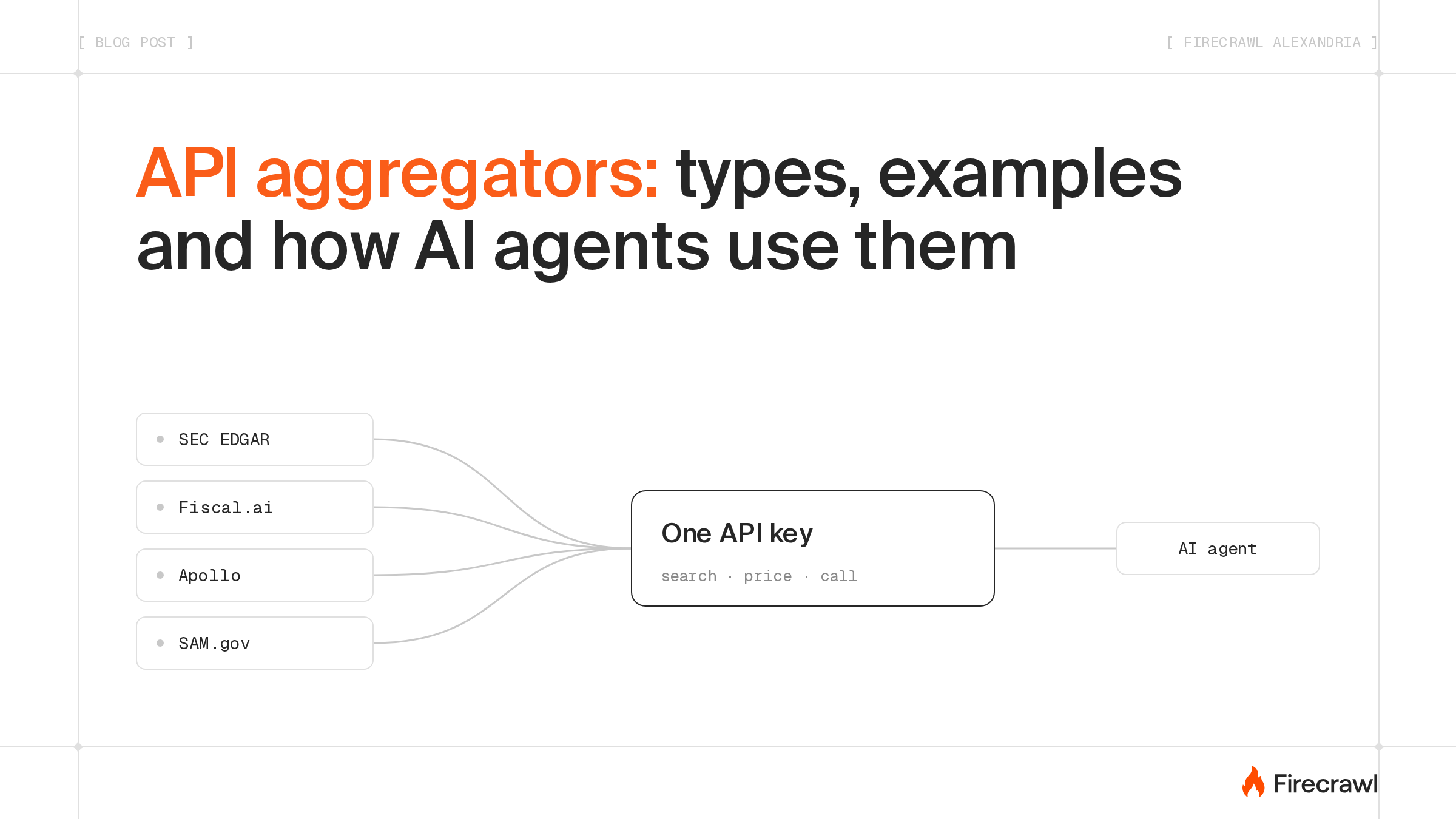
- Firecrawl Alexandria is an API aggregator for the data AI agents need. One Firecrawl account or API key reaches data providers such as SEC EDGAR, Fiscal.ai, Apollo and Best Buy, plus Firecrawl's Government & Legal, Research and Developer indexes. Finding tools is free, and every tool lists its price in Firecrawl credits.
- An API aggregator puts many third-party APIs behind one interface, so you sign up, authenticate and pay once instead of once per provider.
- Firecrawl works in ChatGPT, Claude and any MCP client. Developers get the same tools through the REST API, SDKs and CLI.
Firecrawl Alexandria lets an AI agent describe the data it needs, find the provider that holds it and call that provider with the Firecrawl key it already has. Standing in for many integrations with one is the job of an API aggregator. The term covers products that solve different problems, so this guide explains how they work, how they differ and where Firecrawl fits.
What is an API aggregator?
API aggregators sit between your code and many third-party APIs and expose them through one interface. You create one account, use one credential and learn one request format, while the aggregator deals with each provider's own keys, schemas, errors and billing behind the scenes.
API aggregation changes five things compared with calling each provider yourself:
| Calling each API directly | Calling through an API aggregator | |
|---|---|---|
| Accounts and keys | One per provider | One |
| Authentication | Each provider's own flow: API keys, OAuth or signed requests | One flow |
| Request and response formats | Learned and mapped per provider | One documented format or a shared data model |
| Billing | A plan or contract per provider | One bill |
| Adding a source | A new integration project | A new call |
An aggregator covers the providers and fields it supports. A provider outside its catalog still needs a direct integration, which is why the size and shape of the catalog matters as much as the interface.
How is a data API aggregator different from a unified API?
A data API aggregator such as Firecrawl Alexandria returns data that providers own, such as SEC filings, company profiles or retail prices, and you call it with your own key. A unified API returns data your customer owns, from their own SaaS accounts, after that customer signs in. One answers lookups about the world, and the other syncs a customer's records.
| Data API aggregator (Firecrawl Alexandria) | Unified API | |
|---|---|---|
| Whose data | Providers': public records, licensed publishers and Firecrawl's own indexes | Your customers': records in their own apps |
| Who signs in | You, once, with a Firecrawl account or API key | Each customer, through OAuth |
| Typical calls | Search, look up and retrieve | Read and sync records, with writes on some vendors |
| Data shape | Each tool documents its own inputs and response | A shared model per category |
| Pricing | Each tool lists its price per call in Firecrawl credits | Set by each vendor |
| Typical caller | AI agents and apps that need facts | SaaS products that need their customers' data |
The two often sit in the same product. A sales tool can sync a customer's CRM accounts through a unified API while its agent enriches the same accounts with funding, headcount and filings through Firecrawl Alexandria.
How does a unified API work for SaaS integrations?
A unified API maps every app in one software category, such as CRM or HR, to a shared data model. Your customer connects their own account through a sign-in component the unified API vendor provides, the vendor stores the credentials, and your product reads or writes records like contacts, invoices or employees through one set of endpoints.
Unified APIs exist because SaaS stacks keep growing. BetterCloud's 2026 State of SaaS report, a survey of 525 IT and security professionals published in July 2026, found the average number of apps per organization up 11% year over year, with AI tools driving the growth. Every new app a customer adopts is another integration request for the products they use.
That request lands on the roadmap fast. One DEV Community post from June 2026 describes an enterprise buyer asking whether an AI product can read SharePoint and write to Salesforce, at which point "half the roadmap turns into connector engineering."
For a B2B product, each app a unified API adds is one more integration request it can say yes to. That is why vendors pitch them on winning deals, keeping customers and entering regions where customers run different apps.
Unified API vendors differ on three points. Check how many of the fields you need sit in the shared model, whether the vendor copies customer data into its own store or passes each request through to the source app, and whether you can write records back.
Why do AI agents need an API aggregator?
AI agents decide which data they need while a task runs, so integrations a developer wired up in advance only go so far. Our guide to how AI agents use APIs covers the integration patterns behind that. An API aggregator gives an agent one credential, a way to search for the right tool, and each tool's inputs and price before it spends anything.
Agents already depend on APIs. Postman's 2026 State of the API report, a survey of 8,953 developers, architects and executives published in November 2026, found that one in four organizations run AI agents that call APIs in production. Only 13.2% say their APIs are fully ready for agents, and 37.7% haven't enabled any way for agents to discover their APIs.
Companies want agents to make those calls without a person in the loop. In Box's 2026 State of AI in the Enterprise survey of 1,640 IT decision-makers, run by The Harris Poll and published in June 2026, 79% said it's important or critical that agents connect directly to systems, APIs and data sources without a human interface.
The data those agents need is often the hardest to reach. Firecrawl's November 2026 white paper, AI's Search-Bar Problem, puts it this way:
Much of what matters most sits a little out of reach. Registries live behind search forms. Filings live in databases. Research papers live behind indexes.
Developers building agents describe the same problem. In a September 2026 post on X, Prachiti Parkar summed up a personal agent that works across travel, email, calendars and payments as "One agent. So many tools. So many integrations." She points out that an agent starts with a goal and has to discover and choose its tools at runtime. Uber Engineering wrote in October 2026 that before it built a central MCP gateway, teams built integrations independently and tools were "hard to discover."
Even small workflows stitch several sources together. Andrew Allsop built one that joins Firecrawl and the Companies House API to qualify new signups for a friend's business:
Companies House is one of the public registries an agent can call through Firecrawl Alexandria, with the same key it uses for Firecrawl /search and /scrape.
Why use a third-party API aggregation platform?
A third-party platform takes over the work that grows with every provider you add. These benefits matter most for agents:
- Less integration work. Engineers build to one API instead of one per provider, and keeping each provider connection working when its API changes becomes the platform's job, not yours.
- New sources without new code. When a provider joins Firecrawl Alexandria, agents find its tools through the same search they already run, so coverage grows without a release.
- Automatic fallback routing. When one provider has no answer, the platform tries the next one. Firecrawl's people and company enrichment tries providers in order of listed price and past success rate, stops at the first one that finds each field, and charges nothing for a miss.
- Consolidated billing. You pay one bill instead of holding a contract and invoice with every provider. Every Firecrawl Alexandria tool bills in Firecrawl credits on your Firecrawl plan.
- Fewer rate limits to juggle. You manage one account's limits instead of a separate quota with each provider. Firecrawl lists its limits per plan in its rate limits docs.
- Broad compatibility. The platform should work wherever your agent runs. Firecrawl Alexandria works from ChatGPT, Claude and any MCP client, plus the REST API, SDKs and CLI, as the setup steps below show.
How does Firecrawl Alexandria work as an API aggregator?
Firecrawl Alexandria is a library of data providers that AI agents reach through one Firecrawl API key, MCP server or CLI. It works like an aggregator: instead of signing up for each data API separately, you search the whole catalog and call any provider through the same connection.
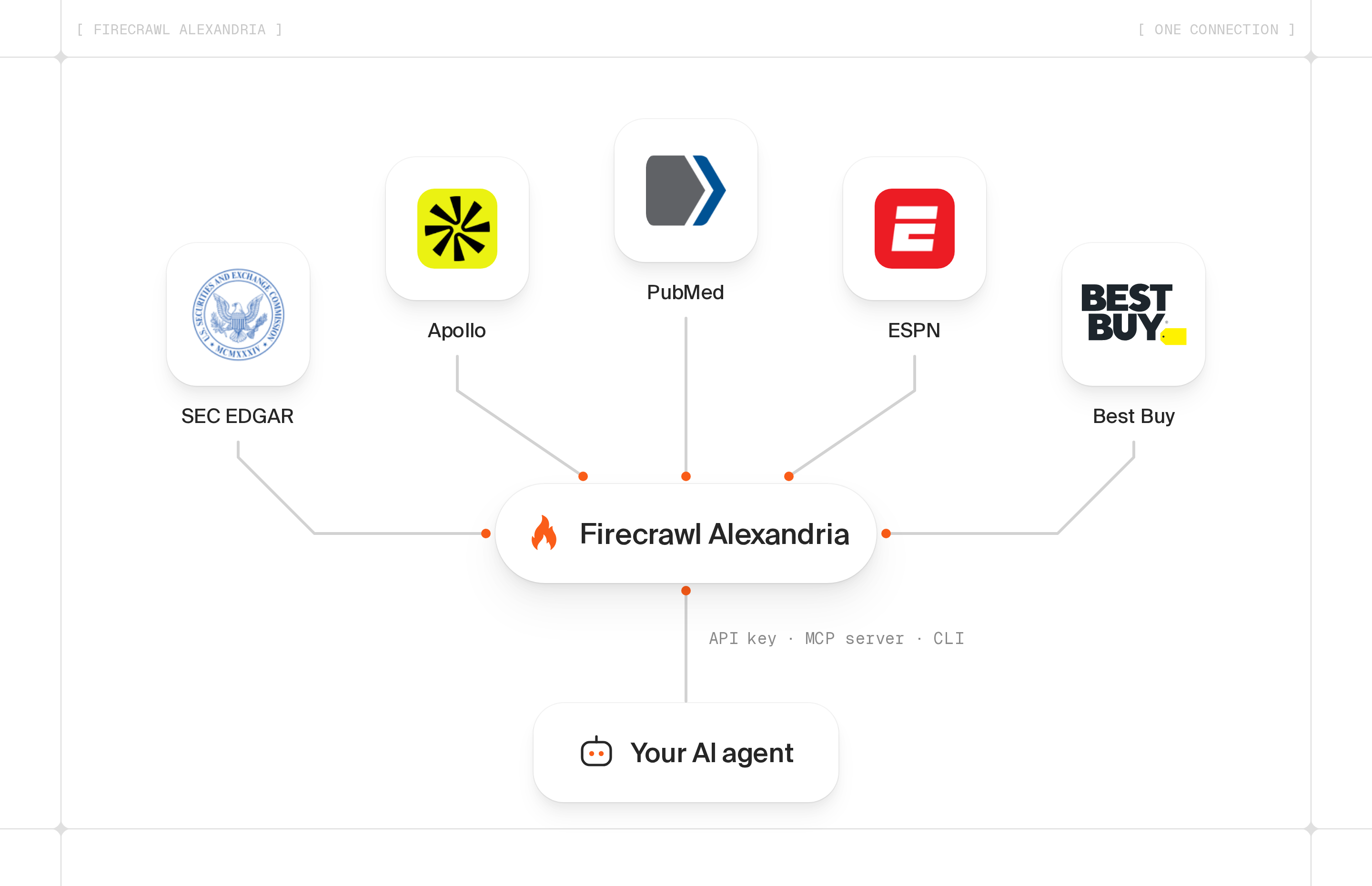
An agent describes what it needs, gets matching tools from many providers at no cost, reads each tool's inputs and price in Firecrawl credits, then runs the tool with the same Firecrawl account or API key. Providers range from public registries and licensed publishers to Firecrawl's own indexes.
Each call follows three steps:
- Find. Firecrawl /search with
sources: ["alexandria"]returns ranked tools for free. Add"web"to the sources to get web results in the same call, billed as a normal search. - Check. Find Tools returns a tool's inputs, response format and price in Firecrawl credits before anything runs, and it's free too. Agents on the Firecrawl MCP server read the same contracts through its Alexandria library tools.
- Run. Firecrawl /scrape with an
alexandriablock (provider, capability and options) runs the tool and bills its listed price.
One search can surface tools from several providers. A request for a public company's annual report filings, for example, can return tools from both SEC EDGAR and Fiscal.ai, and the agent picks by inputs and price. For people and company data, the Firecrawl MCP server runs the fallback waterfall described above, and our Firecrawl MCP v3 post covers it in detail.
Credal, which runs AI agents for enterprise customers, describes the problem an aggregator removes:
Our customers need their agents to reference today's facts or pull from their customer-facing support docs without building a custom integration.
Jack Fischer, Co-Founder and CTO, Credal
What makes Firecrawl Alexandria a strong API aggregator for agents?
Six things make Firecrawl Alexandria a good fit for agents that call APIs on their own:
- Broad coverage. Providers cover finance, company and people data, public records, retail, health, travel, sports and more, next to Firecrawl's own Government & Legal, Research and Developer indexes. The table below links every category.
- Accurate, structured data. Each tool returns typed records with a named source instead of a scraped page the agent has to clean up. In tests reported in the Firecrawl Alexandria launch post, agents using Firecrawl Alexandria scored 21% higher on answer quality than agents using built-in web tools, across 845 tasks with the same model and prompts and blind AI judging.
- Clear commercial licensing. Firecrawl pays official data providers under agreement, and a provider with its own terms shows them to an admin on your Firecrawl team before the first call.
- Fallback built in. People and company lookups through the Firecrawl MCP server try several providers in one call and move to the next when one comes back empty, so a single provider's gap doesn't stop the agent. For other data, one search often returns tools from more than one provider, which gives the agent a second source to try.
- Pricing that scales. Each tool has one listed price in Firecrawl credits, and the same credits run from the free plan up to Scale and Enterprise plans, so you don't switch products as volume grows.
- Proven in production. The public rankings page showed 5.3 million agent calls through Firecrawl Alexandria in the 24 hours before this post.
Users rate it well too. On G2, Firecrawl Alexandria holds a 4.5 out of 5 rating from 300+ reviews and Firecrawl holds 4.7 out of 5 from 1,500+ reviews, as of November 2026. One verified reviewer at a small business wrote that Firecrawl Alexandria "solves the headache of building and maintaining dozens of separate API integrations, authentication keys, and billing accounts for our AI agents."
What data can an AI agent reach through Firecrawl Alexandria?
Firecrawl Alexandria includes three Firecrawl indexes for fields where the open web is hard to search:
| Firecrawl index | What it covers |
|---|---|
| Government & Legal Index | 30M+ pages from US federal, state, county and city government sites, including statutes, regulations and court opinions |
| Research Index | Research papers and preprints, including 41M+ life sciences papers |
| Developer Index | Code examples, official documentation and repository discussions |
The same white paper measured what that reach changes. Across 581 legal research requests, the Government & Legal Index put the official document first 76.2% of the time, against 47.8% for an agent working from memory, which is 1.6 times as often.
Data providers cover the rest. The table below links every Firecrawl Alexandria category page and shows what an agent can pull from each.
| Category | What an agent can pull | Example providers |
|---|---|---|
| AI models | Model catalogs, benchmarks and model pricing | Artificial Analysis, Hugging Face, Ollama |
| Apps | App store listings, ratings and package metadata | Apple App Store, Aptoide, AlternativeTo |
| Company | Company profiles, funding and fundamentals | Apollo, Y Combinator, People Data Labs |
| Developer | Repositories, documentation and vulnerability data | GitHub, NVD, Developer Index |
| Entertainment | Films, TV, box office and audio archives | TMDB, Box Office Mojo, Internet Archive |
| Finance | Filings, fundamentals, market prices and financial news | SEC EDGAR, Fiscal.ai, Benzinga |
| Health | Doctors, hospitals, drug prices and public health statistics | CMS, CDC PLACES, ClinVar |
| Jobs | Open roles from employer job boards and hiring activity | Greenhouse, Workable, Ashby |
| Life sciences | Clinical trials, protein structures and genetic variants | ClinicalTrials.gov, AlphaFold, Research Index |
| Marketing | Search trends, rankings, keywords and competitor ads | Similarweb, Serpstat, DataForSEO |
| News | Headlines and articles on companies and topics | Benzinga, Akta, DEV Community |
| People | Contact search and enrichment, including verified work emails | Apollo, Hunter, FullEnrich |
| Places | Local businesses, places and venues | Overture Maps, Hipcamp, SpotHero |
| Podcasts | Podcast episodes, transcripts, guests and sponsors | Particle |
| Public records | Court cases, patents, trademarks, contracts and legislation | CourtListener, WIPO Global Brand Database, Government & Legal Index |
| Real estate | Property listings, auctions and permits | StreetEasy, Auction.com, ArcGIS |
| Research | Research papers, preprints and grants | Research Index, NIH Grants, Internet Archive |
| Restaurant | Restaurants, menus, reviews and reservations | Maps, Domino's, SevenRooms |
| Retail | Product catalogs, prices and availability | Home Depot, Shopify, Open Food Facts |
| Sports | Scores, stats, rankings and fantasy data | ESPN, NFL.com, Baseball Savant |
| Travel | Hotel rates, flights and transit | Agoda, FlightAware, Amtrak |
| Web analytics | Website traffic, referrals and archived pages | Similarweb, Wayback Machine |
| Tools | A free lookup of every Firecrawl Alexandria tool, plus reviewed website skills | Firecrawl |
Risyad R., a software engineer and data scientist, wrote in a G2 review: "Firecrawl Alexandria gives me structured, sourced data from many providers through a single tool, covering companies, people, finance, news, and more."
For anything no provider covers, Firecrawl /search and Firecrawl /scrape read the live web with the same key, and Firecrawl /agent handles multi-step research. Our explainer on data connectors covers how agents reach third-party data more broadly.
How do you connect Firecrawl Alexandria to ChatGPT, Claude or your own agent?
Firecrawl Alexandria also takes the technical work out of getting data to agents, for developers and non-developers alike. As more teams put AI agents to work, those agents are only as good as the data they can reach, and with Firecrawl Alexandria that data arrives through one MCP connection. In ChatGPT, it's as simple as installing the Firecrawl plugin and signing in. There are no servers to set up, no provider keys to manage and no integrations to maintain.
Firecrawl connects to ChatGPT through a plugin, to Claude through a connector, and to any other AI agent through the Firecrawl MCP server. Each one signs in to your Firecrawl account, so there is no API key to paste, and the whole Firecrawl Alexandria catalog is available as soon as you connect.
- ChatGPT: open Plugins, search for Firecrawl, select Install and sign in.
- Claude: add the Firecrawl connector from the connector directory, sign in, then turn it on from the + menu.
- Claude Code: run
claude mcp add --transport http firecrawl https://mcp.firecrawl.dev/v2/mcp-oauth, then finish signing in from/mcp. - Codex: install the Firecrawl plugin in the Codex app, or run
codex mcp add firecrawl --url https://mcp.firecrawl.dev/v2/mcp-oauthand thencodex mcp login firecrawl. - Cursor or any MCP client with a JSON config: add
https://mcp.firecrawl.dev/v2/mcp-oauthas a server namedfirecrawl.
Two prompts show the aggregator at work, each pulling from several providers in one request:
Use Firecrawl Alexandria to brief me on Nvidia: its three most recent 10-K
filings from SEC EDGAR, its latest income statement from Fiscal.ai, and this
week's headlines from Benzinga. Check each tool's inputs and price before you
run it, and tell me which provider each fact came from.
Use Firecrawl Alexandria to find 10 US logistics companies with 200 to 1,000
employees from Apollo, then check SAM.gov for any federal contract notices that
name them. Show the price of each tool before you run it.Builders already run this kind of multi-source lead research from Claude:
How do developers call Firecrawl Alexandria?
Developers can call every Firecrawl Alexandria tool from the Python, Node.js, Go and Rust SDKs, the REST API or the Firecrawl CLI. This Python example finds filing tools across providers for free, reads one tool's inputs and price, then calls SEC EDGAR with the same key:
import os
from firecrawl import Firecrawl

firecrawl = Firecrawl(api_key=os.environ["FIRECRAWL_API_KEY"])

# 1. Describe the data you need. Tool discovery is free.
found = firecrawl.search(
    "latest annual report filings for a public company",
    sources=["alexandria"],
    limit=5,
)
for tool in found.tools or []:
    print(f"{tool.provider}/{tool.capability}")

# 2. Read the chosen tool's inputs and price before running it. Also free.
contract = firecrawl.find_tools(
    providers=["sec-gov"],
    capabilities=["filings/filings"],
    level="tools",
    expand=["options"],
).items[0]
print(contract["id"], contract["creditsCost"], "credits per call")
print([option["name"] for option in contract["options"]])

# 3. Run it with the same Firecrawl API key.
filings = firecrawl.scrape(
    alexandria={
        **contract["execute"],
        "options": {"ticker": "NVDA", "forms": ["10-K"], "limit": 3},
    },
)
for filing in filings.alexandria[0].data["filings"]:
    print(filing["form"], filing["filing_date"], filing["primary_document_url"])
The search returns tools from more than one provider, Find Tools returns the chosen tool's price and inputs, and the scrape returns the filings as structured records:
sec-gov/filings/filings
fiscal-ai/filings/list
sec-gov/filings/companies_get
sec-gov/filings/sections
sec-gov/filings/filing
sec-gov/filings/companies_status
sec-gov/filings/daily_index_list
sec-gov/filings/filings 5 credits per call
['cik', 'forms', 'from', 'include_amendments', 'limit', 'name', 'ticker', 'to']
10-K 2026-02-25 https://www.sec.gov/Archives/edgar/data/1045810/000104581026000021/nvda-20260125.htm
10-K 2025-02-26 https://www.sec.gov/Archives/edgar/data/1045810/000104581025000023/nvda-20250126.htm
10-K 2024-02-21 https://www.sec.gov/Archives/edgar/data/1045810/000104581024000029/nvda-20240128.htm
How do you choose the right API aggregator?
The right API aggregator depends on whose data you need and who calls it. Firecrawl Alexandria fits AI agents and apps that need facts from providers on demand, such as filings, company records, prices, research or public records. A unified API fits products that read and write their customers' CRM, HR or accounting records.
Many products use more than one. Our guide to APIs for AI agents covers how unified APIs, MCP servers and direct calls fit together in one agent, and our guide to RapidAPI alternatives compares the data API marketplaces.
What should you check before you pick an API aggregator?
An aggregator sits in the path of every call, so its speed, uptime, pricing and data handling become yours. These are the checks that matter most:
| Check | What to look for | How Firecrawl Alexandria handles it |
|---|---|---|
| Latency | Whether calls reach the provider live or come from a cache, and how long a typical call takes, since an agent waits on each call mid-task | Benchmarks compare tools on quality, speed and cost, and rankings show what agents call most |
| Reliability and uptime | A public status page, and a cheap way to test tools before you build on them | Firecrawl status shows live status and 90-day uptime history, and inspecting a tool is free |
| Pricing transparency | A price per call you can see before the call runs, and clear rules for calls that find nothing | Each tool lists its price in Firecrawl credits before it runs, and in the people and company waterfall a miss is free |
| Data privacy | A current security audit, clear retention terms and a DPA | Firecrawl is SOC 2 Type II, and Enterprise plans add zero data retention and a DPA |
| Data sources | Where each record comes from and whether the platform has an agreement with the source | Each tool names its source, and Firecrawl pays official data providers under agreement |
The red flags are the reverse of that table. Watch for prices you only see on the invoice, no public status page, records with no named source, and no way to inspect a tool before you pay for it.
How much does Firecrawl Alexandria cost?
Finding a Firecrawl Alexandria tool is free, and each tool shows its price in Firecrawl credits before it runs. Searches of the Government & Legal Index and the Research Index cost nothing, and Scale and Enterprise plans have no daily limit on them. The Firecrawl free plan includes 1,000 Firecrawl credits a month, and paid plans start at $19 a month billed monthly, or $16 a month billed annually, for 5,000 Firecrawl credits.
Christopher Porter uses Firecrawl for professional research and called it "well worth a subscription."
Firecrawl Alexandria needs a signed-in Firecrawl account or a Firecrawl API key. Some providers, such as Apollo and FullEnrich, ask an admin on your Firecrawl team to accept their terms once before the first call. Each provider page on Firecrawl Alexandria lists its tools and prices, and pricing has the plan details.
Teams that need a security review can start with the enterprise page and the security docs.
Use Firecrawl in your agent
Add Firecrawl to ChatGPT, Claude, Cursor and more in one click.
Frequently Asked Questions
What is an example of an API aggregator?
Firecrawl Alexandria is one: a single Firecrawl account or API key reaches data providers such as SEC EDGAR, Fiscal.ai and Apollo, plus Firecrawl's own indexes. Other well-known examples include Merge and Apideck for SaaS integrations and Plaid for bank account connections.
What is the difference between an API aggregator and an API gateway?
Firecrawl Alexandria shows the aggregator side: it routes a request to outside providers that Firecrawl connects and bills for. An API gateway sits in front of APIs you run yourself and handles routing, authentication and rate limits for them. A gateway can also combine calls to several of your own services into one response, which architects call gateway aggregation.
Is a unified API the same as an API aggregator?
Firecrawl Alexandria and a unified API are both API aggregators, but they reach different data. A unified API maps many apps in one software category, such as CRM or payroll, to a shared model so a product can read its customers' records the same way in every app. Firecrawl Alexandria returns data that providers own, through each tool's documented inputs and response.
Can AI agents use an API aggregator?
Yes, and Firecrawl Alexandria is designed for it. Firecrawl Alexandria is a library of data providers that AI agents reach through one Firecrawl API key, MCP server or CLI. It works like an aggregator: instead of signing up for each data API separately, you search the whole catalog and call any provider through the same connection. An agent connected through the Firecrawl MCP server, the ChatGPT plugin or the Claude connector searches the catalog in plain language, checks a tool's price and calls it in the middle of a task, all with one sign-in.
Do I need a separate API key for each provider in Firecrawl Alexandria?
No. Firecrawl Alexandria needs a signed-in Firecrawl account or a Firecrawl API key, and every provider bills in Firecrawl credits. Keyless Firecrawl access doesn't include it. A few providers, such as Apollo and FullEnrich, ask an admin on your Firecrawl team to accept their terms once before the first call.
Should I worry about data privacy when using an API aggregator?
Firecrawl is SOC 2 Type II, and Firecrawl Enterprise plans add zero data retention, SSO and a DPA, which is the kind of evidence to ask any aggregator for. Your requests and results pass through the aggregator on the way to each provider, so check its security audit, how long it keeps request data and what its retention terms say.
What are red flags with third-party API platforms?
Firecrawl Alexandria is built to avoid the common ones: each tool lists its price before it runs and names its data source, and Firecrawl publishes live status and 90-day uptime history. Watch for platforms that hide per-call prices until the invoice, can't say where their data comes from, or have no public status page.
How much does an API aggregator cost?
Firecrawl Alexandria charges per call. Looking up tools costs nothing, each tool states its price in Firecrawl credits, and the Firecrawl free plan includes 1,000 Firecrawl credits a month. Other aggregators set their own pricing models, so compare them at the call volume you expect.