Credal helps enterprises safely deploy AI agents that can access both internal knowledge and real-time web data, without writing a single line of scraping code - using Firecrawl.
When you're building AI agents for enterprise customers, the stakes are different. A chatbot that hallucinates can cost huge $$$. An agent making decisions with stale data or broken sources can be business-critical.
Jack Fischer, Co-Founder & CTO of Credal, and his team understand this very well. They've built a platform that lets companies deploy AI agents with strict access controls, comprehensive audit trails, and, crucially, the ability to pull in fresh external context when needed.
We run production agent workflows where the model needs either fresh external context or non-standard data without ETL. Our customers need their agents to reference today's facts or pull from their customer-facing support docs without building a custom integration.
— Jack Fischer, Co-Founder & CTO, Credal
Why does web data need two different approaches?
Credal's architecture treats web data differently depending on the use case:
-
"Web search" (ephemeral): Fetch a handful of relevant pages for this specific conversation, show the links as sources, and move on. The agent needs to know what happened at yesterday's press conference or check current API documentation.
-
"Webpages ingestion" (durable): Crawl an entire site, snapshot the content, and push it through Credal's indexing + retrieval + citations pipeline, the same infrastructure they use for internal sources like Confluence or Google Drive.
This split keeps the UX honest. Users can see exactly what the model looked at, right now. And it delivers on Credal's product promise: easily crawl any URL into your knowledge base without code.
But implementing this dual approach meant solving some hard technical problems.
What makes "LLM-ready" content so hard?
Our ingestion and retrieval stack expects clean text. We need a stable way to turn messy HTML into markdown we can snapshot, embed, and cite.
Anyone who's tried to extract usable content from the modern web knows this isn't trivial. JavaScript-rendered content, nested navigation structures, ads, cookie banners, duplicate boilerplate: the list goes on. And when you're processing millions of pages monthly, edge cases become routine cases.
Credal integrated Firecrawl specifically for its reliable markdown extraction.
The content that comes back is already normalized, which means it flows directly into their vector indexing pipeline without additional cleanup.
How do you turn site crawling into a product feature?
The second critical capability: recursive site crawling that works at production scale.
We don't just scrape single pages. We support recursive site crawls that land as a folder-like object in our system, with per-page snapshots and vector indexing.
When a customer adds their documentation site to Credal, they expect it to "just work": discover all the pages, handle rate limits gracefully, manage timeouts, normalize the content, and index everything for retrieval. Building this from scratch means reinventing solutions to problems that Firecrawl has already solved through hard-earned edge-case handling.
If we lost Firecrawl, we could replace search discovery relatively quickly. But replacing scrape + crawl + normalization at production quality? That's what would hurt.
What does production-ready actually mean?
Credal's integration reflects their enterprise DNA. They built assuming production realities: timeouts, partial failures, load spikes. They added their own health checks, logging, and rate limits to make the system debuggable and reliable.
The result: 6 million+ URLs scraped monthly, powering AI agents that enterprises actually trust with business-critical workflows.
For companies building AI products where reliability isn't optional, Credal offers a blueprint: focus on your differentiation (secure agent orchestration, access controls, audit trails) and lean on specialized tools for the undifferentiated heavy lifting.
As Jack puts it:
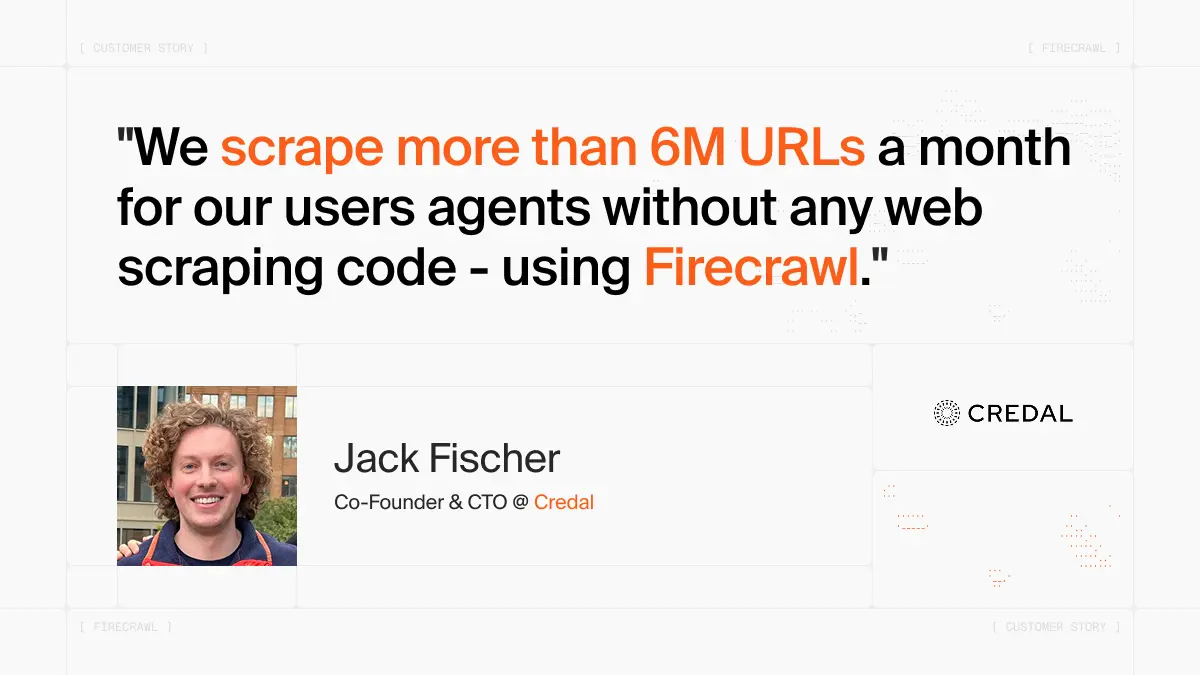
We scrape more than 6M URLs a month for our users' agents without any web scraping code.
Ready to power your AI application with reliable web data? Try Firecrawl and ship faster.
Frequently Asked Questions
How does Firecrawl help Credal?
Firecrawl handles two distinct web scraping jobs for Credal: ephemeral web search (fetch a handful of pages for a specific conversation) and durable webpage ingestion (crawl entire sites and index them into Credal's knowledge base alongside internal sources).
How much web scraping does Credal handle with Firecrawl?
Credal scrapes more than 6 million URLs per month for their users' AI agents, all without maintaining any web scraping code in-house.
What would Credal miss most without Firecrawl?
Two things: reliable LLM-ready markdown extraction that feeds directly into their vector indexing pipeline, and crawl-as-a-feature that handles recursive site crawls with production-quality edge-case handling. As Jack Fischer puts it: "If we lost Firecrawl, we could replace search discovery relatively quickly. But replacing scrape + crawl + normalization at production quality? That's what would hurt."