TL;DR
- A data provider for an AI agent supplies current facts from outside the model's training, such as today's filings, prices, trial results or contact details, as structured records the agent can call for in the middle of a task.
- Firecrawl Alexandria connects AI agents to data providers and Firecrawl's own indexes through one Firecrawl account. It covers public sources such as SEC EDGAR and ClinicalTrials.gov, licensed data such as Apollo and Fiscal.ai, and the Government & Legal, Research and Developer indexes. Finding tools is free, and each tool lists its price in Firecrawl credits.
- Pick providers by what the agent can verify and act on: a source link on every record, a price before the call, fast responses for bursts of lookups, and results screened for unsafe content.
Firecrawl Alexandria is where an AI agent goes when a question needs an official record instead of a web page. The agent describes the data, finds the provider that holds it, and calls it with the Firecrawl account it already uses for search and scraping.
What is a data provider for AI agents?
A data provider for AI agents is a service that returns facts an agent requests during a task, through an API or an MCP server. Firecrawl Alexandria groups several kinds behind one connection, including official public sources, licensed commercial data, Firecrawl's search indexes and the live web. Each kind answers a different type of question.
| Provider type | What it supplies | How Firecrawl covers it |
|---|---|---|
| Official public sources | Filings, court records, statistics, registries and government data | Firecrawl Alexandria providers such as SEC EDGAR, CourtListener and the US Census Bureau |
| Licensed commercial data | Company profiles, contacts, financial statements and market news | Firecrawl Alexandria providers such as Apollo, Fiscal.ai and Benzinga |
| Specialized search indexes | Ranked results from one field where general search falls short | The Firecrawl Government & Legal, Research and Developer indexes |
| The live web | Any public page, document or site, read when the agent asks | Firecrawl /search, Firecrawl /scrape, Firecrawl /parse and Firecrawl /interact |
| Bulk datasets | Large files delivered on a schedule for a warehouse or a training run | Firecrawl /crawl collects whole sites, and Firecrawl /monitor reports changes |
Many lists of data providers for AI agents only cover the second row, which helps a sales agent but not one that needs a statute, a trial result or a price posted this morning.
Why do AI agents need data providers?
AI agents need data providers because a model's knowledge stops at its training cutoff and general web search returns what ranks, which is often not the official record. A data provider gives the agent the current fact from its source, in fields it can use without cleaning up a page. Firecrawl measured how much that changes the work.
Firecrawl's November 2026 white paper, AI's Search-Bar Problem, tested this on 581 legal research requests. An agent working from memory put the official document first 47.8% of the time. Firecrawl's Government & Legal Index put it first 76.2% of the time and had it in the top ten results on 96.6% of requests. The Legal Retrieval Benchmark post has the full method.
The paper explains why search alone misses these records:
General web search rewards what ranks, and official sources are often the pages that don't.
The same pattern holds outside law. Across 845 tasks with the same model and prompts, agents using Firecrawl Alexandria scored 21% higher on answer quality than agents using built-in web tools.
Agents already make these calls in production. Postman's 2026 State of the API report, a survey of 8,953 developers, architects and executives, found that one in four organizations run AI agents that use APIs in production. 37.7% have not enabled any way for agents to discover their APIs, so the agent often can't find the provider it needs on its own.
What makes a data provider good for AI agents?
A good data provider for AI agents returns structured records with a source the agent can cite, states its price before the call, answers fast enough for many lookups in a row, and screens out unsafe content. Firecrawl Alexandria is built around those checks. The white paper calls the first check a receipt, meaning a source link, a citation and structured fields for every fact the agent acts on.
| Check | Why it matters for an agent | How Firecrawl Alexandria handles it |
|---|---|---|
| A receipt for every fact | A person can open the source and review the work in seconds | Each tool names its provider and returns typed fields instead of a page to parse |
| Discovery the agent can run | The agent picks the right tool mid-task without a developer wiring it in | Firecrawl /search with sources: ["alexandria"] returns matching tools for free |
| A price before the call | The agent, or the person, can decide whether a lookup is worth it | Find Tools returns each tool's inputs and price in Firecrawl credits, also for free (in the Firecrawl CLI, add --include-costs) |
| Speed for bursts | One job can mean dozens of lookups in a few minutes | Firecrawl's Government & Legal Index answered in under half a second at the median in the benchmark above |
| Safety of what it returns | Agents act on what they read, so a bad result can turn into a bad action | Firecrawl ranked first of 8 search APIs in AIR's WebSec Benchmark |
| Access where the agent runs | The provider has to work from the chat app or framework you use | ChatGPT plugin, Claude connector, MCP server, REST API, SDKs and CLI |
| Clear licensing | Data used commercially has to come from a source that allows it | Firecrawl pays official data providers under agreement, and a provider with its own terms shows them to an admin first |
Safety gets less attention than coverage, but it decides what an agent does next. AIR, an AI agent security company, sent the same 4,719 real coding-agent searches to 8 search APIs and scanned more than 282,000 results for lookalike packages, hidden instructions and malicious downloads. In its WebSec Benchmark, Firecrawl ranked first with a WebSec Index of 21.59, where the last-placed API scored 5.02. Firecrawl also had the lowest share of searches with a risky URL, malicious content or risky content.
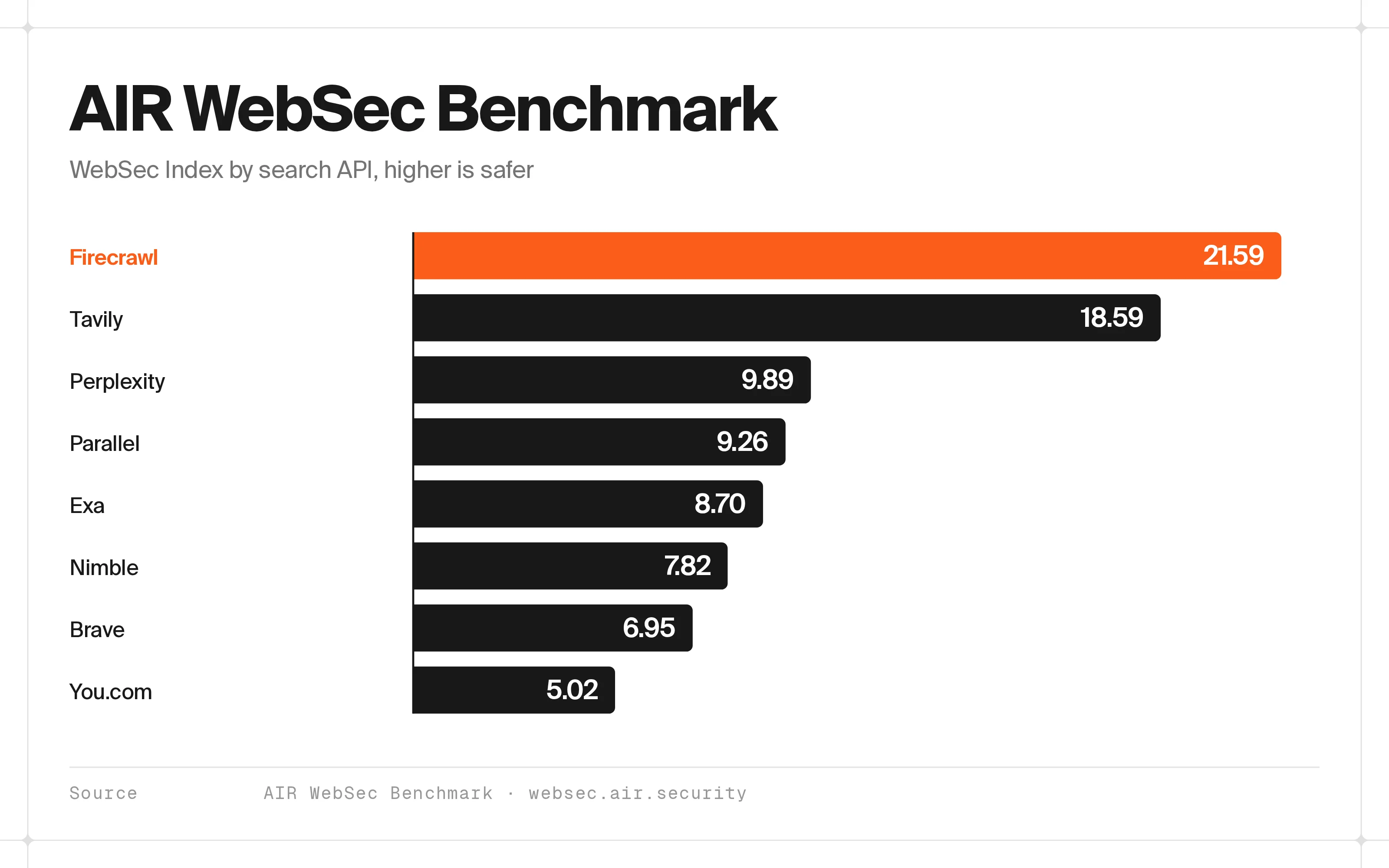
AIR found risky results across the whole field, and its advice to agent builders starts with choosing a web provider based on safety. Our guide to AI agent security covers the rest of that checklist.
Should an agent use one data provider or many?
An agent that does varied work needs many data providers, because no single provider covers filings, contacts, prices, research and law. The practical answer is many providers behind one connection, which is what Firecrawl Alexandria does as a data API aggregator. Four things make that better than wiring providers one at a time:
- Coverage. One Firecrawl account reaches public sources, licensed data and Firecrawl's indexes, so the agent isn't limited to the providers a developer happened to integrate.
- One integration to maintain. You connect Firecrawl once. When a provider joins Firecrawl Alexandria, agents find its tools through the same search.
- A fallback when a provider comes back empty. People enrichment through the Firecrawl MCP server checks one source, then the next, until it finds the record, as described in the Firecrawl MCP v3 post.
- Cost per call, with no per-provider contract. Every tool bills in Firecrawl credits on your Firecrawl plan, so trying a provider costs one call.
Our explainer on API aggregators covers how this model compares with unified APIs, and the guide to data connectors covers how agents reach third-party data more broadly.
Which data providers can AI agents reach through Firecrawl Alexandria?
Firecrawl Alexandria is a library of data providers and Firecrawl indexes that AI agents reach through one Firecrawl API key, MCP server or CLI. It spans company and people data, finance, health, life sciences, public records, retail, sports, travel and more. The table links every category page with a few example providers.
| Category | Example data an agent pulls | Example providers |
|---|---|---|
| AI models | Model cards, model pricing and benchmark scores | Hugging Face, OpenRouter, Artificial Analysis |
| Apps | App listings, ratings and package metadata | Apple App Store, npm, PyPI |
| Company | Firmographics, funding and company records | Apollo, Crustdata, Data Legion |
| Developer | Repositories, documentation and vulnerability records | GitHub, OSV.dev, Developer Index |
| Entertainment | Films, shows, books, ratings and cast | TMDB, Rotten Tomatoes, Goodreads |
| Finance | Filings, financial statements and economic series | SEC EDGAR, Fiscal.ai, FRED |
| Health | Drug records, Medicare prices and local health estimates | FDA, CMS, CDC PLACES |
| Jobs | Open roles from employer career sites | Greenhouse, Lever, Workday |
| Life sciences | Clinical trials, papers and protein data | ClinicalTrials.gov, PubMed, UniProt |
| Marketing | Site traffic, keywords and search trends | Similarweb, DataForSEO, Trends |
| News | Market news, press releases and topic coverage | Benzinga, GlobeNewswire, Akta |
| People | Contact search and enrichment, including work emails | People Data Labs, Hunter, FullEnrich |
| Places | Local businesses with hours, ratings and addresses | Maps, OpenStreetMap, Overture Maps |
| Podcasts | Episodes, transcripts, guests and sponsors | Particle |
| Public records | Court cases, census data and government records | CourtListener, US Census Bureau, Government & Legal Index |
| Real estate | Property auctions and public GIS layers | Auction.com, ArcGIS |
| Research | Papers, grants and research datasets | Research Index, NIH Grants, Harvard Dataverse |
| Restaurant | Menus, reservations and nutrition data | Domino's, SevenRooms, USDA FoodData Central |
| Retail | Product details, prices and availability | Best Buy, IKEA, Newegg |
| Sports | Scores, player stats and fantasy data | ESPN, NFL.com, Baseball Savant |
| Travel | Hotel stays, campsites and train routes | Agoda, Recreation.gov, Amtrak |
| Web analytics | Website traffic and archived versions of pages | Similarweb, Wayback Machine |
Ray Fernando, who spent 12 years at Apple and builds live for 40,000 followers, said he was "blown away at the financial data" after a few weeks of using the Firecrawl plugin in Grok Bot:
Firecrawl Alexandria holds a 4.5 out of 5 rating on G2 from more than 300 reviews.
For anything no provider covers, Firecrawl /search and Firecrawl /scrape read the live web with the same account, and Firecrawl /agent runs multi-step research. Retell uses Firecrawl to keep its AI phone agents answering from each customer's current docs and help center:
Firecrawl made our knowledge base creation workflow easy, handling different kinds of websites reliably.
Zexia Zhang, Co-founder & CTO, Retell
How do you match data providers to your agent's jobs?
Start from the jobs your agent does, not from a vendor list. The white paper's advice is to list the sources each job depends on, check whether the agent can reach every one directly, and connect a source library such as Firecrawl Alexandria for the gaps. Write each job as a goal, its sources and what done looks like.
These jobs show how one connection covers very different sources:
| Agent job | Firecrawl tool |
|---|---|
| Check a project's dependencies for known vulnerabilities | OSV.dev vulnerabilities/query_batch |
| Screen a supplier against sanctions lists before onboarding | OpenSanctions sanctions-screening/search_entities |
| Find a city's rules for a business permit | Government & Legal Index search |
| Track the latest US unemployment rate | FRED economic-data/series_observations |
| List clinical trials recruiting for a condition | ClinicalTrials.gov clinical-trials/search |
| Read a supplier's own site or a PDF report | Firecrawl /scrape and Firecrawl /parse |
For research, lead generation and news monitoring, our guide to real-time data for AI agents maps those jobs to providers too. Business verification has its own walkthrough in the KYB guide.
How do you connect data providers to ChatGPT, Claude or your own agent?
Firecrawl connects to ChatGPT through a plugin, to Claude through a connector, and to other agents through the Firecrawl MCP server. Each one signs in to your Firecrawl account, so every Firecrawl Alexandria provider is available without a provider key. Setup takes one step per client:
- ChatGPT: open Plugins, search for Firecrawl, select Install and sign in.
- Claude: add the Firecrawl connector from the connector directory and sign in.
- Claude Code: run
claude mcp add --transport http firecrawl https://mcp.firecrawl.dev/v2/mcp-oauth, then finish signing in from/mcp. - Codex: run
codex mcp add firecrawl --url https://mcp.firecrawl.dev/v2/mcp-oauth, thencodex mcp login firecrawl. - Cursor or any MCP client with a JSON config: add
https://mcp.firecrawl.dev/v2/mcp-oauthas a server namedfirecrawl.
To try it, ask in plain English from ChatGPT or Claude:
Use Firecrawl Alexandria to check whether Acme Logistics appears on any
sanctions list in OpenSanctions, then find its latest SEC filings in
SEC EDGAR. Show each tool's price before you run it, and link the source
for every fact.Developers can call the same tools from the Python, Node.js, Go and Rust SDKs, the REST API or the Firecrawl CLI. This Python example finds vulnerability tools for free, reads one tool's price, then checks an old version of the requests package against OSV.dev:
import os
from firecrawl import Firecrawl

firecrawl = Firecrawl(api_key=os.environ["FIRECRAWL_API_KEY"])

# 1. Describe the data. Finding tools is free.
found = firecrawl.search(
    "known security vulnerabilities in a Python package version",
    sources=["alexandria"],
    limit=4,
)
for tool in found.tools or []:
    print(f"{tool.provider}/{tool.capability}")

# 2. Read the tool's inputs and price before it runs. Also free.
contract = firecrawl.find_tools(
    providers=["osv-dev"],
    capabilities=["vulnerabilities/query"],
    level="tools",
    expand=["options"],
).items[0]
print(contract["id"], contract["creditsCost"], "credits per call")

# 3. Run it with the same Firecrawl API key.
result = firecrawl.scrape(
    alexandria={
        **contract["execute"],
        "options": {"ecosystem": "PyPI", "name": "requests", "version": "2.25.0"},
    },
)
for vuln in result.alexandria[0].data["vulns"][:3]:
    print(vuln["id"], vuln.get("summary"))
The output lists the matching tools, the tool's price and the first advisories, each with an ID the agent can cite:
osv-dev/vulnerabilities/query
osv-dev/vulnerabilities/query_batch
osv-dev/vulnerabilities/vuln
pypi-org/packages/release
osv-dev/vulnerabilities/query 5 credits per call
GHSA-9hjg-9r4m-mvj7 Requests vulnerable to .netrc credentials leak via malicious URLs
GHSA-9wx4-h78v-vm56 Requests `Session` object does not verify requests after making first request with verify=False
GHSA-gc5v-m9x4-r6x2 Requests has Insecure Temp File Reuse in its extract_zipped_paths() utility function
How much do data providers for AI agents cost with Firecrawl?
Firecrawl Alexandria bills per call. Finding a tool is free, and each tool states its price in Firecrawl credits before it runs. Searches of the Government & Legal Index and the Research Index cost nothing. The Firecrawl free plan includes 1,000 Firecrawl credits a month, and paid plans start at $19 a month billed monthly, or $16 a month billed annually, for 5,000 Firecrawl credits.
Firecrawl Alexandria needs a signed-in Firecrawl account or a Firecrawl API key, so keyless sessions don't include it. A few providers, such as Apollo and FullEnrich, ask an admin on your Firecrawl team to accept their terms once before the first call. Each provider page lists its tools and prices, and pricing has the plan details.
Teams at 67% of the Fortune 100 use Firecrawl. Teams that need a security review can start with the enterprise page and the security docs.
Use Firecrawl in your agent
Add Firecrawl to ChatGPT, Claude, Cursor and more in one click.
Frequently Asked Questions
What is a data provider for an AI agent?
It is a service an agent calls during a task to get facts the model doesn't hold, such as a company's filings, a person's work email, a drug trial's status or a product's price. Firecrawl Alexandria is one example: it puts public sources, licensed data providers and Firecrawl's own search indexes behind one Firecrawl account.
What are some examples of data providers for AI agents?
SEC EDGAR for company filings, FRED for economic series, ClinicalTrials.gov for trials, Apollo and People Data Labs for company and people records, OSV.dev for software vulnerabilities, and Benzinga for market news. Agents can reach all of these through Firecrawl Alexandria, alongside Firecrawl's Government & Legal, Research and Developer indexes.
How does an AI agent connect to a data provider?
Most agents connect through an API or an MCP server. With Firecrawl, ChatGPT uses the Firecrawl plugin, Claude uses the Firecrawl connector, and coding agents such as Claude Code, Codex and Cursor add the Firecrawl MCP server. Each one signs in to a Firecrawl account and can then search the Firecrawl Alexandria catalog and call any provider in it.
Is it safe to let an agent act on data from a provider?
It is safer when every record names its source, so a person can check it, and when the provider screens what it returns. In AIR's WebSec Benchmark of 8 search APIs, Firecrawl ranked first on safety for AI agents. Treat web content as untrusted input either way, and keep a person in the loop for actions that are hard to undo.
Do I need a separate account for each data provider?
Not with Firecrawl Alexandria. A signed-in Firecrawl account or a Firecrawl API key reaches every provider in the catalog, and each call bills in Firecrawl credits. A few providers, such as Apollo and FullEnrich, ask an admin on your Firecrawl team to accept their terms once before the first call.
How much do data providers for AI agents cost?
Pricing models vary from annual data licenses to per-call billing. In Firecrawl Alexandria, finding a tool costs nothing, each tool states its price in Firecrawl credits before it runs, and searches of the Government & Legal and Research indexes are free. The Firecrawl free plan includes 1,000 Firecrawl credits a month.