How Stanford's AI Playground Covers 10,000+ Domains for Real-Time LLM Grounding
 Hiba Fathima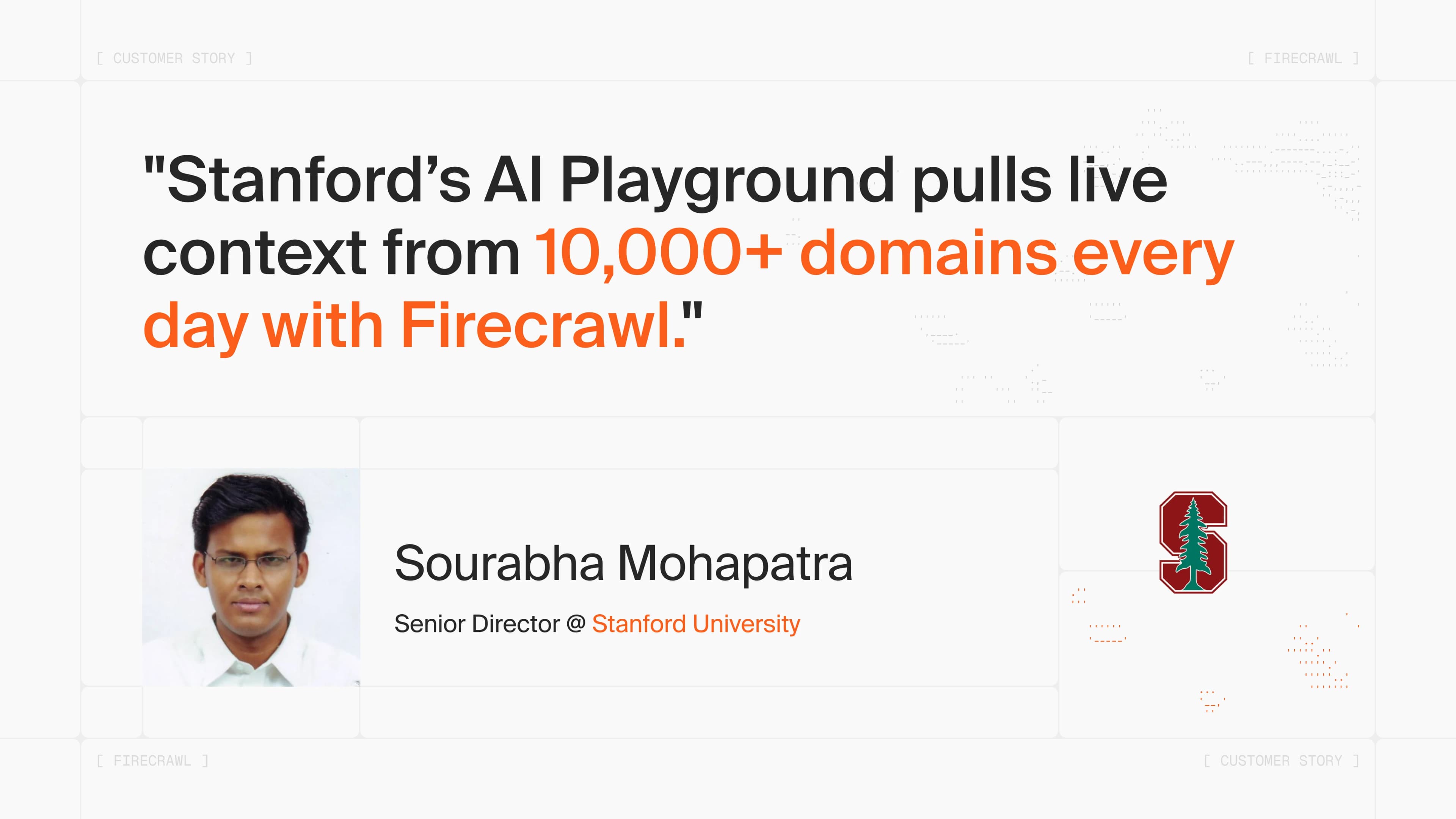
Stanford AI Playground is a tool built on LibreChat that serves the Stanford University community by augmenting LLM responses with real-time web data. Using Firecrawl's Search and Scrape endpoints, it processes roughly 800 web sources daily across 15,000+ unique domains. This includes scholarship databases, news outlets, government resources, and academic repositories, with no scraping infrastructure to maintain.
LLM responses are bounded by training data cutoffs. For applications that need current information, relying on static training snapshots means responses can quickly go stale.
Sourabha Mohapatra, Senior Director, Enterprise AI and Service Management at Stanford University, leads the team behind Stanford AI Playground. The tool was built to extend LLM capabilities with live web context. Firecrawl helps with that web context layer.
Which Firecrawl features does Stanford AI Playground rely on most?
The system runs search-and-scrape jobs each day across a range of domain types.
We typically run 800+ search-and-scrape jobs daily, using the Search endpoint to find relevant sources and Scrape to pull full-page content for LLM grounding. The sub-2-second search latency is what makes real-time augmentation viable.
— Sourabha Mohapatra, Senior Director, Enterprise AI and Service Management, Stanford University
Coverage spans scholarship databases, news outlets, government resources, and academic repositories.
How long did Firecrawl integration take?
Getting to production required minimal setup. Firecrawl has a first-party integration with LibreChat, the framework powering Stanford AI Playground.
Firecrawl has a first-party integration with LibreChat - the framework powering our tool - so setup was as simple as adding an API key.
Which Firecrawl capability would be hardest for Stanford AI Playground to replace?
The hardest thing to replace is the breadth of reliable extraction across 10,000+ domains without maintaining our own scraping infrastructure. Building that ourselves would mean a dedicated engineering effort for proxies, browser management, and content extraction across wildly different site structures.
How did Firecrawl impact growth at Stanford AI Playground?
Before Firecrawl, our LLM responses relied on training data cutoffs. Now AI Playground processes ~800 real-time web sources daily across 10,000+ domains.
Stanford AI Playground coverage grew from 293 URLs in September 2025 to 13,469 in February 2026, a 46x increase in knowledge base breadth.
Firecrawl also helps the Stanford AI Playground team maintain data freshness. Search latency averages 1.5 seconds; scrape latency 2.6 seconds, enabling real-time augmentation rather than relying on stale training data.
Sourabha says that the key gain is zero infrastructure overhead - no proxy management or browser fleets to maintain.
Firecrawl lets us turn the entire live web - from arxiv papers to breaking news to government data - into real-time context for our LLMs with no scraping infrastructure to manage.
Ready to power your AI application with reliable web data? Try Firecrawl and ship faster.
Frequently Asked Questions
How does Stanford AI Playground use Firecrawl?
AI Playground uses Firecrawl's Search endpoint to find relevant sources and the Scrape endpoint to pull full-page content for LLM grounding. The system processes roughly 800 web sources per day across 10,000+ unique domains, including scholarship databases, news outlets, government resources, and academic repositories.
What data coverage has AI Playground achieved with Firecrawl?
AI Playground grew from 293 unique URLs in September 2025 to 13,469 in February 2026, a 46x increase in knowledge base breadth. It now covers 10,000+ unique domains with no infrastructure overhead for web data collection.
What made Firecrawl a practical fit for AI Playground?
Firecrawl has a first-party integration with LibreChat, the framework powering AI Playground, so setup required only adding an API key. The breadth of reliable extraction across diverse domain types, without the need to maintain proxies, browser fleets, or custom scraping infrastructure, was the key operational factor.