The Best Fantasy Data Tools for AI Agents in 2026: What FantasyBench Found
 Hiba Fathima
TL;DR: Best Fantasy Data Tools for AI Agents
| Tool | Best for | FantasyBench score |
|---|---|---|
| Firecrawl Alexandria | Most accurate fantasy data overall | 80.5% |
| Native web search | Quick answers when accuracy is less critical | 71.7% |
| Flaim | League-aware advice from your own roster | 71.3% |
| FantasyPros Coach AI | Human-facing chat, not agent tools | Not tested |
| SportsDataIO | Building your own fantasy app | Not tested |
You ask your AI agent who to start at flex this week and it confidently names a player projected for 8 points by FantasyPros. You check manually and find the actual projection is 14. The agent hallucinated a number because it scraped a page, misread a table, and returned something plausible instead of something true.
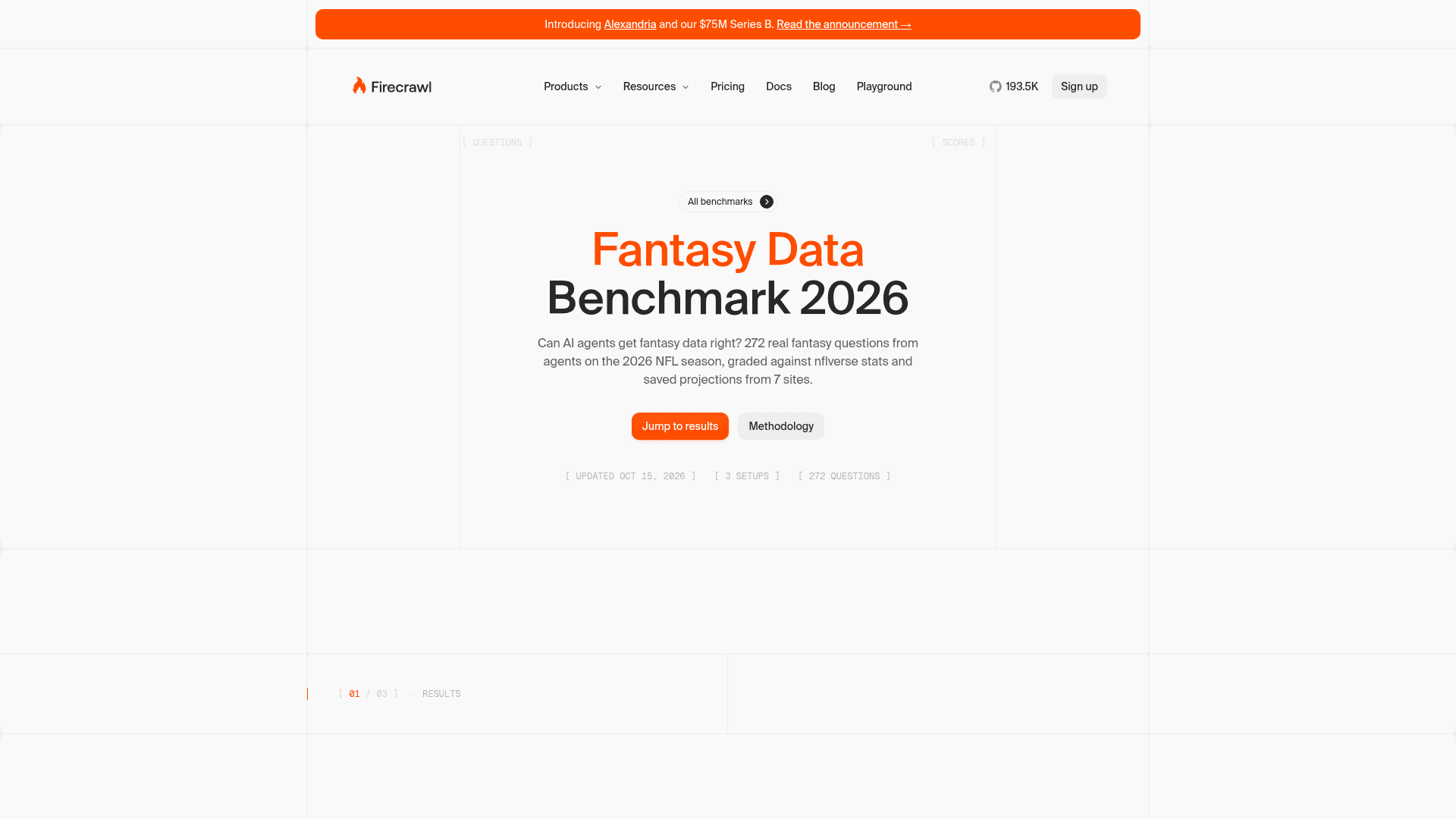
This was the state of AI fantasy advice until recently. Every tool could read a rankings page, but accuracy was untested. That changed in October 2026, when Firecrawl published FantasyBench, the first public benchmark measuring how accurately AI agents answer real fantasy questions:
- 272 real questions from agent searches on the 2026 NFL season, split between past-game stats (graded against nflverse) and live Week 6 projections (graded against saved pages from 7 projection sites).
- Firecrawl Alexandria scored 80.5%, answering 219 of 272 questions fully correctly, 8.8 percentage points ahead of native web search (p = 0.005).
- The gap is on projections. On Week 6 projection questions, Alexandria scored 77.9% against 60.7% for web search and 61.5% for Flaim. On past-game stats, all three tools clustered around 80%.
- Value accuracy matters too. When Firecrawl Alexandria returned a number, it was correct 98.8% of the time. Web search accuracy was 85.0%, meaning 15% of the numbers it reported were wrong.
This post ranks the best fantasy data tools for AI agents using FantasyBench results. Tools that weren't tested (like FantasyPros Coach AI and SportsDataIO) are included based on how often they appear in community discussions, with their benchmark status clearly marked.
What is a fantasy data tool for AI agents?
A fantasy data tool for AI agents is any service that gives an agent structured access to fantasy sports information: projections, rankings, stats, injury reports, or league data. Instead of scraping a web page and hoping the model parses the table correctly, a proper tool returns JSON with the exact fields the agent needs.
The tools fall into three categories:
- Data providers: APIs that return structured fantasy data. Firecrawl Alexandria aggregates multiple providers (CBS, FantasyPros, Draft Sharks, etc.) through one connection.
- Web search and scraping: The agent reads fantasy sites directly. Claude's built-in web search and web fetch work this way.
- League-aware tools: MCP servers like Flaim that connect to your actual fantasy league and return your roster, matchups, and available players.
FantasyBench tested all three categories on the same questions with the same agent (claude-opus-5-5), so the scores are directly comparable.
How FantasyBench measures accuracy
The benchmark uses two question types with different answer keys.
Past-game stats (150 questions): Player stats, usage, and injury designations from Weeks 1-5 of the 2026 season. Answer key built from nflverse and cross-checked against Sleeper (416 of 417 values agree) and ESPN (79 of 79 scores).
Live projections (122 questions): Week 6 projections and rankings from CBS, Draft Sharks, StartWho, FantasyPros, Fantasy Football Calculator, FantasyData, and FFToday. Answer key: pages saved directly before and after the answers were collected.
| Metric | What it measures |
|---|---|
| Success rate | Share of questions answered fully right (past games: 90%+ of checked values; player-list projections: no wrong or missing players; projection tables: at least 3 checked values and 90% correct) |
| Accuracy | Share of individual checked values that are correct across all answers |
| Median time | How long the agent takes to answer each question |
A model copies values out of each answer but never judges them. A frozen program compares them with the answer key, so the same answers always get the same score.
Source: Firecrawl FantasyBench, updated October 16, 2026.
The best fantasy data tools for AI agents in 2026
1. Firecrawl Alexandria
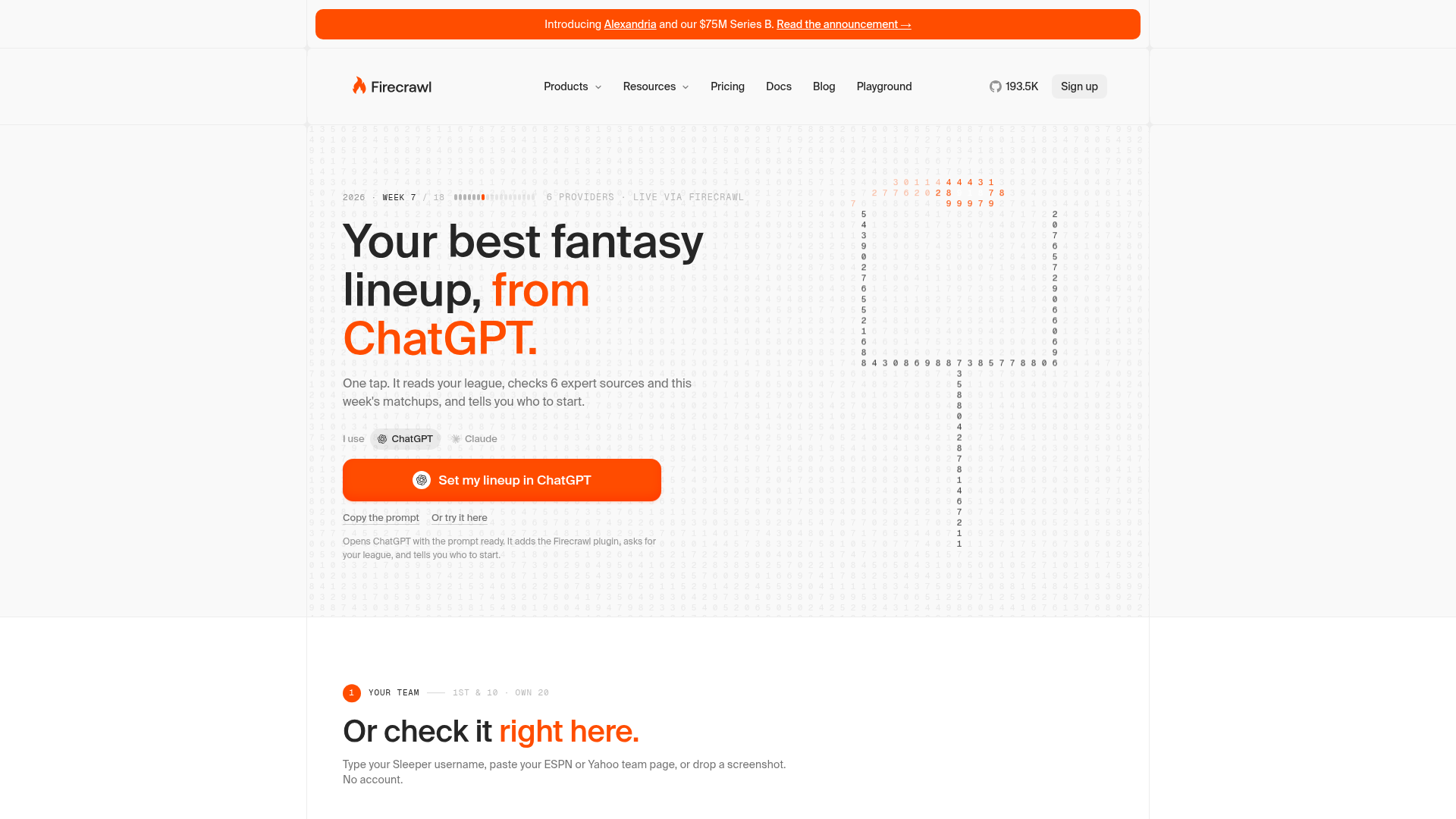
Firecrawl Alexandria is a library of data providers your agent can search and call through the Firecrawl API, and you can use it directly in ChatGPT, Claude, and other AI apps. For fantasy, it includes structured data from 5 projection sources (CBS, Draft Sharks, StartWho, Fantasy Football Calculator, and FFToday), and it scored highest on FantasyBench.
Firecrawl with Alexandria answered 80.5% of questions fully right, 8.8 points ahead of native web search. The gap is statistically significant (p = 0.005, exact McNemar test). On the 122 Week 6 projection questions, Alexandria scored 77.9% against 60.7% for web search, a 17-point lead.
The difference is how the data reaches the agent. Web search reads a page and asks the model to extract numbers from tables. Alexandria returns structured records with the exact fields the agent asked for. When the data is already parsed, there's nothing to misread.
| Metric | Firecrawl Alexandria | Native web search | Difference |
|---|---|---|---|
| Success rate (overall) | 80.5% | 71.7% | +8.8 points |
| Success rate (projections) | 77.9% | 60.7% | +17.2 points |
| Success rate (past games) | 82.7% | 80.7% | +2.0 points |
| Value accuracy | 98.8% | 85.0% | +13.8 points |
| Median time | 46.8s | 65.0s | 18s faster |
- 5 projection sources: CBS, Draft Sharks, StartWho, Fantasy Football Calculator, and FFToday, all through one connection
- League integration: Pull your roster from ESPN, Sleeper, or Yahoo and match it against projections
- Injury and news: The weekly injury report and player news, so the agent knows who's questionable before it sets a lineup
- Rest-of-season boards: Long-range rankings for trades and waivers, plus dynasty boards and ADP
- Works where you already ask: Use it in ChatGPT and Claude, or in coding agents like Claude Code, Codex, and Cursor
- One key, one bill: Every provider is called with your Firecrawl key and billed in Firecrawl credits
Install:
In ChatGPT, install the Firecrawl plugin from the plugin directory. In Claude, add the Firecrawl Claude connector. Sign in with your Firecrawl account when prompted, since Alexandria runs on your Firecrawl API key. Then ask your fantasy question in plain English and the assistant calls Alexandria for the data, no code needed.
For Claude Code, Codex, Cursor, and other agents, use the CLI, SDK, or MCP server:
# CLI and skills, wired into Claude Code, Codex, Cursor, and other agents
npx -y firecrawl-cli@latest init --all --browser

# Python SDK
pip install firecrawl-py

# MCP server
# https://mcp.firecrawl.dev/v2/mcp-oauth
Codex also supports the Firecrawl plugin.
Example prompts:
"Show me Draft Sharks' half-PPR running back rankings for Week 7"
"Compare CBS and FFToday projections for my flex options this week"
"Who's on the injury report for Sunday, and who's questionable?"
"Which rest-of-season risers should I target on waivers?"
Honest take: The benchmark numbers speak for themselves. On the job fantasy agents are asked to do most often, getting accurate projections, Firecrawl Alexandria is 17 points ahead of the next option. The trade-off is it requires a Firecrawl account and uses credits.
Cons: Needs a Firecrawl API key; the free plan's credits cover evaluation. Some niche projection sources aren't in Alexandria yet.
Full reference at firecrawl.dev/alexandria/fantasy and the fantasy sports launch post. Code examples for every sports provider are in the sports data API docs.
2. Native web search (Claude)
Claude's built-in web search and web fetch scored second on FantasyBench at 71.7%, statistically tied with Flaim.
Native web search is the default when no specialized tool is connected. The agent searches the web, reads pages, and extracts information from what it finds. For fantasy questions, this means scraping rankings pages, parsing tables, and hoping the model correctly interprets what it reads.
On past-game stats, where answer keys are stable and widely published, web search performed well: 80.7%, only 2 points behind Alexandria. The weakness is projections, where web search scored 60.7%, a 17-point gap.
| Metric | Native web search |
|---|---|
| Success rate (overall) | 71.7% |
| Success rate (projections) | 60.7% |
| Success rate (past games) | 80.7% |
| Value accuracy | 85.0% |
| Median time | 65.0s |
The 85% value accuracy is the real concern. When the agent returns a number, it's wrong 15% of the time. For start/sit decisions where a few projected points change the answer, that error rate matters.
When to use it: Quick questions where you don't need to trust the exact numbers. Checking if a player is injured. Getting a general sense of rankings. Tasks where you'll verify the output anyway.
When to avoid it: Setting your actual lineup. Making trade decisions. Any task where a wrong number costs you a matchup.
Honest take: Web search is fine for casual use, but the accuracy gap is real. If you're using an agent to manage a league you care about, the 15% error rate on values will cost you eventually.
3. Flaim
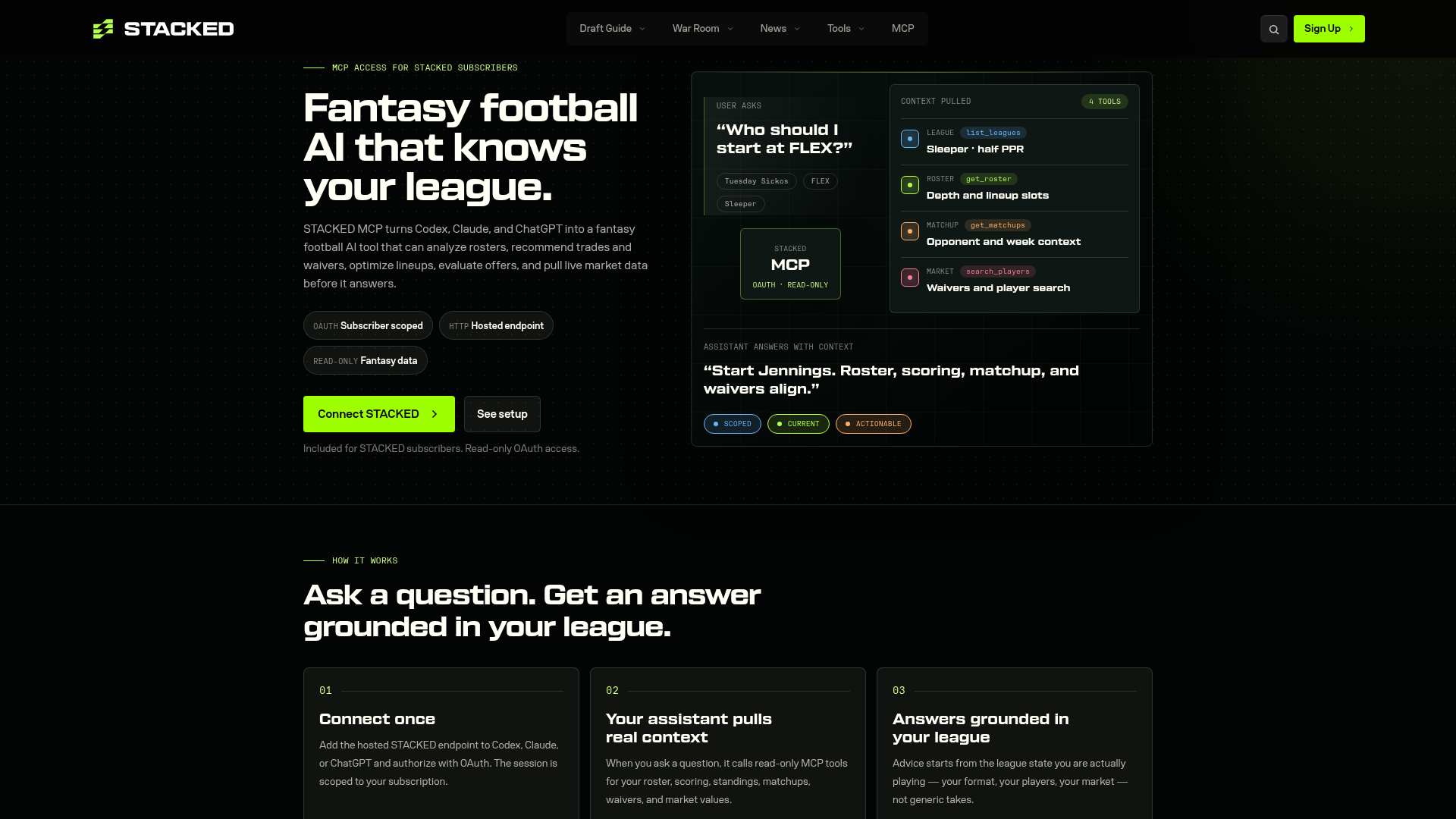
Flaim is a free MCP server that connects your ESPN, Yahoo, or Sleeper fantasy leagues to ChatGPT, Claude, and other AI apps, with read-only access to your roster, matchups, standings, and waiver wire. It scored 71.3% on FantasyBench, statistically tied with native web search.
Flaim connects to your ESPN, Yahoo, or Sleeper league and returns your actual roster, league settings, standings, matchups, and available players. The agent can then reason about your specific situation instead of giving generic advice.
On FantasyBench, Flaim scored 79.3% on past-game stats (close to the others) and 61.5% on projections (better than web search but 16 points behind Alexandria).
| Metric | Flaim |
|---|---|
| Success rate (overall) | 71.3% |
| Success rate (projections) | 61.5% |
| Success rate (past games) | 79.3% |
| Value accuracy | 92.6% |
| Median time | 61.9s |
The 92.6% value accuracy is better than web search (85.0%) but still behind Alexandria (98.8%).
- League sync: Connects multiple ESPN, Yahoo, and Sleeper leagues to one account
- League data: Rosters, standings, matchups, free agents, transactions, player stats, drafts, and past seasons
- Sports: Football, baseball, basketball, and hockey
- AI apps: Listed in ChatGPT's plugin directory and Claude's connector directory; works as a custom connector in Perplexity, Gemini, Grok, and Muse
- Read-only: The agent can never make trades, add or drop players, edit lineups, or change league settings
- Free: No subscription; your AI app's own plan and limits still apply
Install:
Create a Flaim account and connect your leagues at flaim.app/leagues (ESPN needs Flaim's Chrome extension once; Yahoo and Sleeper don't). Then add Flaim Fantasy from ChatGPT's plugin directory or Claude's connector directory. For Perplexity, Gemini, Grok, and Muse, add it as a custom connector using the address in Flaim's custom connector guide at flaim.app/docs/custom-connectors, then sign in to your Flaim account.
Example prompts:
"What is my biggest roster hole?"
"How is my matchup looking this week?"
"Give me the best waiver wire add in my league"
"Summarize yesterday's league activity"
Honest take: Flaim's strength is league context, not projection accuracy. Use it for questions about your specific roster, your matchup, other teams in your league, or who to drop for a waiver add. For raw projection accuracy, pair it with Firecrawl Alexandria; both work in ChatGPT and Claude, so one chat can see your roster and accurate projections.
Cons: It doesn't provide projections itself, so projection questions fall back to whatever other tools the agent has. In the benchmark that was web search, and the projection score was close to web search alone. ESPN setup needs the Chrome extension once.
Reference: flaim.app.
4. FantasyPros Coach AI
FantasyPros Coach AI is an AI-powered fantasy assistant built into FantasyPros, designed for human users rather than agent integrations. Not tested on FantasyBench.
FantasyPros Coach AI combines AI-driven advice with FantasyPros' rankings, projections, and expert analysis. It's designed for managers who want to ask questions in a chat interface rather than developers building agent workflows.
- Personalized recommendations: Answers based on your league and roster context
- Start/sit decisions: Backed by FantasyPros consensus rankings
- Trade and waiver advice: Evaluates offers against your roster needs
- Injury context: Real-time updates on player availability
Why it wasn't tested: Coach AI is a consumer product, not an API or MCP server. It doesn't expose tools for external agents to call. The benchmark tested tools that can be wired into Claude, Codex, Cursor, and custom agent pipelines.
When to use it: If you want a self-contained AI assistant for fantasy advice and don't need to integrate it into other tools. FantasyPros' underlying data is solid (it's one of the sources Alexandria aggregates).
Reference: fantasypros.com/coach.
5. SportsDataIO (FantasyData)
SportsDataIO (formerly FantasyData) is a sports data API platform with fantasy projections, DFS data, and real-time stats. Not tested on FantasyBench.
SportsDataIO is the API behind many fantasy apps. It covers NFL, NBA, MLB, NHL, college sports, soccer, golf, NASCAR, MMA, tennis, and esports. For fantasy specifically, it provides:
- Fantasy projections: Season and weekly projections across major sports
- DFS salary data: Pricing from DraftKings, FanDuel, and Yahoo DFS
- Real-time data: Live scores, play-by-play, and injury updates
- Historical stats: Multi-year player and team statistics
Why it wasn't tested: SportsDataIO is a data provider, not an agent-ready tool. Using it requires building your own integration to fetch, parse, and serve the data to an agent. FantasyBench tested end-to-end tools that agents can call directly.
When to use it: If you're building a fantasy app or dashboard and need raw data. SportsDataIO has the coverage, but you'll need to build the agent integration yourself.
Pricing: Starts at $25/month for basic NFL data. Full fantasy packages with projections run higher.
Reference: sportsdata.io.
Questions fantasy players ask about AI tools
These come from threads on r/fantasyfootball, r/fantasyfootballcoding, and r/FFCommish.
What's the best AI tool for fantasy football? For accuracy, Firecrawl Alexandria leads the only public benchmark at 80.5%. For league-aware advice from your own roster, Flaim connects to your league for free. For a self-contained chat experience, FantasyPros Coach AI works without any setup. The right choice depends on whether you need an agent tool or a consumer product.
Can I trust AI-generated fantasy projections? It depends on the tool. On FantasyBench, Firecrawl Alexandria got 98.8% of all checked values correct and a 77.9% success rate on projections. Native web search got 85.0% overall value accuracy. If you're using AI for actual lineup decisions, use a tool with measured accuracy or verify the numbers yourself.
Where can I get free fantasy data for my AI project? The r/fantasyfootballcoding community maintains several free resources: nflverse for historical stats, League Logs API for player metadata, and various open datasets. For forward-looking projections, most quality sources charge for API access. Firecrawl Alexandria serves projections from five sources with a free Firecrawl API key, and the free plan's credits cover evaluation.
How do I wire fantasy data into Claude or ChatGPT? For ChatGPT and Claude, install the Firecrawl plugin or connector. For Codex and Cursor, add the Firecrawl MCP server. For Flaim, connect your leagues at flaim.app, then add Flaim Fantasy from ChatGPT's plugin directory or Claude's connector directory. Each connection gives the agent tools it can call when you ask fantasy questions.
Is it cheating to use AI in fantasy leagues? This comes up in r/FFCommish regularly. Most leagues don't have explicit rules. The common take: using AI for research is no different from using FantasyPros rankings or a cheat sheet. Using AI to fully automate decisions feels different. Set expectations with your league before the season.
What free resources are people using for fantasy AI projects? Per r/fantasyfootballcoding: nflverse for past-game stats, Sleeper API for league data, and scrapers for projection sites. The challenge is getting quality forward-looking projections without paying. Most projection sources protect their data because it's their product.
Building the best fantasy data tools into your workflow
The benchmark results suggest a clear stack: Firecrawl Alexandria for projection accuracy, and Flaim if you need league-aware context about your specific roster.
For most fantasy questions, Alexandria alone handles it. The agent finds the right provider, gets structured data, and returns accurate numbers. Connect it once to Claude, ChatGPT, Codex, or Cursor and ask in plain English.
For league-specific questions like "who should I trade for given my roster needs," Flaim adds the context Alexandria doesn't have. The two complement each other: Alexandria knows what players are worth, Flaim knows what players you have.
Before you commit to any tool, test it on your own questions. The FantasyBench harness is open source, and the 137-question public sample re-grades offline with no API keys. Your league's questions might differ from the benchmark distribution, and the only way to know is to run them.
For the full methodology and per-field breakdowns, the FantasyBench results page has confidence intervals, the question distribution, and a changelog of benchmark updates.
Use Firecrawl in your agent
Add Firecrawl to ChatGPT, Claude, Cursor and more in one click.
Frequently Asked Questions
What is the best fantasy data tool for AI agents?
On Firecrawl's FantasyBench of 272 real NFL fantasy questions, Firecrawl with Alexandria scored highest at 80.5% success rate, 8.8 points ahead of native web search (p = 0.005). The gap is widest on weekly projections: 77.9% for Alexandria against 60.7% for web search.
What is FantasyBench?
FantasyBench is Firecrawl's public benchmark for AI agent accuracy on fantasy football questions. It tests 272 real questions from agent searches on the 2026 NFL season, split between past-game stats (150 questions, graded against nflverse) and live Week 6 projections (122 questions, graded against saved pages from 7 projection sites).
Can AI agents get accurate fantasy projections?
It depends on the tool. On FantasyBench, Firecrawl Alexandria answered 77.9% of projection questions correctly, while Claude web search and Flaim both scored around 61%. The difference is how the data is retrieved: Alexandria returns structured records from official projection sites, while web search reads and interprets page content.
What is Flaim MCP?
Flaim is a free MCP server that connects your ESPN, Yahoo, or Sleeper fantasy leagues to AI apps like ChatGPT and Claude, with read-only access to rosters, matchups, standings, free agents, and transactions. On FantasyBench it scored 71.3% overall, statistically tied with native web search.
Is Firecrawl Alexandria better than Claude web search for fantasy?
Yes, in this benchmark. Using the same Claude agent, Firecrawl Alexandria answered 80.5% of questions correctly versus 71.7% for Claude's built-in web search. The lead is statistically significant (p = 0.005) and comes primarily from projection questions, where Alexandria was 17 points ahead.
What fantasy data sources does Firecrawl Alexandria include?
Firecrawl Alexandria includes weekly projections and rankings from CBS, Draft Sharks, StartWho, Fantasy Football Calculator, and FFToday. It also includes injury reports, player news, league and schedule data, and rest-of-season boards for trades and waivers.
How accurate are AI fantasy football tools?
On FantasyBench, the best tool (Firecrawl Alexandria) got 98.8% of checked values correct, meaning when it returned a projection or stat, it was almost always right. Native web search accuracy was 85.0%, which means 15% of the numbers it reported were wrong.
Can I reproduce the FantasyBench results?
Yes. The grader, answer keys, and a 137-question public sample with every answer and grade are open source at github.com/firecrawl/benchmark-fantasy. One command re-grades the public sample offline with no API keys.