companies of all sizes


Choose Firecrawl for the best LLM-ready web data. /scrape delivers clean markdown, /agent does autonomous research with no URLs required, and Parallel Agents batch hundreds of queries at once. No-code integrations like Lovable let you build workflows with simple prompts.
Choose Apify when you need pre-built scrapers for specific platforms (Instagram, TikTok, Google Maps) or want to build and monetize your own Actors. Note: Apify only offers SERP scraping, not autonomous research like Firecrawl's /agent.
Over a million developers
love Firecrawl
Learn more
Learn more
Learn more
Firecrawl vs. Apify: Key Differences
| Feature | Firecrawl | Apify |
|---|---|---|
| Output format | LLM-ready markdown, JSON, HTML, screenshots (all included) | Varies by Actor (typically JSON/CSV, requires post-processing) |
| JavaScript rendering | Automatic on all requests (included) | Depends on Actor (some use Puppeteer, some don't) |
| Structured extraction | Natural language prompts + JSON Schema | Requires CSS selectors or custom Actor code |
| Autonomous research | /agent does deep research with no URLs needed | SERP scraping only, no autonomous data gathering |
| Pricing model | Flat rate: 1 credit = 1 page ($0.0008/page at scale) | Compute-based: varies by Actor, runtime, memory |
| Open source / Self-hosted | Yes (fully open source) | Partial (Crawlee is open source, platform is closed) |
Last updated: Feb 04, 2026 • See full matrix ↓
Firecrawl vs. Apify: Full comparison matrix
Here's a complete feature overview of Firecrawl vs. Apify.
| Feature | Firecrawl | Apify | What this means |
|---|---|---|---|
LLM-ready output | Clean markdown optimized for AI. Preserves links, code blocks, formatting | Raw HTML/JSON output requires post-processing for LLM use | Firecrawl pioneered markdown output for AI. Apify requires you to convert and clean data yourself. |
When it matters Critical for RAG pipelines, AI agents, and any LLM-based application. Trade-offs Firecrawl is ready for AI out of the box. Apify needs additional processing. | |||
JavaScript rendering | Automatic on all requests (included) | Depends on Actor (some use Puppeteer/Playwright, some don't) | Firecrawl always renders JS. Apify varies by Actor (some are headless, some aren't). |
When it matters Modern SPAs and dynamic content require JS rendering. Trade-offs Firecrawl is consistent. Apify requires checking each Actor's capabilities. | |||
Output formats | Markdown, JSON, HTML, screenshots, links, summary, branding (all included) | Varies by Actor (typically JSON, CSV, or custom formats) | Firecrawl has consistent output across all scrapes. Apify output depends on the Actor. |
When it matters Consistent formats simplify downstream processing. Trade-offs Firecrawl is predictable. Apify Actors may offer more specialized output formats. | |||
Structured extraction | Natural language prompts + JSON Schema | Requires CSS selectors or custom Actor code | Firecrawl: describe what you want in plain English. Apify: write selectors or use Actor-specific config. |
When it matters Important for non-developers or rapid prototyping. Trade-offs Firecrawl is more flexible. Apify Actors can be more precise for known structures. | |||
Pricing model | Flat rate: 1 credit = 1 page ($0.0008/page at scale) | Compute-based: $0.20-$0.30/compute unit + Actor rental fees + proxy costs | Firecrawl: predictable costs. Apify: costs vary by Actor, runtime, memory, and proxy usage. |
When it matters Budget predictability matters for production workloads. Trade-offs Firecrawl is simpler to budget. Apify can be cheaper for specific use cases but harder to predict. | |||
Site crawling | /crawl discovers and scrapes entire sites with one call | Website Content Crawler Actor with configuration required | Firecrawl crawls and returns LLM-ready markdown. Apify requires Actor setup and compute estimation. |
When it matters Critical for documentation ingestion, knowledge bases, and site-wide scraping. Trade-offs Firecrawl is simpler. Apify offers more granular control over crawl behavior. | |||
Autonomous research (/agent) | /agent does deep research autonomously, no URLs required | No equivalent. SERP scraping only, no autonomous data gathering | Firecrawl's /agent searches, navigates, and extracts intelligently. Apify requires URLs and manual Actor configuration. |
When it matters Critical for AI agents, lead enrichment, and research where you don't know URLs upfront. Trade-offs Firecrawl handles the full research pipeline. Apify requires manual orchestration. | |||
Entry pricing | $19/month billed monthly, or $16/month billed annually (5,000 pages guaranteed) | $29/month (prepaid usage, varies by Actor) | Firecrawl: fixed page count. Apify: prepaid credits consumed at varying rates. |
When it matters Important for startups and individual developers. Trade-offs Firecrawl is cheaper and more predictable. Apify's $29 may go further or shorter depending on usage. | |||
Open source / Self-hosted | Yes (fully open source, self-host available) | Partial (Crawlee library is open source, platform is closed) | Firecrawl can be fully self-hosted. Apify's platform requires their cloud. |
When it matters Data residency, air-gapped environments, cost optimization at scale. Trade-offs Firecrawl offers full control. Apify's Crawlee can be self-hosted but without the platform features. | |||
No-code integrations | Native Lovable integration + n8n, Zapier, Make | Zapier, Make, Airbyte (requires Actor selection and configuration) | Firecrawl's Lovable integration lets you build scraping workflows with natural language. Apify integrations still require Actor configuration. |
When it matters Critical for non-developers or teams wanting to build quickly without code. Trade-offs Firecrawl is more accessible to non-developers. Apify offers more customization for technical users. | |||
Click any row to see when it matters and trade-offs
Measured performance
Published Firecrawl results, each with the dataset it was measured on and the date it was run. Follow a row to the run it comes from.
| Metric | Value | Dataset | Measured | Source |
|---|---|---|---|---|
| Coverage (success rate) | 96% | Scrape coverage and quality, 1,000 URLs | Jan 13, 2026 | Methodology |
| Extraction accuracy (F1) | 0.638 | Scrape coverage and quality, 1,000 URLs | Jan 13, 2026 | Methodology |
| Content recall | 0.639 | Scrape coverage and quality, 1,000 URLs | Jan 13, 2026 | Methodology |
| Latency (P95) | 3,387 ms | Scrape coverage and quality, 1,000 URLs | Jan 13, 2026 | Methodology |
Scrape coverage and quality scored against the public dataset firecrawl/scrape-content-dataset-v1, so the inputs are checkable. The harness is not published yet, so the run cannot be reproduced end to end.
Every benchmark Firecrawl runs is listed on /benchmarks.
People love
building with Firecrawl


Firecrawl is an open-source framework that takes a URL, crawls it, and conver..."

Upload a CSV of emails and..."
Firecrawl is an open-source framework that takes a URL, crawls it, and conver..."
Upload a CSV of emails and..."
Fast-moving orgs are building with Firecrawl
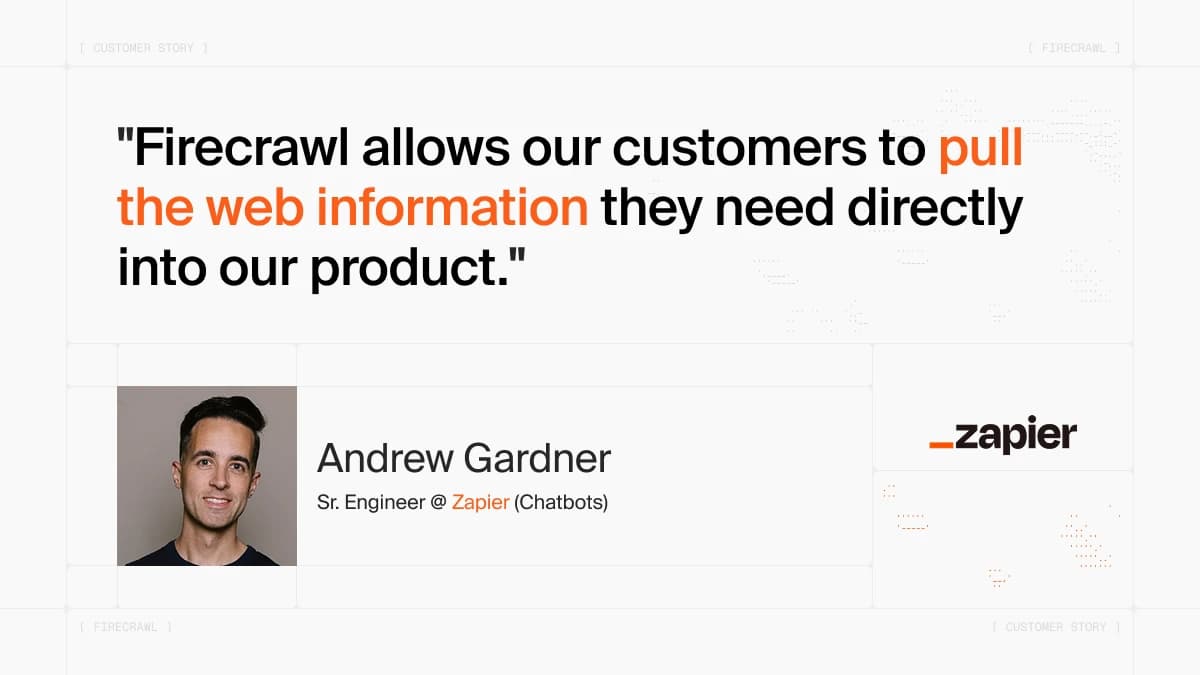
How Zapier uses Firecrawl to Empower Chatbots
Discover how Zapier uses Firecrawl to empower customers with custom knowledge in their chatbots.
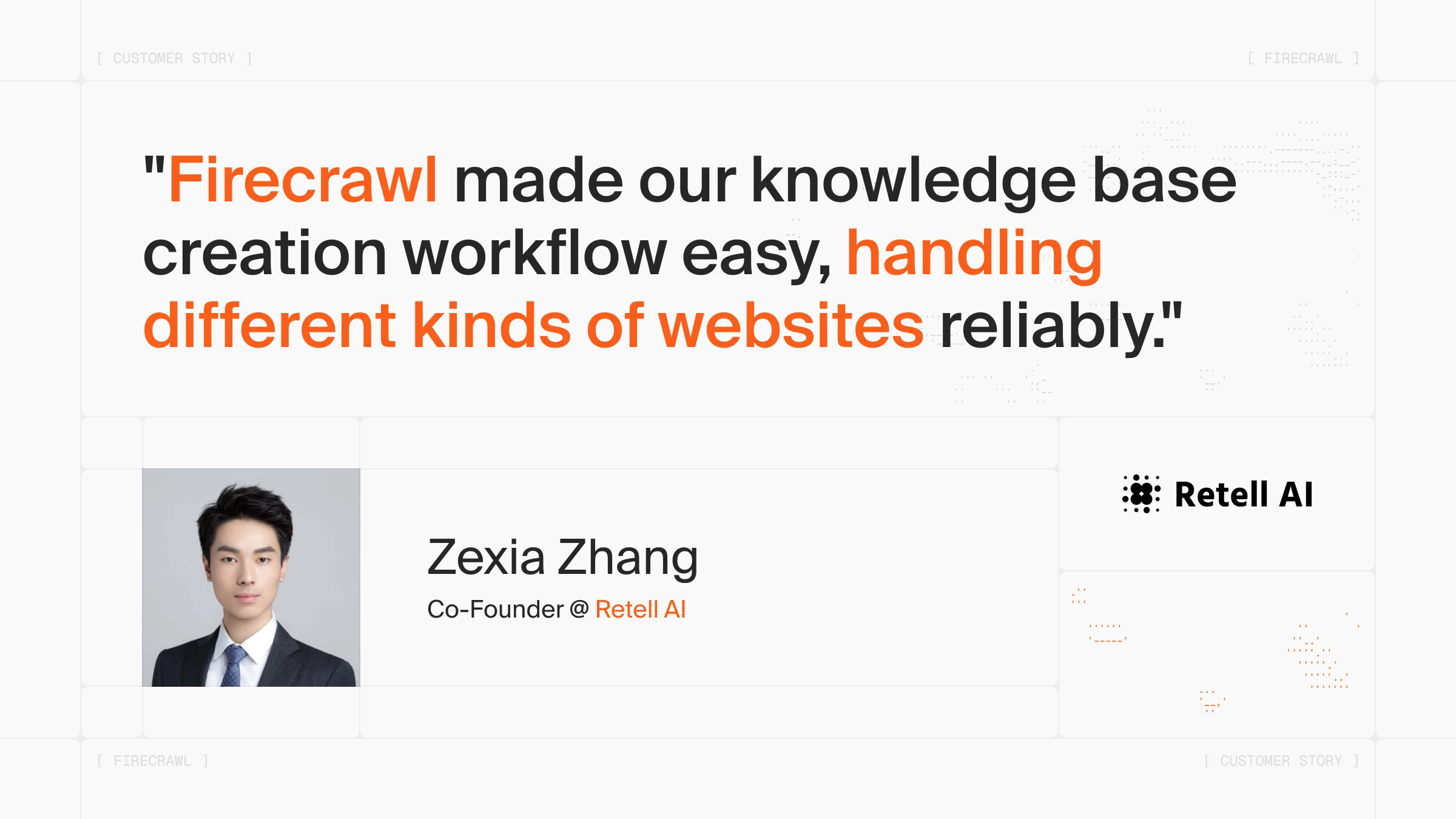
Retell's AI phone agents get LLM-ready content from Firecrawl
How Retell keeps AI phone agents answering from live, LLM-ready content using Firecrawl's context API.
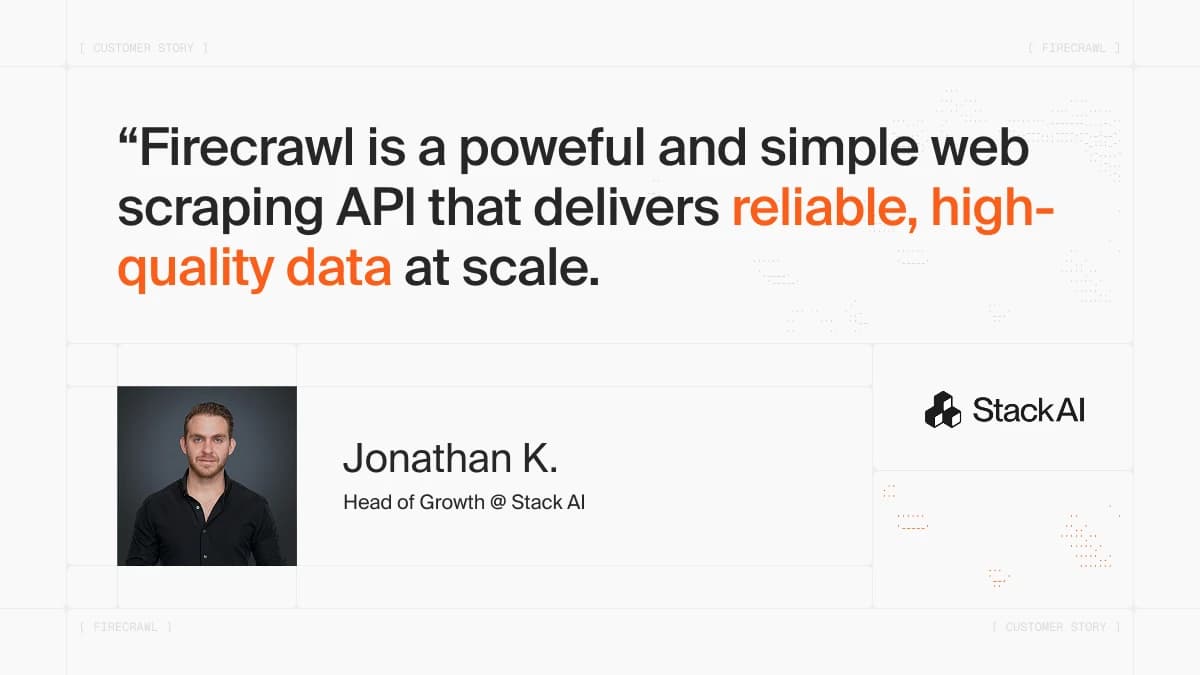
How Stack AI Uses Firecrawl to Power AI Agents
Discover how Stack AI leverages Firecrawl to seamlessly feed agentic AI workflows with high-quality web data.
Frequently
asked questions
Flexible pricing
Free Plan
Hobby
StandardMost popular
Growth
Scale Plans
High-volume plans for teams that need more power and dedicated support. Get access to higher rate limits, more concurrent browsers, and priority support. Scale checks out instantly, no sales call needed.
Need more? Contact us