Introducing Firecrawl Developer Index: A Specialized Index for Coding Agents
 Neha Patil
 Karan Lokchandani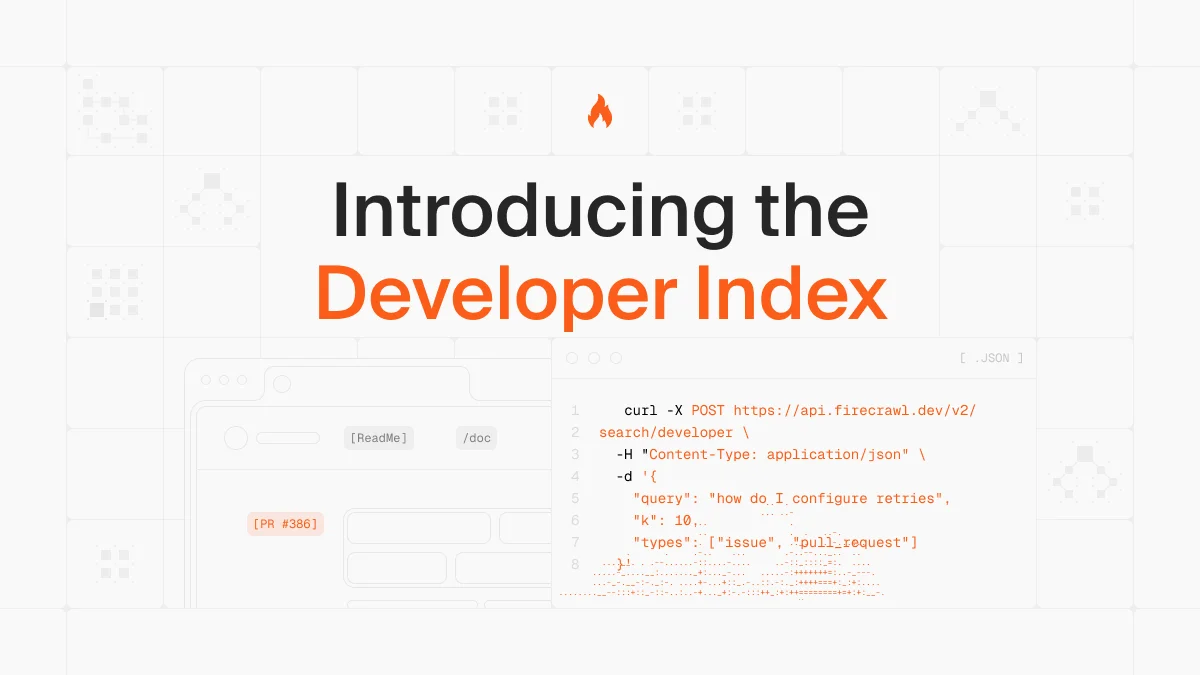
Coding agents spend a large share of their tool calls searching for one of three things:
- the repository that implements an idea
- the documentation page that answers a question
- the issue or pull request where a bug was fixed
That context is scattered across GitHub, docs sites, and threads, and the existing options for retrieving it are lexical, incomplete, or both.
Today we're launching the Firecrawl Developer Index, a specialized index for coding agents. It indexes the artifacts agents actually need to write working, current code (READMEs, external documentation, issues, pull requests, and OpenAPI specs) with semantic retrieval and metadata filters, refreshed daily.
Alongside the index, we're releasing DevDex, an open benchmark of 1,179 developer-search queries scored on Recall@10 and MRR@10, so teams can measure how well any retrieval system supports real coding-agent workflows.
Why we built the Firecrawl Developer Index
Coding agents are one of the biggest categories of what customers search and scrape for on Firecrawl. When we dug into what customers were actually retrieving, three patterns kept surfacing:
- Agentic products (think Lovable, Replit, Bolt) doing backend debugging on behalf of end users.
- Knowledge-base builders stitching internal and external repos into a single retrieval layer.
- Frontier labs that need open developer documentation, code, issues, and PRs as training and evaluation data.
They were all working around the same gap. Existing providers weren't designed for a world of agents: search is lexical, not semantic, and getting complete artifacts (a README plus its issues plus its recent PRs) meant stitching together 50+ API calls, or building the whole pipeline from scratch. Even Firecrawl's general search and scrape gave subpar results for this shape of query, because a coding agent doesn't want a web page, it wants an artifact.
The Developer Index is that artifact layer.
What's in the Firecrawl Developer Index
- 70M+ artifacts across READMEs, pull requests, issues, OpenAPI specs, skills, and external documentation, refreshed continuously, with most sources refreshed daily.
- Issues and pull requests from top repositories, with their linked artifacts.
- READMEs from a broad set of public repositories.
- External documentation sources (Stripe, and everything of that shape).
- OpenAPI specs and popular skill repos.
- Metadata on every artifact: stars, licenses, artifact type.
To be clear about what it is not: the Developer Index does not store code, and it is not a general web search endpoint. It is a purpose-built retrieval layer organized around the artifacts coding agents produce and consume.
How the Firecrawl Developer Index works
You send a natural-language question to the Firecrawl Developer Index and get back ranked developer results with the passages that matched, so an agent can act on the answer without a second scrape. There are two ways to reach it:
- Firecrawl
/search/developerreturns developer sources only, with result-type, repository, and documentation-source filters. This is the surface to reach for when you want ranked developer results with matched passages. - Firecrawl
/searchwithcategories: ["developer"]returns Developer Index results through the standard/searchresponse, in the same shape as ordinary web results.
Every Firecrawl Developer Index result carries a stable id (like issue:owner/repo#123) whose prefix tells you the artifact kind (doc:, issue:, pull_request:, or readme:), a url, and its matched passages in markdown, so tables and code blocks survive. Through the API, filters let you scope by types, repos, sources, language, topic, license, min_stars, and more. You can also set skills: "only" to search indexed agent-skill files. These filters are API-only: on the CLI and MCP, agents perform best without them, so they are intentionally not exposed there.
No Firecrawl API key is needed to get started; add one for higher rate limits. A developer search costs 2 credits per 10 results, rounded up.
# No API key needed to get started; add -H "Authorization: Bearer $FIRECRAWL_API_KEY" for higher rate limits:
curl -s "https://api.firecrawl.dev/v2/search/developer?query=how%20do%20I%20configure%20retries&k=10"
The easiest way to give your agent access is Firecrawl's dedicated developer skill, which plugs into the Firecrawl CLI or MCP server:
npx -y firecrawl-cli@latest setup developer-indexFor the full parameter reference and response schema, see the Developer Index docs.
What is Firecrawl DevDex?
DevDex is an open benchmark for developer-search retrieval, scoring how well any system returns the right docs, GitHub pages, and Stack Overflow answers for real coding-agent queries. We built it because the standard search benchmarks don't reflect what agents actually look up while writing code.
How does DevDex measure developer search?
To measure whether a specialized artifact index like the Firecrawl Developer Index actually improves agent outcomes, we built DevDex. It's a benchmark of 1,179 developer-search queries across three tracks that mirror how coding agents actually retrieve.
We are releasing part of the dataset and the evaluation harness as an open-source evaluation so that DevDex can serve as a public standard for developer search on the web.
The three tracks:
- Repository discovery. Find the repo that matches a described capability without knowing its name. Example: "a library for incremental PDF parsing."
- Documentation lookup. Find the exact page that answers a how-to. Example: "How do I add Pydantic to my project using uv instead of pip?"
- Issue and PR resolution. Find where a specific bug was discussed and fixed. Example: "scikit-learn LogisticRegression random_state not working."
Each track is scored deterministically on Recall@10 and MRR@10 against fixed gold references, with a memorization check to drop any query the driver model can answer from pretraining. Every provider runs under a matched setup: same driver model (Claude Opus 4.8), one search tool active per run, same harness.
Results
The Firecrawl Developer Index leads overall recall, ahead of general web search and every other developer-search provider.
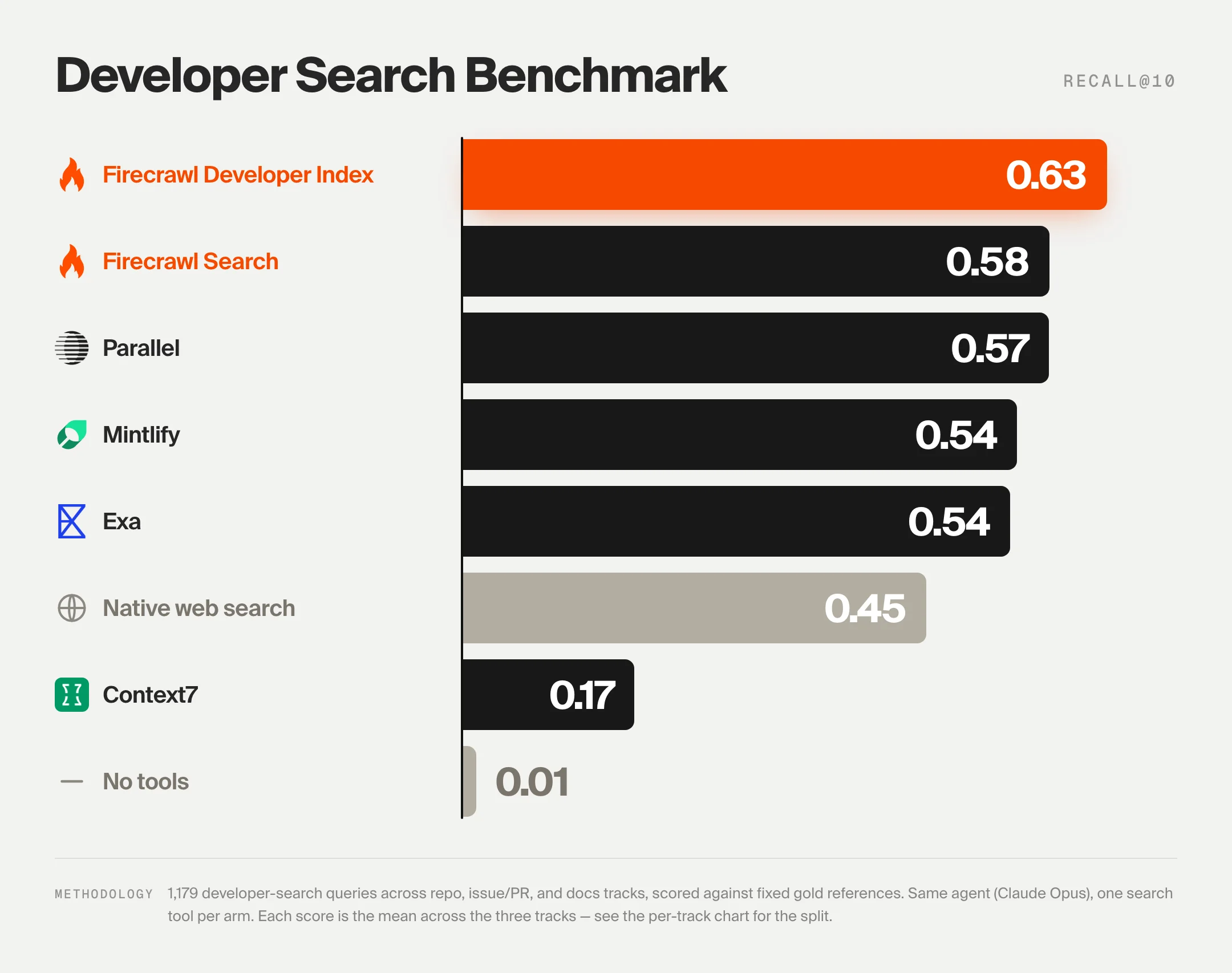
Recall@10 measures whether the correct artifact appears anywhere in the top ten results. Higher is better. Each overall score is the mean across the three tracks. The Firecrawl Developer Index scores 0.63, ahead of Firecrawl Search (no category) at 0.58, Parallel at 0.57, and Mintlify and Exa at 0.54. Native web search sits at 0.45, and Context7 at 0.17.
Broken out by track, the Firecrawl Developer Index leads issue and PR resolution at 0.66, and is statistically tied with Context7 on documentation lookup (both at 0.47, a 0.006 gap well inside the 95% CI). Context7 is docs-focused, and scores near zero on the other two tracks (0.01 on repository discovery, 0.03 on issues and PRs). On repository discovery the Developer Index posts 0.76, behind Parallel at 0.82 and Firecrawl Search at 0.78.
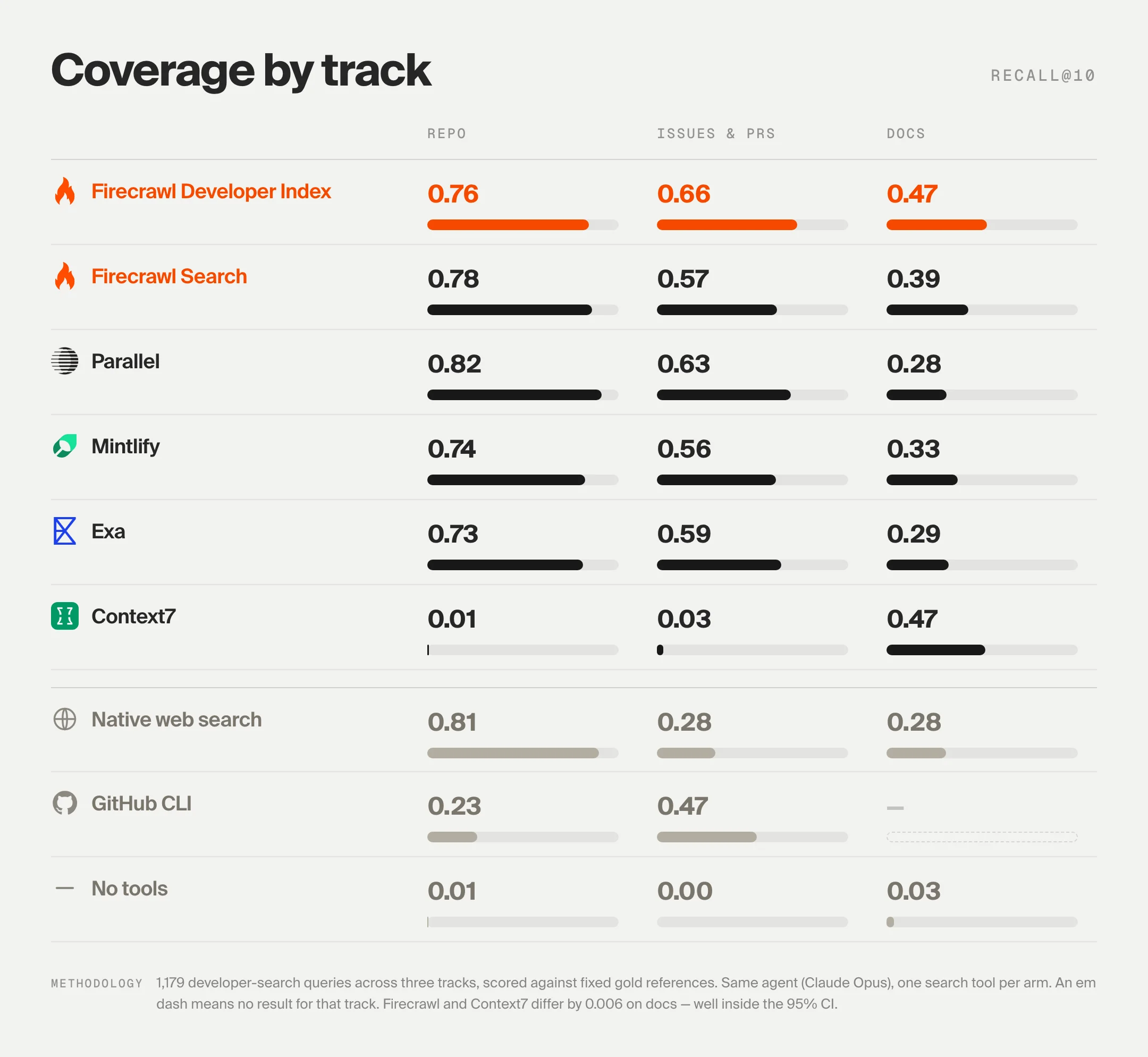
The gap between the "no tools" control and every other row is the size of the retrieval problem: coding agents can't answer these queries from pretraining alone. The gap between native web search and the specialized indexes is what a purpose-built artifact layer buys you.
Release
We're open-sourcing half of the dataset plus the evaluation harness so any team can reproduce results on their own systems.
- Repo: github.com/firecrawl/benchmark-devdex
- To submit a provider: open a PR against the repo with your results on the public half, and email
rafael@sideguide.devwith valid API keys so we can rerun on the held-out half.
What you can build with the Firecrawl Developer Index
- Ship an agentic product that debugs its own code. Wire the Firecrawl Developer Index into your agent's tool loop and let it search issues and PRs the moment it hits an error, instead of guessing.
- Build a developer knowledge base. Use the Firecrawl Developer Index to pull external documentation and repo artifacts alongside your internal sources, without maintaining a GitHub scraper.
- Train or evaluate coding models. Use the Firecrawl Developer Index as a retrieval layer for RAG-style training data pipelines, and use DevDex to score whatever retriever you build.
Try it today
Firecrawl Developer Index is available now in the API, CLI, MCP, and SDKs. It plugs into any harness you already run, including Codex, Claude Code, and Grok Build.